

'The day tilkut gets the GI tag, it will be a big hit for its health benefits during the cold season in the USA, Canada and Europe.'

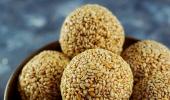
Hundreds of families engaged in making tilkut, bars of sesame seeds, in Bihar's Gaya district are struggling to popularise the winter fare in the rest of the country and overseas due to the absence of GI tag.
Tilkut, a popular winter edible, is believed to boost one's immunity in the cold season.
The aroma of tilkut permeates Gaya during winter, from the congested Ramna road, Tekari road and Station road in the heart of the city, to most of the rural markets, particularly in Dangra and Tekari. There are more than 250 tilkut shops in Gaya town itself, making it a hub for the delicacy.
Gaya's own product
A number of vendors can be spotted at Gaya railway junction and every nook and corner of the city selling the popular sweet that comes in various shapes and sizes.
Interestingly, sesame and sugar or jaggery being pounded to make the sweet is a common sight at open air shops, where workers are busy giving the final shape to the traditional sweet.

During winter it is estimated that about 50 quintal of tilkut is sold each day in Gaya, as per local traders, so high is the demand.
While the top quality tilkut sells for Rs 350 to Rs 400 a kg, lesser varieties go for Rs 200 a kg.
How GI tag can help
Although tilkut is a source of livelihood for three-four months a year and is fast emerging as a small scale and cottage industry in Gaya, it is yet to become a business that can provide sustainable work round the year.
"For nearly a decade we have been wanting to get GI tag for tilkut. The day tilkut gets the GI tag, it will be a big hit for its health benefits during the cold season in the USA, Canada and Europe. GI tag for tilkut will make a real difference to both makers and traders," said Lalji Prasad, who heads a body of tilkut makers in Gaya.
Another trader, Pramod Bhadani, said tilkut and Gaya have become so synonymous that sellers in different parts of the state are compelled to use the city's name to attract customers. "Tilkut and Gaya have become inseparable," agreed Ramesh Kumar, another tilkut trader.
"Tilkut has become so popular across Bihar and in neighbouring Jharkhand, Uttar Pradesh and even in Kolkata that shops sell tilkut claiming it is sourced from Gaya," said Suresh Gupta, owner of a tilkut shop and a third generation tilkut maker.
Lalji Prasad said state and central governments should promote tilkut in neighbouring countries, the Middle East, Europe and America with facilities and a roadmap to export it. If tilkut demand grows, it will become a big industry that will generate more jobs round the year, he said.

Traditionally sesame seeds are consumed in winter. It is a must in every Hindu household during Makar Sankranti celebrations in Bihar and neighbouring states as well as for migrant workers' families elsewhere.
Tilkut bars originated in Gaya about 150 years ago and according to historians, it is referred to as palala in Buddhist texts.


 © 2026