
The fierce battles of Galwan, Rezang La, Gurung Hill, and Walong taught the PLA a hard lesson: Fighting the Indian Army would never be easy or inexpensive.
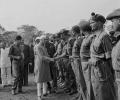
The well-fought defensive battles in Aksai Chin and eastern Arunachal, in remote and forbidding locations such as Galwan, Rezang La, Gurung Hill and Walong, effectively halted Chinese advances not once but twice during the campaign. These engagements, fought with grit and without adequate support, were not immediately known to the world in 1962, points out Dr Kumar.

If they act now, they can reshape the strategic map of Asia without firing a shot. If they wait, the next opportunity will come only after a serious Taiwan Strait incident -- by which time the price will be far higher, and the room for boldness far smaller -- the opportunity may well be lost by then. The question is no longer whether this can or should be done, points out Varun Arya.

The Indian Army is celebrating the diamond jubilee of the Battle of Walong which is as an example of bravery and sacrifice made by the bravehearts of the force in the face of Chinese aggression in 1962.

As per preliminary investigation, Lt Mohit Gupta has been missing since 6 am on Friday.

Union Home Minister Amit Shah will visit Arunachal Pradesh on April 10 and 11 where he will launch the 'Vibrant Villages Programme' in Kibithoo, a village along the India-China border.

Chinese troops are reinforcing their posts in large numbers, increasing their patrolling, stepping up violations in the Tawang and Walong areas.

The Arunachal Pradesh government has launched an ambitious plan to build 50 mini hydropower projects along the border with China for electrification of remote villages that are facing challenges of poor connectivity and mountainous terrain.

'The Kuki-Zo are aware of this rich resource in their areas and feel the Meitei push for ST status is because of this reason'.

'Guarding the borders in extreme weather conditions is not easy and most people don't realize it is a very tough job.'
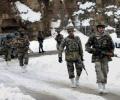
The Indian Army is effecting a major "reorientation" and "rebalancing" of its troops in the strategically sensitive areas along the Line of Actual Control (LAC) in Arunachal Pradesh, with a top general saying its overall combat readiness in the region is of a "very high order."
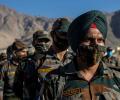
'China is mindful of the fact that it is not confronting the Indian Army of 1962. But the sabre rattling will continue.'
"After the tri-junction in Doklam in the Sikkim sector, this is the most important tri-junction along the Sino-India border."

The mortal remains of Sepoy Karam Chand, who died while fighting Chinese aggressors in Arunachal Pradesh in 1962, were consigned to flames with full military honours in his native village near Palampur on Thursday morning. Touching scenes were witnessed at the cremation ground as his family members had assumed that Chand had been made a Prisoner of War.The martyr's body was spotted under the debris by a detachment of the Border Roads Organisation in Walong area on July 1.

Was Wang Yi'S visit intended to remind India of 1962, asks Claude Arpi?
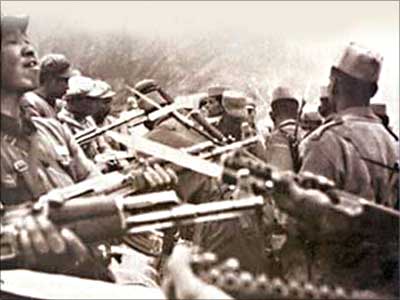
From March 1959 to March 1962, the PLA fought 12 major battles in central Tibet which was seen as an opportunity to train China's soldiers, notes Ajai Shukla.

The excavated skeletal remains of soldiers and artefacts of a US Air Force B-24 bomber that had crashed in north-east India during the Second World War were given a full honors ceremony at New Delhi's airport on Wednesday before being sent to the United States.

'On June 15, 1965, Major A K Afridi of the Pakistan army was captured by Papa's 1 Mahar unit near Vigokot, when he accidently walked into Indian territory.' 'While he was being airlifted to Delhi from Kutch, Major Afridi made a request: He wanted to watch Sangam>, the movie starring Raj Kapoor and Vyjayantimala. It was a request that the Indian Army fulfilled.' 'Major Afridi was sent with armed escorts to watch the movie in Ahmedabad and then sent to Delhi for further interrogation.'
Activation of this advanced landing ground would not only improve the response time for various operational situations but also the efficacy of the air operations in the eastern frontier.

'Often reviled, mostly ignored, sometimes venerated, he has taken it all in his stride.' 'He has stood by the nation through thick and thin,' says Brigadier Gurmeet Kanwal (retd).

'Does the Indian army's new assertiveness risk a clash escalating into shooting and possibly skirmishes?' asks Ajai Shukla.
 © 2026 Rediff.com - Advertise with us - Disclaimer - Privacy Policy - Sitemap - Feedback - About us - Terms of use - Grievances