
Glimpses from Beijing's grand Auto China exhibition reveal the rapid evolution of electric, autonomous and futuristic mobility.
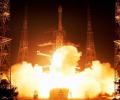
Indian Space Research Organisation is gearing up for one of its busiest times with seven more launches planned this financial year, even as India's first human spaceflight remains scheduled for 2027, its chairman V Narayanan said.
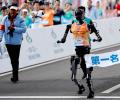
The race featured 21 humanoid robots competing on a 21.1 kilometre course.
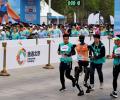
Twenty-one humanoid robots joined thousands of runners at the Yizhuang half-marathon in Beijing on Saturday, the first time these machines have raced alongside humans over a 21-km (13-mile) course.

China is all geared up to launch into space on Thursday the first part of its maiden space lab Tiangong-1, which will form the test-bed for a larger 60-ton space station to be put in place by 2020.

The three astronaut crew were carried to China's Tiangong space station and will replace a similar crew that have been in space for the last six months.
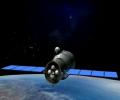
'The location was the central part of the southern pacific and most part of the Tiangong-1 was burnt up on the re-entry.'
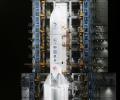
The debris from China's disintegrating Long March rocket entered the Earth's atmosphere on Sunday and reportedly fell into the Indian Ocean area close to the Maldives, the country's space agency said, ending an anxious week as people and the governments wondered where and when the space junk would fall.
China may launch the country's first space laboratory module at the end of this week with hectic last minute preparations in full swing.
China on Tuesday successfully launched its fifth and longest manned space mission with three astronauts, including a woman, on board 'Shenzhou-10' as part of the Communist giant's efforts to build a permanent space lab of its own by 2020
China completed its first manned space docking on Monday, as a spacecraft carrying three astronauts including the country's first spacewoman, successfully coupled with an orbiting module, in a major milestone for its ambitious space programme.
Achieving a key breakthrough in space technology, three Chinese astronauts including the country's first woman astronaut Liu Yang, on board the spacecraft Shenzhou-9 (Divine Grace) docked with the orbiting Tiangong-1 lab (Heavenly Palace).

China on Tuesday alleged that US billionaire Elon Musk-owned SpaceX's satellites had two 'close encounters' with its space station in orbit, and has complained to the United Nations about the incidents which endangered the safety of the Chinese astronauts.

China, only the third country to independently send a person into space in 2003, after the US and Russia, plans to launch its next manned space mission in June next year, state media reported today.
The Shenzhou 8 spacecraft silently coupled the Tiangong 1 module more than 343 km above earth, in a manoeuvre carried live on state television.
As a Chinese spacecraft was put on its path to attempt the country's first docking mission, a feat achieved by Soviet Union years back, questions were raised about its relevance and whether it was appropriate for China to spend heavily on space technology when "money is needed elsewhere".
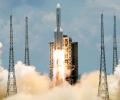
China on Thursday declined to comment on reports that the debris of its Long March 5B rocket, which last week launched the core module of the country's space station, is set to re-enter the earth's atmosphere this weekend, amid concerns that it could cause damage if it crashes in civilian areas.
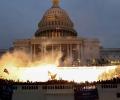
Images that capture what it was like living through 2021.
Breaking its silence on its tumbling space rocket, whose debris is expected to fall on Earth this weekend, China said most of it would be burnt during re-entry and it is "highly unlikely" to cause any damage on the ground.

China's second woman astronaut Wang Yaping, who is currently orbiting the earth in an experimental space lab, has become the country's first space teacher as she delivered a lecture to over 60 million Chinese students about various aspects life in space.

Chinese astronauts Jing Haipeng, 50, and Chen Dong, 37, were blasted off into space by Shenzhou-11 (heavenly vessel) spacecraft.
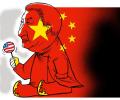
'Seen in the context of world turmoil in face of the pandemic and the Chinese 'miracle' of being the only country in the world to control it, this is not merely a 'Sputnik' moment, but a 'Sputnik Plus' moment,' argues Colonel Anil A Athale (retd).

The ongoing experiments on Moon, Mars and elsewhere could translate into better crop yields and hardier plants that could thrive in inhospitable parts of the world, says Devangshu Datta.
 © 2026 Rediff.com - Advertise with us - Disclaimer - Privacy Policy - Sitemap - Feedback - About us - Terms of use - Grievances