
Asserting that global threats like terrorism require global response, he said globalisation had "sharpened the threat posed to us by instability in both our immediate and our proximate neighbourhood".
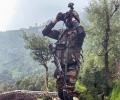
Pakistan may want to undertake a 'false flag' operation in J&K to divert attention from the situation in Balochistan and Khyber Pakhtunkhwa but infiltrating one SSG battalion into J&K and having two SSG battalions waiting to follow suit means war, which Pakistan cannot afford in its current economic crisis, notes Lieutenant General Prakash Katoch (retd).
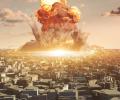
A step away from nuclear weapons being used in conflicts, warns Colonel Anil A Athale (retd).

We have already suffered considerable collateral damage as a result of the war, and its continuance will continue to dampen our prospects for faster economic growth. We have a direct and legitimate interest in its early cessation, counsels former foreign secretary Shyam Saran.

But it is less adventurous. It seems, at last, that in its eighth decade, Pakistan has settled into being a parliamentary democracy just like Bangladesh has and like we have always been, observes Aakar Patel.

The only thing that might justify a response is the desperate state of Pakistan's economy and how its people are suffering. But it's better to be heartless for now, argues Shekhar Gupta.
The Indian Air Force is planning to induct its first self-destructing combat drones from Israel by next year for enhancing its firepower.
Pakistan has an "addiction" of "playing around" with militant groups against India, a top Pentagon official has said. "They have an addiction to playing around with militia groups to achieve certain interests, particularly vis-a-vis India. That gets them in all kinds of trouble," Michael Sheehan, assistant secretary of defence for special operations/low-intensity conflict, told lawmakers at a Congressional hearing.

The Indian Air Force will induct lethal drones within two years, providing itself the capability to hit high value targets such as enemy missile and radar sites, and even terrorist hideouts.

Without going to war here are some ways in which India can express anger its over Pakistan's relentless support to terror.
Putting a premium on knowledge, Union Home Minister Shivraj Patil Monday said in the age of low-intensity conflicts, a strong intelligence network was more important than sophisticated technology.
The exercise would be carried out at the Indian Army's prestigious Counter Insurgency and Jungle Warfare School at Vairangte from March 27 to April 17.

India's indigenously developed Pinaka rockets were on Thursday successfully test-fired thrice from a multi-barrel rocket launcher at an armament base in Chandipur-on-sea, about 15 km from Balasore in Odisha.

'In this regard, the future stability of Pakistan remains a wild card,' said the report.

China plans to sell to foreign countries its new short-range air to surface missile which can be mounted on drones and is designed for anti-terrorism operations.

Bengaluru based Dinesh Malhotra, 54, an ex-Army officer who is working as a human resource professional in a construction firm shares some survival tips.

'Pakistan thinks it is winning this low intensity conflict.' 'It is a serious observation. Half the battle is convincing your adversary that he cannot make headway.' 'A lot depends on how the internal professional management of the army and the handling of situations that are bound to rise sooner than later in his command, are done.'

'The travesty of recent Indian strategic thought is it emerges not from our brains, but from whatever part of the anatomy that secretes the prickliest hormones,' says Shekhar Gupta.

'India has both the wherewithal and the will to fight the enemy, but is living in a make believe world of its own since it is yet to accept that it is indeed at war,' says military historian Colonel Anil A Athale (retd).

'No one needs to lose sleep if a person with better operational credentials supersedes lesser endowed peers,' says Group Captain Murli Menon (retd).
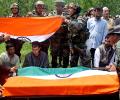
'In times to come this will be considered a watershed event, but only if the establishment can see the flag which is up and the straws in the wind which are flying,' says Lieutenant General Syed Ata Hasnain (retd).
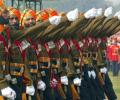
The average Indian soldier remains as hardy as before but he is certainly confused with the pace of change occurring all around him. It is here that the leaders -- the officers -- will have to adapt themselves to the new reality, says Nikhil Gokhale

'The government must make clear once and for all that promotions in the Indian Army are not the right of individuals, but a privilege given in accordance with role and function.'

When Rediff.com's Archana Masih and Rajesh Karkera set course from the foothills of the Himalayas to the Arabian Sea, they could not think of a better place to begin their journey than the stately campus that has given India some of its greatest military heroes.

'If Indian armed forces entered Pakistan and succeeded in inflicting major damage on the Pakistani army and occupied territory in the Pakistani heartland, there is reason to think the Pakistani military would use some nuclear weapons against the incoming Indian forces to compel India to stop.'
 © 2026 Rediff.com - Advertise with us - Disclaimer - Privacy Policy - Sitemap - Feedback - About us - Terms of use - Grievances