
The satellite, weighing about 4,410 kg will be the heaviest to be launched from the Indian soil and into a Geosynchronous Transfer Orbit (GTO), the space agency said. The satellite will travel onboard a LVM3-M5 rocket, dubbed as 'Bahubali' for its heavylift capability.

ISRO is set to launch its communication satellite CMS-03 from Sriharikota. The satellite, weighing 4,410 kg, will be the heaviest launched from Indian soil into a Geosynchronous Transfer Orbit (GTO).
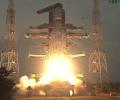
The heaviest communication satellite to be launched from the Indian soil onboard a new generation, homegrown 'Bahubali' rocket was successfully placed into the intended orbit on Sunday, the Indian Space Research Organisation said.

The 4,700 kg GSAT-N2 High-throughput (HTS) satellite has been injected into the desired orbit, NewSpace India Limited (NSIL) said in a series of posts on microblogging site 'X.

Besides the scientists at the Indian Space Research Organisation, officials at the European Space Agency are also involved in tracking the lander module of the Chandrayaan-3 mission which is minutes away from making a soft landing on the surface of the moon, a senior scientist said on Wednesday.

'When a Project Director is appointed, the whole organization -- including the Chairman ISRO -- works for his success. It is a lesson that has been of abiding value all through the other projects I have worked on,' recalls the late President, one of the earliest pioneers at ISRO.

The 3,357-kg satellite, which was deployed from the lower passenger position of Ariane-5 launch vehicle (VA 251) into the geostationary transfer orbit, is configured on ISRO's enhanced I-3K Bus structure to provide communication services from Geostationary orbit in C and Ku bands.

The 3,357-kg satellite is slated to blast off from the Ariane Launch Complex at Kourou, a French territory located along the northeastern coast of South America, at 02:35 hrs IST. "GSAT-30 is to serve as a replacement to INSAT-4A spacecraft services with enhanced coverage", ISRO said.

It also carries equipment for meteorological data relay and satellite based search and rescue services being provided by earlier INSAT satellites.

India's 3,400-kg communication satellite GSAT-10 is now ready to be shipped to the spaceport at Kourou in French Guiana for launch by European space consortium Arianespace in two months, according to Indian Space Research Organisation Chairman, K Radhakrishnan.
India's latest communication satellite GSAT-8 was successfully launched on Saturday by Arianespace from Kourou in French Guiana to give a boost to direct-to-home services in the country.

"ISRO has been launching at least one satellite every month, so our calender is perennially packed and at this point of time it looks difficult to launch the South Asian satellite in December. It could get delayed by a month," a senior official said.
The Indian Space Research Organisation will launch four foreign satellites this year as it seeks to make further inroads into the international satellite-building and launch services market in 2009.

The GSAT-31 is a 'high power' communication satellite going to serve and replace some of the satellites that are going to expire soon.
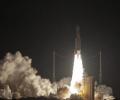
Boosting India's communication services, its latest satellite GSAT-16 was successfully launched on board Arianespace rocket from the spaceport of Kourou in French Guiana in the early hours of Sunday, after a delay of two days due to bad weather.
The most advanced and powerful fourth generation communication satellite INSAT 4A was now closer to its space home in geostationary orbit.
The anomaly was found in the 'water deluge system' that is intended to reduce the acoustics level for the safety of the launch-pad
All systems on board the satellite were functioning normally.
Indian space scientists have received signals of Indian National Satellite-4A.
INSAT-4A ready for launch on December 22
The MCF subsequently issued commands to the satellite to make the earth viewing face to orient towards earth. The calibration of the gyros on board the satellite was also carried out.
The rocket is carrying two other spacecrafts, took off from Kourou, French Guyana.
The launch of Ariane-5, which will carry India's indigenously-built 3,025 kg INSAT-4B geostationary satellite and Skynet 5A of EADS Astrium, is set for between 3.55 am and 4.28 am on Sunday.

Arianespace launch vehicle Ariane-5 VA-231, carrying GSAT-18 along with co-passenger Sky Muster II for the Australian operator nbn (National Broadband Network) was scheduled for launch at 2am on Wednesday.
The European space agency would be asked to launch the INSAT-4A and INSAT-4B spacecraft.

Here's a recap of events that occurred in India in the past 24 hours.

A high power satellite, GSAT-15 is being inducted into the INSAT/GSAT system. GSAT-15 carries a total of 24 communication transponders in Ku-band as well as a GPS-Aided GEO Augmented Navigation (GAGAN) payload operating in L1 and L5 bands.

The Indian Space Research Organisation has resolved to alight its lander on the lunar surface with Chandrayaan-3 in addition to a maiden solar expedition in 2020.

GSAT-18, which aims at providing telecommunications services for the country by strengthening ISRO's current fleet of 14 operational telecom satellites, was launched into a Geosynchronous Transfer Orbit about 32 minutes after the lift-off.

Except Pakistan, seven SAARC countries are a part of the project.

INSAT-3D, developed by the Indian Space Research Organisation and its Space Applications Centre, is designed to provide meteorological observation and monitoring of land/ocean surfaces.

Hit by inclement weather, the launch of India's latest communication satellite GSAT-16 was deferred for the second time after it was rescheduled to be put into space in the early hours on Saturday by Ariane 5 rocket from the space port of Kourou in French Guiana.

ISRO Chairman K Sivan described the GSAT-11 as the "richest space asset" for India.

India's first exclusive defence satellite GSAT-7 was successfully launched by European space consortium Arianespace's Ariane 5 rocket from Kourou spaceport in French Guiana on Friday, giving a major push to the country's maritime security.
And the first Indian to go into space from 'Indian soil' could well be a woman.
 © 2026 Rediff.com - Advertise with us - Disclaimer - Privacy Policy - Sitemap - Feedback - About us - Terms of use - Grievances