
Air India, IndiGo and SpiceJet have told the government that the country's airline industry is under extreme stress and on the verge of "stopping operations", as they sought revision in ATF pricing and financial support.

In 2025, the total net induction was 35 planes -- 79 added and 44 returned -- making it much lower than even 2024.

Prime Minister Narendra Modi inaugurated the first phase of the Noida International Airport in Jewar, Uttar Pradesh, highlighting its role as a multi-modal transport hub and its potential to significantly boost cargo and passenger handling capacity.
Flight bookings for Halwara airport in Punjab are scheduled to begin in April, with the first commercial flight expected between May 10 and 15. The airport's opening is anticipated to significantly enhance air connectivity and boost economic growth in the region.

Pakistan has extended its airspace ban for Indian aircraft until January 23, 2026, continuing restrictions imposed after the Pahalgam attack. India has reciprocated with a similar ban.

The Airports Authority of India (AAI) on Monday issued a travel advisory as dense fog gripped Northern India, urging passengers to check their flight status before leaving for the airport to avoid prolonged waiting periods at the airport in case of flight cancellations or delays.
'Where rostering systems are automated and duty time software interfaces directly with DGCA, the assertion that they suddenly discovered crew shortages is simply implausible.' 'If adequate crew planning hasn't materialised within 12 to 24 months from inception, how will 45 days -- from December 5 to February 12 -- suddenly resolve matters?'
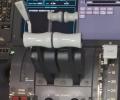
'...from the recovered part of the throttle quadrant -- the control panel that manages engine power -- it is hard to say at this stage if the locking mechanism was damaged in any way.'
'If anything happened out of the normal, there would be instantaneous ECAM, EICAS warnings, the master caution or master warnings going off.' 'It would be like a Christmas tree in the cockpit if things start going wrong.'
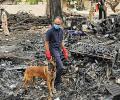
'The crash site must be secured because something small -- like a pipe or hydraulic line -- could hold a critical clue.'

'In those 10 seconds, they even made a MAYDAY call -- which is only issued in case of a serious, imminent emergency.'
The recent spate of technical glitches in aircraft has prompted the Directorate General of Civil Aviation (DGCA) to issue an order on July 18, making aircraft maintenance engineers (AMEs) with category B1/B2 licences the final authorities in certifying planes. This has put the spotlight on the availability of such personnel. According to the order, airlines were resorting to frequent one-off authorisation by the Category A certifying staff at transit stations, which is not in line with existing regulatory provisions.

'Whoever is doing it (threats to airlines), they are actually carrying out a recce.' 'This is the manner in which terrorists strike.'
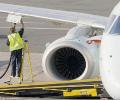
With airlines reporting multiple technical malfunction incidents, aviation regulator DGCA on Monday said it conducted spot checks and found that there is an insufficient number of engineering personnel certifying planes of various carriers before their departure. Before each departure, an aircraft is checked and certified by an aircraft maintenance engineer (AME). The DGCA has now issued guidelines for airlines on the deployment of AME personnel and directed them to comply by July 28.

Rising fuel costs have grounded the high-flying ambitions of India's carriers and have sent their stocks into a tailspin.
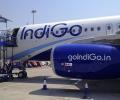
Disability rights came under the spotlight again as the country's largest airline IndiGo refused to let a teenager with special needs board its aircraft. While the twitterati as well as fellow passengers have called for strict action, IndiGo has stood by its action saying the airport manager took the decision to ensure safety of other passengers. "Throughout the check-in and boarding process, our intent of course was to carry the family. "However, at the boarding area, the teenager was visibly in panic.
The airlines in India are expected to add around 370 aircraft worth Rs 150,000 crore (Rs 1.5 trillion) to their fleet by FY17, according to a study by Assocham.
The load factor of six major domestic airlines--IndiGo, SpiceJet, Air India, GoAir, Vistara and AirAsia India -- stood between 70 per cent and 64.9 per cent in January.
Within two weeks of many airlines deciding to roll back salary cuts encouraged by a steady increase in traffic flow, a second wave of coronavirus along with rules of compulsory RT-PCR test has hit forward bookings. The fears of last summer, when the pandemic had overturned all the wisdom of airline boardrooms, have returned to haunt the aviation industry. According to an official in the Ministry of Civil Aviation, flight occupancy is down to 60 per cent from 70 per cent in the first week of March. Airline lobby group IATA estimates that low cost airlines need to fly at 80 per cent occupancy to be profitable.
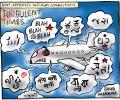
India remained the world's fastest growing domestic aviation market with 51 straight months of doubled-digit traffic growth but the woes of passengers as well as carriers manifested in myriad forms.

The biggest let down for India's aviation sector has been the failure of the government to privatise Air India, says Anjuli Bhargava.
An executive of a private airline said even though volume picked up, it will be difficult for airlines to make money as fares have remained low even during festive season.
Stressful work schedules and limited growth opportunities are taking a toll on a large number of senior professionals in airlines.

Let Air India - that anyway flies very limited international routes, often bleeding profusely and makes huge losses on trunk routes - do this national service, says Anjuli Bhargava.

IATA informed travel agents that they would have to remit the ticket sale proceeds to airlines every week.
National carrier Air India incurred a loss of over Rs 5,500 crore during the 2009-10 fiscal, the government said on Wednesday.
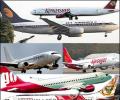
A total of 406 aircraft are in the fleet of eight scheduled airlines in the country, most of which were suffering losses, Lok Sabha was informed.
Indicating its intentions to fly abroad very soon, proposed airline AirAsia India on Wednesday trashed the "bizarre" policy of allowing carriers to operate international flights only after five years of domestic operations.

Higher economic growth and affordability will help Indian aviation firms register strong growth.
India's domestic air traffic rose during to 258.07 lakh from January to May 2012 as against 244.98 lakh during the corresponding period of previous year, registering a growth of 5.34 per cent.
India's air traffic continued to rise in April.
There is a high possibility that one or two Indian airlines might not survive the rough weather.
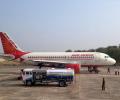
The US has ordered Tata-group owned Air India to pay a whopping $121.5 million as refunds and $1.4 million as penalties for extreme delays in providing refunds to passengers due to the cancellation or change in flights, mostly during the pandemic, officials said. Air India is among the six airlines that have agreed to cough up a total of over $600 million as refunds, the US Department of Transportation said on Monday. Air India's policy of "refund on request" is contrary to the Department of Transportation policy, which mandates air carriers to legally refund tickets in the case of cancellation or change in flight, officials said.

Competition is intense and with the blurring of differences in service proposition and fares, it becomes imperative that airlines use their on-time performance for messaging and brand building.
Though India's airlines are certainly bleeding, they haven't yet faced the ignominy of shutting down.
This is an increase from a Boeing forecast last year of 1,450 new airplanes worth $175 billion.
The Indian aviation industry faced a paradoxical situation in 2011 suffering huge losses in the face of a burgeoning domestic air traffic, as it battled high fuel costs and fierce competition while looking up to the government for help.
Life of air passengers was different in the 1970s.
Domestic airlines are preparing to offer lower fares for passengers without check-in bags in a move to improve seat occupancy and market share. IndiGo chief executive officer Ronojoy Dutta indicated the airline's interest to offer zero bag fares in an interaction with Bloomberg. Regulatory caps on fares and capacity related to Covid-19 have prevented IndiGo from taking a decision and the airline is discussing the issue with the government, he said.
Kingfisher Red topped the list of loss-makers with Rs 79,8.34 crore (Rs 7.98 billion).
 © 2026 Rediff.com - Advertise with us - Disclaimer - Privacy Policy - Sitemap - Feedback - About us - Terms of use - Grievances