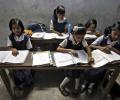
The top five states with a high Human Development Index in 2017 were Kerala, Chandigarh, Goa, Lakshadweep, Delhi. The bottom five states in 2017 were Bihar, Uttar Pradesh, Jharkhand, Madhya Pradesh and Odisha.

The key question is how much of the latest growth record represents recovery from the 2020-2021 downturn, and what is the sustainable growth rate now, asks T N Ninan.

Human Development -- a measure of a nation's health, education, and average income -- has declined for two years in a row.
Life expectancy of Indians at birth in 2019 was 69.7 years while Bangladesh has a life expectancy of 72.6 years and Pakistan 67.3 years, the 2020 Human Development Report said.

The report further said that none of the (BRIC) Brazil, Russia, India China and South Africa countries were in the high human development category and India remained at the bottom with lowest HDI value among them.
India's rank in terms of Human Development Index (HDI) stood unchanged at 127 during 2002, with per capita income coming down but literacy rate improving slightly, the United Nations Development Programme said in its report on Thursday.
The Human Development Index in the country rose by 21 per cent, according to a report which cautions that health, nutrition and sanitation remain the key challenges for India.

'We have 38 Dalits who are MLAs and ministers. But that does not mean the Dalits of Bihar are prospering.'

India also fares poorly on maternal mortality rate.
Like its predecessors, the 2014 report (released two days ago) allows one to compare India's performance with other countries.

However, 63 per cent Indians were "satisfied" with their standard of living
It will be interesting to see what shifts have been recorded in the last decade-and-a-half -- from the effects of demonetisation and Covid's second wave to the drop in fertility and increase in farm workers -- but we will only know this if and when the Census is conducted, points out Aakar Patel.
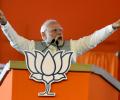
Prime Minister Narendra Modi's goal of making India a high-income economy by 2047 is unlikely to be achieved, but the country should become an upper middle-income nation by then, Financial Times chief economics commentator Martin Wolf said on Friday. Wolf further said that India would also become a superpower by 2047. "India wishes to become a high-income country by 2047.

The point made by sociologist M N Srinivas, that it represented a Sanskritic act that was linked to caste, is never raised in Indian debates and the disapproval of drink is almost universal, notes Aakar Patel.
'Chinese are going bang, bang, bang building 30-35 reactors.' 'We should announce a programme of 50 new reactors and show that we mean business on the ground and not just announcements.'

If we as citizens, do not take ownership of public places, public facilities and public conveniences, Swachh Bharat will remain just a hollow slogan, notes Biswajit Dasgupta.

'The response from the government using words like malicious, deliberate, etc is diverting from the real issue.' 'The indicators related to young children such as stunting or child mortality are a reflection of the social development in the country.' 'That's how we have to look at it and not ignore the issue by denying the data.'

The Lok Sabha contest in Thiruvananthapuram is shaping up to be a significant battle involving key candidates like Shashi Tharoor, Rajeev Chandrasekhar, and Panniyan Ravindran. This three-cornered fight highlights the political dynamics in Kerala's capital city, with each candidate bringing their own vision and promises for the region's development, notes Rajeev Srinivasan.
'To summarise, PM Modi's failures in the last nine years can be categorised under 'durniti' (bad policies), 'anyay' (injustice) and - perhaps most importantly - 'badniyat' (ill intention)'

Even as India strives to climb the development mountain, the fact is that the mountaintop is already crowded. If it got there in 2047, India would be very much a late-comer, observes T N Ninan.

With a narrow industrial base and dysfunctional politics, and a counter-productive national security agenda, Pakistan could well remain an 'international migraine', observes T N Ninan.

Rediff Labs compared the happiness levels of each country with its Human Development Index and its Peace Deficit Index.
India may be one of the fastest growing economies in the world, but the quality of life in the country has worsened, says the Human Development Index released by the United Nations Development Programme on Monday.
Gujarat Chief minister Narendra Modi on Monday said his government would make sincere efforts to bring the state's human development index at par with those of the developed countries.
'...to come back to power because it was not doing well.'
There are some countries where not only the Gross Domestic Product figure is high but also standard of education and income equality.

Rediff Labs analysed the data on happiness, peace and human development for countries all over the world.

'It will impact the 2024 Lok Sabha elections.'
While India's human development index has improved, absolute performance levels aren't satisfactory, says T N Ninan.
The robust economic growth notwithstanding, India has garnered a lowly 119th rank in the United Nation's Human Development Index due to poor social infrastructure, mainly in areas of education and healthcare.
According to Human Development Report (HDR) 2010, the Human Development Index (HDI) for India was 0.519 in 2010 with an overall global ranking of 119 (out of the 169 countries).

India has the lowest labour force participation rate in South Asia and one of the lowest in the world, points out Aakar Patel.
In the 2010 Human Development Report, prepared by UNDP, India had been ranked at 119 out of 169 countries.

Speaking at the first Khan Abdul Gaffar Khan Memorial Lecture at Jamia Millia Islamia University, Amitabh Kant said, "The eastern part of India, particularly states like Bihar, UP, Chhattisgarh, Madhya Pradesh and Rajasthan, is keeping India backward, especially on social indicators. While we have improved on ease of doing business, we have remained backward on human development index. We are still 131 out of 188 countries in HDI."

India ranked 52 in 2011 index against its position at 53rd among 125 nations a year ago.
In a nation of 1.2 billion, only 62 per cent are literate. About 420 million poor live in only eight states.

'Better hygiene practices could lower a person's immunity and make the person susceptible to auto-immune diseases.'
The United Nations Development Programme has just put out its latest Human Development Report, containing the human development index (HDI) for 177 countries, with the data being for 2005. India ranks 128th (with an index of 0.619), which is a notch down from the 127th rank that it used to occupy.
The Committee also expressed "strongest concern" over the decision of the Governemnt regarding cap on the total number of BPL families.

India has entered a 'demographic sweet spot' with half of its population being under the age of 29. This 'demographic dividend' is likely to last for 2-3 decades and provides the government a unique opportunity to harness the vast potential of India's youth, points out Raj Kishore Mishra, the former civil servant turned development professional.
 © 2026 Rediff.com - Advertise with us - Disclaimer - Privacy Policy - Sitemap - Feedback - About us - Terms of use - Grievances