
The MiG-21's sharp silhouette and supersonic roar will live on in the memories of those who flew it, those who maintained it, and those who watched it streak across the sky as a symbol of India's strength, asserts IAF veteran Air Commodore Nitin Sathe (retd).
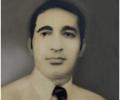
Squadron Leader Kanwal Deep Mehra's daredevilry during the 1971 War brought down a Pakistani F-86 Sabre. But he had to bail out of his plane, was badly injured. Then a fierce band of armed guerillas evacuated him to safety at great risk to their lives.

To share your Father's Day story (Father's Day will be celebrated on Sunday, June 16), just mail us at getahead@rediff.co.in (subject: Father's Day) along with your name, the place where you live, your father's name and picture and your message about him.

'There cannot be anyone like Air Marshal Keelor -- he was so difficult to emulate.' Air Commodore Nitin Sathe (retd) salutes War Hero Air Marshal Denzil Keelor PVSM, KC, AVSM, VrC who passed into the ages last month.

'The tank battle was fought at ranges of 300-700 metres.' 'It was a rare example of the complete destruction of a squadron by another squadron.'

Reports say, Indian army had destroyed 13 M24 Chaffee light tanks and two F-86 Sabres (fighter jet) along with capturing of two Pakistani air officials by Muktibahini, reported Bangladesh Live News.
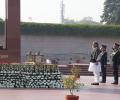
Dhaka emerged as the free capital of independent Bangladesh on December 16, 1971 after the war between India and Pakistan broke out on December 3 when the Indian troops directly stood beside the Mukti Bahini soldiers.

For all those auto enthusiasts who thought Mahindra have only been manufacturing Jeeps and trucks in the '90s, Timeless Mahindra offers plenty of interesting surprises, discovers Rajesh Kareka/Rediff.com.
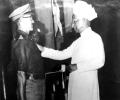
'Anglo-Indians have played a significant role at the forefront, meeting every challenge to the security of the motherland.' A fascinating excerpt from Barry O'Brien's The Anglo-Indians: A Portrait of a Community.
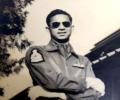
Air Commodore Jawahar Lal Bhargava recalls how he ejected from his failing aircraft in Pakistan during the 1971 War.
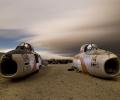
Have you ever wondered what happens to aircraft after they become too old? They are put to rest -- they undergo funeral-esque rituals known as 'pickling'; their engines are removed, the windows covered and the fluids drained. But of course these giants are too big to bury. In the parched deserts, where a dry climate is an old machine's best ally, aircraft, young and old, lie nose to tail, row after row like fallen soldiers in the secluded airplane boneyards. And these airplane graveyards become the perfect playground for photographer Troy Paiva.

Nirmal Jit Singh Sekhon is the only Indian Air Force warrior to be decorated with the Param Vir Chakra. 'My admiration for his gallant action remains undiminished,' says M P Anil Kumar. 'It was not his day, yet he made it his own.'
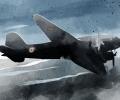
'We flew all missions in the first part of the war at low levels; that is at 300 to 500 feet above the ground.' 'These sorties were no doubt stressful since the pilots and crew had to look out for birds and obstructions as well as enemy gunfire.'

December 3, 2021 marks 50 years since the beginning of the 1971 War which ended in a decisive military victory for India and the liberation of Bangladesh. Most analysts of the 1971 War agree that the IV Corps dash across the mighty Meghna river led by the brilliant General Sagat Singh was the turning point in the war, recalls military historian Colonel Anil A Athale (retd).
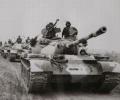
Why did Pakistan sign a cease-fire without acquiring Kashmir, which was the sole purpose of the 1965 War, asks Ahmad Faruqui.

The Chinese air force is now a 400,000-person force that flies some 2,000 combat aircraft -- more than thrice the size of the Indian Air Force.

'ISI-backed jihadi groups like the Jaish-e-Mohammed and Lashkar-e-Tayiba are now prepared to cross the International Border and attack targets in Punjab at will,' says Ambassador G Parthasarathy, India's former high commissioner to Pakistan.
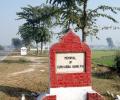
In super-human acts of valour, Havildar Abdul Hamid personally knocked out five tanks over two days, effectively derailing the enemy offensive in the 1965 Indo-Pak War. 'Decades later, I realised not only how much the nation owed to this great son of India but also that my entire family was probably alive thanks to him,' says Vijay Dandapani.
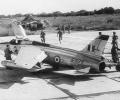
'As the IAF kicks off another round of myth-making -- launching a year-long commemoration of the 50th anniversary of the 1965 India-Pakistan war -- it is worth remembering how little there was to celebrate in those September days when the underdog PAF got the better of the IAF in raid after raid, dogfight after dogfight.'

'India was in no position to wage another war in 1965, having suffered a morale-shattering defeat in 1962. The three services were in the middle of a modernisation and expansion phase and therefore not fully trained or battle-ready.'
 © 2026 Rediff.com - Advertise with us - Disclaimer - Privacy Policy - Sitemap - Feedback - About us - Terms of use - Grievances