
The Royal Swedish Academy of Sciences announced on Monday that it has decided to award the Nobel Prize in Economics 2025 to Joel Mokyr, Philippe Aghion, and Peter Howitt "for having explained innovation-driven economic growth." The 2025 Sveriges Riksbank Prize in Economic Sciences in Memory of Alfred Nobel goes to the trio, with one half awarded to Mokyr "for having identified the prerequisites for sustained growth through technological progress" and the other half jointly to Aghion and Howitt "for the theory of sustained growth through creative destruction."

The IISER Aptitude Test is conducted for students who wish to get admission to IISER.

The Royal Swedish Academy of Sciences on Monday has decided to award the 2024 Nobel Prize also known as the Sveriges Riksbank Prize in Economic Sciences to Daron Acemoglu, Simon Johnson and James A Robinson 'for studies of how institutions are formed and affect prosperity'.

The Royal Swedish Academy of Sciences on Monday has decided to award the 2024 Nobel Prize also known as the Sveriges Riksbank Prize in Economic Sciences to Daron Acemoglu, Simon Johnson and James A. Robinson "for studies of how institutions are formed and affect prosperity."

In her oeuvre, Han Kang confronts historical traumas and invisible sets of rules and, in each of her works, exposes the fragility of human life.
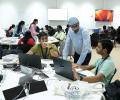
The Indian Institutes of Science Education and Research, Bhopal (IISER) is inviting applications from science students for its 5-year BS-MS programme and 4-year BS in Engineering Sciences and Economic Sciences.

American economic historian and labour economist Claudia Goldin won the 2023 Nobel Economics Prize for her work examining wage inequality between men and women, the Royal Swedish Academy of Sciences said on Monday. The Sveriges Riksbank Prize in Economic Sciences in Memory of Alfred Nobel 2023 was awarded to 77-year-old Claudia Goldin "for having advanced our understanding of women's labour market outcomes" the prize-giving body said in a statement. Goldin will receive 11 million Swedish kronor, or around $1 million, as the sole winner of this year's prize.

The four students -- two boys and two girls aged 18-20 -- were studying at the nearby Novgorod State University in Veliky Novgorod city.

The Sveriges Riksbank Prize in Economic Sciences in Memory of Alfred Nobel was on Monday awarded to Ben S Bernanke, Douglas W Diamond, and Philip H Dybvig for their research work on bank regulation and how financial crises should be managed.

"This year's Laureates, Paul Milgrom and Robert Wilson, have studied how auctions work. They have also used their insights to design new auction formats for goods and services that are difficult to sell in a traditional way, such as radio frequencies. Their discoveries have benefitted sellers, buyers and taxpayers around the world," the academy said.

'But unlike Bond who killed an individual, Israel is killing a nation.'

The Royal Swedish Academy of Sciences has decided to award the Sveriges Riksbank Prize in Economic Sciences in Memory of Alfred Nobel 2021 with one half to David Card "for his empirical contributions to labour economics" and the other half jointly to Joshua Angrist and Guido Imbens "for their methodological contributions to the analysis of causal relationships". Card is the Class of 1950 Professor of Economics at the University of California, Berkeley and Director of the Labor Studies Program at the National Bureau of Economic Research. Angrist is an Israeli American economist and Ford Professor of Economics at the Massachusetts Institute of Technology. Imbens is Professor of Economics at the Stanford Graduate School of Business since 2012. After earning his Ph.D. from Brown University in 1991, he taught at Harvard University, UCLA, and UC Berkeley.

Indian-American economist Abhijit Banerjee and his French-American wife Esther Duflo along with their colleague Michael Kremer received the 2019 Nobel Prize in Economic Sciences on Tuesday for their work to alleviate global poverty that has helped millions of children in an experimental approach that favours practical steps over theory.

I suggest we build a Vigyan Mandir (Temple of Science) with the ambience of a place of worship, so that it becomes a destination for pilgrims. We should embed on its walls bronze plaques describing each scientist mentioned here along with about a dozen of our ancient mathematicians, recommends Professor Kalyan Singhal, historian of science and technology.

MIT, in a release, said the 'work of Duflo and Banerjee has emphasised the use of field experiments in research, to bring the principles of laboratory-style randomised, controlled trials to empirical economics'.

Banerjee joins the list of Indians and people of Indian origin who have received the prestigious Nobel prize in fields like Physics, Chemistry, Peace, Economic Sciences and Medicine.

From his economist mother to politicians and academia -- all hailed Banerjee's achievement.

French economist Jean Tirole won the 2014 economics Nobel Prize for his analysis of market power and regulation, the RoyalSwedishAcademy of Sciences said on Monday.

By winning the Nobel prize winner at the age of 17, Malala has become the youngest ever Nobel laureate.

'The bhadralok would have earlier baulked at the very idea of wearing a coloured dhoti; now, with Dr Banerjee wearing, it is quite likely to be the hot fashion item during Durga Puja next year,' says Uttaran Das Gupta.

The winners will split an eight million Swedish kronor (USD 924,000) award funded by the Swedish central bank.

Kamala succeeded as she identified herself with the larger minority groups rather than narrow ethnicity, prodded by her mother who did not want to return to India, observes Ambassador T P Sreenivasan, who has done multiple stints in India's embassy in Washington, DC.

For Duflo and Banerjee, an important part of their work has been ensuring that the agency of the "beneficiaries" -- usually, in developing countries like India, poorer individuals -- is put at the centre of any policy design. This is a crucial way in which experimental results are often better than large scale data-based inference, says Mihir S Sharma.

Time magazine lists 100 'people who inspire us, entertain us, challenge us and change our world'.

Rahul Gandhi said he had helped the party conceptualise its 'Nyay' scheme to help remonetise the economy.
Nobel Prize laureates attend the 2010 Nobel Prize ceremony at the Concert Hall in Stockholm, on Friday.
In 1968, Sveriges Riksbank (Sweden's central bank) established The Sveriges Riksbank Prize in Economic Sciences in Memory of Alfred Nobel.

They won for their analysis of markets with search frictions.

"Excellent meeting with Nobel Laureate Abhijit Banerjee. His passion towards human empowerment is clearly visible. We had a healthy and extensive interaction on various subjects. India is proud of his accomplishments. Wishing him the very best for his future endeavours," Modi said in a tweet, sharing a picture of their meeting at his official residence.
Elinor Ostrom and Oliver Williamson of the United States have won the 2009 Nobel Economics Prize for their work on the organisation of cooperation in economic governance.
A spokesman of the university said the privately-funded Manmohan Singh Scholarship will send three serving scholars from India every year to St John's College, Cambridge, where the prime minister had studied economics and won the Wright's prize for distinguished performance in the mid-1950s.

In January 2003, the American Finance Association awarded Rajan the inaugural Fischer Black Prize for the best finance researcher under the age of 40.
The pair won the prize "for having enhanced our understanding of conflict and cooperation through game-theory analysis," the Royal Swedish Academy of Sciences said.
Here we present a list of all the recipients of the Economics Nobel that was first given in 1969.

Banerjee, 58, was educated at the University of Calcutta, Jawaharlal Nehru University and Harvard University, where he received his Ph.D in 1988. He is currently the Ford Foundation International Professor of Economics at the Massachusetts Institute of Technology.

The 2004 Nobel Prize for Economics was jointly won by Finn E Kydland of Norway and Edward C Prescott of the United States on Monday.

This year's Laureates have shown how the problem of global poverty can be tackled by breaking it down into a number of smaller - but more precise - questions at individual or group levels, he Royal Swedish Academy of Sciences said.

What does Nobel Laureate Abhijit Banerjee thinks about India's education sector?

Nobel Peace Prize winner Kailash Satyarthi wrote under a chair at the Nobel Museum in Stockholm, thus keeping with the tradition of a unique kind of autograph given by the laureates.
 © 2026 Rediff.com - Advertise with us - Disclaimer - Privacy Policy - Sitemap - Feedback - About us - Terms of use - Grievances