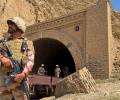
'Neither are Baloch insurgents capable of breaking up Pakistan, nor has Pakistan learned any lessons from the 1971 debacle that led to the country's dismemberment.'

Two important Corps Commands at Multan and Bahawalpur, as also the posts of Adjutant General and Quartermaster General at General Headquarters now stand vacant, reveals Rana Banerji, who headed the Pakistan desk at RA&W.

'It has been 14 years since I began living in exile and it's shocking that the situation in Balochistan has only worsened rather than improved.'

A US expert has termed Canadian Prime Minister Justin Trudeau's claim of a "potential link" between Indian government agents and the killing of a Khalistani leader a "shameless and cynical action" and urged the United States not be part of it.

Musharraf had, in an interview to a news channel, claimed there was lot of evidence of Indian involvement in Balochistan but he would not like to comment on it.
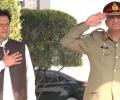
'With the extension issue settled clearly in his favour, Gen Bajwa would be free to fashion a more hardline policy against India. 'We could, therefore, expect a raising of the ante in Kashmir,' says Rana Banerji.

'The Battle of Jamalpur was a turning point in the 1971 War because a small battalion of 700 men broke the back of the Pakistanis.'
Imran Khan, Pakistan's cricketing icon and head of the Tehreek e Insaaf party, told a court in Britain that he was in support of the right of people to take up arms against their government if there was no democratic alternative before them, The Independent newspaper has reported

After Bharatiya Janata Party working president Jagat Prakash Nadda took out a march in Kolkata in support of the newly-enacted citizenship law, the party's West Bengal vice president Chandra Kumar Bose has raised his voice against the act and said India is a country "open to all religions and communities".

India is apprehensive about the Taliban's return as it would mean loss of access to Baluch rebels and help to the restive tribals of Waziristan. This would be a setback to the Indian strategy of returning the compliments of death by a thousand cuts to Pakistan, notes Colonel Anil A Athale (retd).

'I'm now living under threat, but life has to go on because as a soldier, you can't run away from it.'
On the evening of July 14 in Sharm El Sheikh, two days before the meeting between Dr Singh and Gilani, Pakistani Foreign Secretary Salman Bashir told Shiv Shankar Menon that India must delink the talks from terrorism, otherwise Pakistan will be forced to produce at least "three Indian Ajmal Kasabs" before the international media, who were directly or indirectly part of the terrorist activities in Baluchistan, reports Hamid Mir
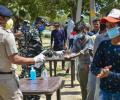
In a communication to his troops on the occasion of the 'Valour day' of the force, CRPF Director General (DG) A P Maheshwari asked them to be strong and fit for serving the country during these tough times.
A tribal leader in the restive Baluchistan has accused Pakistan army of using tanks and helicopter gunships to quell "agitation against outsiders."

'The India-Pakistan relationship is in a deep freeze, though it could be a lot worse had there not been a new LoC ceasefire a year ago.' 'The India-Pakistan relationship will only start to thaw if the Pakistani military decides it's prepared to push for detente.'

'The Citizenship Amendment Bill is a classic case of short-term gain over-riding long-term interest. 'We must welcome all persecuted minorities from our neighbouring countries and not just Hindus, Sikhs, Christians and Buddhists,' says Colonel Anil A Athale (retd).

'By causing military humiliation of India it intends to send a signal to other Asian countries to toe the Chinese line,' argues Colonel Anil A Athale (retd).

'Unlike the Chinese army that has been largely a peace time force, the Indian Army is a battle hardened force,' explains Colonel Anil A Athale (retd).
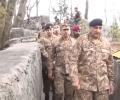
General Bajwa gets inputs from his senior officers, but he has the final word, notes Rana Banerji, who headed the Pakistan desk at the Research and Analysis Wing, India's external intelligence agency.
In the Middle East, which is already coping with the Qatar-Saudi Arabia tensions, comes another pressure point.

'The Pakistanis were lulled adequately to provide one of the fundamental prerequisites for successful execution of such an option: Surprise.' 'The other requisite: Deception in terms of selection of areas for launch/time of offensive action,' explains Brigadier S K Chatterji (retd).

It is time to forge a credible New Delhi-Srinagar axis, says Ajai Shukla.

During a war, there are just four possibilities a soldier faces. One: Victorious and safe. Two: Wounded. Three: Killed in action. Four: Prisoner of War. It was my fate to face the fourth, says Colonel Anil A Athale (retd) on the year spent as a prisoner of war in Pakistan during the 1971 War.
The government has returned to talks with Pakistan, but can it withstand pressure from a jingoistic press and a rabidly nationalistic social media.

Mithali Raj trained in classical dance for eight years until she decided one day it was time to follow her heart and exhibit footwork of another kind.
The 1965 war teaches us that war by escalation is a real possibility. Despite clear threats, Pakistan never believed that India will ever cross the international border. In the age of nuclear deterrence, this failure to deter Pakistan is the central lesson of 1965, says Colonel Anil Athale (retd).

'I want to be murdered at your hands, so I can live on in history. The verdict of who is or is not a traitor cannot be pronounced by a secret agency, but by history.' Pakistani journalist Hamid Mir, who survived an assassination attempt on April 19, challenges his enemies to dub him a traitor and says nothing will stop him from exposing them.

'General J S Aurora, the commander of the Indian forces in the East, asked General Sagat Singh to withdraw his troops who were on the move to Dacca -- but he refused.' 'He said, "Jaggi, over my dead body".' 'Therefore, I say the creator of Bangladesh was General Sagat Singh.'
 © 2026 Rediff.com - Advertise with us - Disclaimer - Privacy Policy - Sitemap - Feedback - About us - Terms of use - Grievances