
'Trust your new governor,' Omkar Goswami advises RBI Deputy Governor Viral Acharya. 'Just because he is from the IAS and doesn't carry a PhD from a US university does not make him unsuitable for the task.' 'If anything, Das will pour oil on troubled waters, and save the RBI's reputation.'

While Governor Das was sanguine on government walking the fiscal prudence path--which was missed three out of the five budgets of the Modi government--Acharya pointed to the fiscal slippages as a worry.
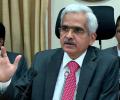
Das favoured shifting the stance of monetary policy from neutral to accommodative to send a clear signal, indicating that more measures could be taken in the near future to boost growth.

The meeting came amid a face-off between the central bank and the finance ministry over issues ranging from appropriate size of reserves that RBI must maintain to ease of lending norms to step up growth in an election year.
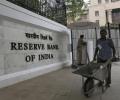
Economic Affairs Secretary Subhash Garg is the finance ministry's primary liaison with the RBI.

Senior bankers are trying to impress upon the central bank that the shift to external benchmark-linked lending be postponed to April 1, 2020.

The committee had eminent people on it and making any allegations like this is 'outlandish', Sitharaman said.

Economists praise Das for his pragmatism and willingness to face challenges head on. And in doing so with the finesse of an able administrator.
To a specific question on the change in RBI's stance from "neutral" to "accommodative", Das said it means that there will not be any rate hike from here on.

Patra, as executive director of the central bank, was the principal advisor to the Monetary Policy Department since July 2012.

If indeed the issues involved between the government and RBI are of immense public interest, why not make public the arguments of both the government and the RBI, irrespective of the outcome of the process, says Tamal Bandyopadhyay.However, the Act is silent on what happens if the governor's views differ from that of the government. If Patel does not want to budge from his stance the government can either see merit in the Governor's arguments and decide against going ahead with its plan or overrule him. My guess is that the issues raised by the government need to be sorted out not at the November 19 board meeting but between the Governor and the government, says Tamal Bandyopadhyay.

Delivering a public speech hours after the RBI launched a rescue act for Yes Bank on March 6, Governor Shaktikanta Das reiterated the RBI's affirmation to do whatever was needed to combat the coronavirus impact. On that day, India had only one confirmed COVID-19 infection, the World Health Organisation was five days off from declaring it as a pandemic and the financially debilitating lockdowns were not even on the horizon. Das' promise on efforts to mitigate COVID-19 impact appeared as a footnote in news reports from the event.

13 eminent economists, including former RBI governor Raghuram Rajan and current International Monetary Fund Chief Economist Gita Gopinath, in a report have asked the political establishment not to resort to populist tricks.
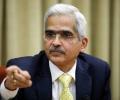
RBI governor Das flags growth slowdown, deputy raises alarm on inflation
'Three external members of the first MPC are respected researchers with excellent academic background, but there is no harm in considering academicians with diverse backgrounds such as finance and labour along with economists for this body,' recommends Tamal Bandyopadhyay.

The government wants the RBI to part with most of its profit as dividend.

The bank, however, maintained that the incremental benefit from the MCLR based lending rates introduced in April 2016 as an alternative to the earlier system of base rate, was positive.

The IL&FS management is also talking to its second-largest shareholder, Orix Corporation of Japan, to infuse more funds into the company - in case any shareholder backs out during the rights issue.
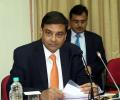
Relations between the Mint Road and North Block have often been frosty, with the former's calls for lowering rates being the biggest point of difference

The broad contours of their assignment are expected to be making independent assessment of recovery prospects, and estimating haircuts for restructuring cases.

'The solution is to enable a graceful transfer of the deposit and funding 'franchise' from capital-deficient firms to capital-surplus firms.' 'This will expand credit intermediation, bring down its costs, and put the financial sector on a definite path of recovery,' argues former RBI deputy governor Viral Acharya.

For his first Budget in July 2014, Jaitley inherited a fiscal deficit target of 4.1 per cent of GDP. From 4.1 per cent, the fiscal deficit came down to 3.4 per cent by 2018-19, with two slippages from the budgeted targets, in 2017-18 and 2018-19, the former due to introduction of the GST, says Arup Roychoudhury.

'Every few days, I wake up with a sense of restlessness that time is running out'... 'We have created a due process for stressed assets to resolve, but there is no concrete plan in place for public sector bank balance sheets,' says RBI Deputy Governor Viral Acharya.

Owing to Finance Minister Nirmala Sitharaman being new to her role, a number of crucial announcements in the Budget bore Garg's imprint, especially the decision to borrow in overseas markets, reduce the fiscal deficit as a percentage of gross domestic product, and resort to off-Budget borrowing to meet that target, says Arup Roychoudury.
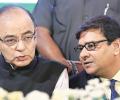
'The finance minister has messed up the economy.'
By no means do economists see the Reserve Bank of India stop at just a 25-bp cut. Some of the economists such as Soumyakanti Ghosh of State Bank of India are of the firm view that rates have room to fall by a total of 75 bps in the current financial year, starting with 25 bps in the August 7 policy.
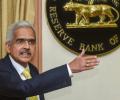
'His (Das) approach to work seems that of working as a team with ease in communication.'
RBI may also be open to injecting liquidity through open market purchases of bonds but is resisting relaxing capital buffers for banks.
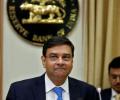
Governor Urjit Patel and his deputies spoke to the media about the central bank's decision to raise the repo rate.

Central bank moves to infuse liquidity into bond market to help boost sentiment.

Given Indian corporates's high indebtedness, new credit will be used for servicing loans rather than building factories. This is setting us up for more companies on life support and more zombie banks, warns Rahul Jacob.

Pressure has been mounting on the Reserve Bank of India to cut interest rates in the wake of declining retail inflation and the need to fuel growth momentum. However, the RBI will have to do a tightrope walk as globally interest rates are inching upwards.
North Block and Mint Road seem likely to now stick to the earlier convention of the RBI governor coming to Delhi and being the only MPC member meeting the finance minister and senior bureaucrats on pre-policy meetings
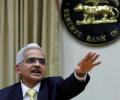
Probably in August. We can argue whether RBI is dovishly neutral or neutrally dovish but the telltale signs of at least one more rate cut are strewn all over the policy statement, points out Tamal Bandyopadhyay.

'But the world would be much poorer without economics' contribution to understanding how societies function and without economists' suggestions as to how politicians might improve them. 'And economists themselves could do wonders by simply incorporating the country-specific factors in their econometric models rather than just applying them in toto," say Soumya Kanti Ghosh and Samir K Jha.
The windfall from RBI may be used to trim borrowing, help fund Rs 3.3 lakh crore capex plan, capitalise banks and provide fiscal stimulus to some stressed sectors, experts and economists said.
The 'bad bank' -- which will help banks clear their balance sheets by transferring the NPAs to special purpose vehicles -- has been one of the most debated ideas for stressed asset resolution.

The RBI had in the past expressed its concerns about allowing foreign investors in short-term paper, because it attracted hot money.

Rather, the existing ones should be implemented speedily to clean up the mess.

There is as yet no clarity on how the process of consulting with the RBI Governor, initiated under Section 7 of the RBI Act, would unfold in the coming days. The government is keen that its suggestions made in the public interest should be heeded by the central bank, says A K Bhattacharya.
 © 2026 Rediff.com - Investor Information - Advertise with us - Disclaimer - Privacy Policy - Sitemap - Feedback - About us - Terms of use - Grievances