
This is the second high profile resignation in the past six months at the Reserve Bank of India.

A lack of adequate disclosures raises the financing costs of corporate firms, especially sub-investment grade ones, and keeps the capital markets small, believes RBI deputy governor Viral Acharya.
The finance ministry has received about 100 applications for the post, which have been sent to the high-level panel that will select a suitable candidate for the post, sources said.

Reserve Bank of India Deputy Governor Viral Acharya is the eighth economist to quit since the Modi government took office.

Hopefully, the grey world of central banking in a nation hit by demonetisation, will lighten up with some of his notes soon.
Acharya emphasised that the time is "really ripe" for land, labour and agricultural reforms in India.
Acharya was one of the youngest deputy governors in the central bank's history and was in charge of the critical monetary policy department which also made him a part of the rate-setting panel.
Governments that do not respect central banks' independence will sooner or later incur the wrath of the financial markets, ignite economic fires, and come to rue the day they undermined an important regulatory institution; their wiser counterparts who invest in central bank independence will enjoy lower costs of borrowing, the love of international investors, and longer life spans, said Acharya, who will return to the New York University's Stern Business School in August.

'Tilting at the Government in English in front of India may make him feel like Joan of Arc, but without a feel for Bharat he will merely be Don Quixote,' says S Muraleedharan, former managing director, BNP Paribas.
Be it bad loans resolution or his uncanny focus on inflation fighting which earned him criticism of being a policy hawk, Acharya was at the centre of it all and deftly steered the policy machinery.

Revising up inflation bands for the central bank will hurt the poor, former deputy governor of RBI Viral Acharya said on Wednesday, terming the current 4 per cent midpoint on price-rise as a "reasonable target".

"We firmly hold that undermining the central bank is a recipe for disaster and government must desist," All India Reserve Bank Association said in a letter. The association said Acharya's comments about the government's interventionist role vis-a-vis the RBI has created a flutter across the nation. "This is, however, not a sudden outburst, but was waiting to happen due to long simmering discontent," the association said.

The 42-year-old Acharya's appointment for a three-year tenure was cleared by the Appointments Committee of the Cabinet.

The price hikes during Covid were more because of supply chain and logistics disruptions caused by the pandemic and the Ukraine war rather than firms increasing prices because of higher pricing power, a report by State Bank of India (SBI) said. "It is thus incorrect to infer that concentration power dictated pricing capacity of firms, thus resulting in unyielding core inflation," the report authored by Soumya Kanti Ghosh, group chief economic adviser, SBI, said. A recent research article by former Reserve Bank of India (RBI) deputy governor Viral Acharya had observed that persistence of core inflation in India is due to purchasing power of top-five corporate houses.

The Reserve Bank (RBI) resisted a 'raid' planned by some in the government to extract Rs 2-3 lakh crore from its balance sheet in 2018 to meet populist spending in run-up to general elections, Viral Acharya, who was deputy governor at RBI at that time, has written.

The report said that "we believe, institutions are more important than individuals" and ultimately what is important is the credibility and the independence of any institution and nothing else.

Although this may not be music to Raghuram Rajan and Viral Acharya's ears, the real reason in my estimation for their quitting is expatriate over-sensitivity, intolerance or arrogance, argues B S Raghavan, the distinguished civil servant.
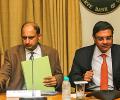
'It is likely the government may opt for an IAS officer.' 'For the government, an IAS officer will be more easy to deal with,' notes A K Bhattacharya.
Governments that did not respect the central bank's independence would sooner or later incur the wrath of financial markets, ignite economic fire, and come to rue the day they undermined the regulatory institution, Deputy Governor Viral Acharya warned.

The RBI working group's proposal to allow corporate houses to set up banks is a 'good-looking' step in a 'bad direction' and may lead to crony capitalism and eventual financial instability, former chief economist of World Bank Kaushik Basu said on Thursday. Basu further said that there is a good reason why all successful economies have a clear dividing line between industries and corporations on the one hand, and banks and lending organisations on the other.

The CIC's directive came while deciding on a plea by Lucknow-based activist Nutan Thakur, who had based her RTI application on some media reports that RBI deputy governor Viral Acharya in a lecture in 2017 had said accounts of some loan defaulters have been sent to banks for resolution.

'The concern that the bad bank may create a moral hazard for the system is extremely valid.'
Today, with growth having slowed and macro-economic challenges in every direction, would the government have benefited from the advice of 'Harvard' economists? asks T N Ninan.
If appointed interim head, Vishwanathan would head the central board meeting scheduled this Friday

Tension between the government, specially the finance ministry, and RBI is as old as the central bank itself.

With Deputy Governor Viral Acharya and another member Chetan Ghate voting for a status quo, RBI governor Shaktikanta Das and three others outvoted them for reduction in repo rate to 6.25 per cent from the existing 6.50 per cent.

'If the RBI board forces the management's hand on all the key issues, it should be prepared for resignations by the governor and the key deputy governor, Viral Acharya,' warns T N Ninan.

'There are deeper, underlying, forces at work and we need institutional arrangements to guard against them.'

'We get to know secrets such as some of India's top-rated firms do not always make payments when due and many State-owned, listed, enterprises that borrow in bond markets default regularly.' 'Without naming the bank, he says that ever-greening of poor loans by a part of India's shadow banking lay at the doorstep of India's banking, notably 'one private bank'.' Viral Acharya's Quest for Restoring Financial Stability in India won't be music to many ears, observes Tamal Bandyopadhyay.

Money permits patronage. Money means power. No wonder details of the crores locked up in NPAs and never repaid loans are top secret, Sunanda K Datta-Ray.

A paper authored by Rajan said, state-linked banks can be a first step in altering the ownership structure of some PSBs, where the government brings down its stakes to below 50 per cent, creating distance from operations of banks, and improving governance along the way.

Even the Central Statistical Office has started using GDP as the main measure of economic activities since January 15 this year
'Those who come from outside are surprised at the relatively small strength of the RBI supervisory cadre, relative to the needs of the country and the needs of the financial sector.'
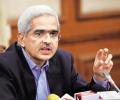
A staunch defender of demonetisation, it would be interesting to see how he handles the government's increasing demand for more cash from the RBI, and letting some weak banks get out of prompt corrective action.

A 10-hour RBI central board meeting, on November 19, decides to set up a panel on the economic capital framework for the central bank and directs it to give forbearances to small businesses.

'Only the coming years will tell whether the government finds this an easy way of relieving itself from its fiscal constraints.'

While there are several instruments in the RBI's disposal, the most effective one for infusing durable liquidity is bond purchase from the secondary market

The IMF expressed its opposition to any move that compromises the independence of central banks anywhere in the world.

'Without appropriate supervisory constraints in place, banks are in a position to delay the recognition of losses and engage in ever-greening or zombie lending, which is essentially the rolling over of debts of unviable borrowers that would have otherwise defaulted,' points out RBI Deputy Governor Viral Acharya.

'Trust your new governor,' Omkar Goswami advises RBI Deputy Governor Viral Acharya. 'Just because he is from the IAS and doesn't carry a PhD from a US university does not make him unsuitable for the task.' 'If anything, Das will pour oil on troubled waters, and save the RBI's reputation.'
 © 2026 Rediff.com - Investor Information - Advertise with us - Disclaimer - Privacy Policy - Sitemap - Feedback - About us - Terms of use - Grievances