
For a segment that thrives on promise more than performance, the country's start-up ecosystem is refusing to get carried away by the funding this calendar year. This has created the highest level of uninvested venture capital in seven years as investors wait for corrections in the working and - more importantly - valuation of start-ups while looking for cockroaches instead of unicorns. "Investors are now keen to invest in companies that have good top and bottom lines.

rediffGURU Chandu Nair advises entrepreneurs and enterprises about how to create and build their business.
Amid the funding winter, 128 Indian startups have raised over $995 million (around Rs 8,000 crore) venture capital funding in August, GlobalData said on Thursday. The funds raised in August are 9.7 per cent more than that in the previous month, the data and analytics company said in a statement. Aurojyoti Bose, Lead Analyst at GlobalData, said: "Although the total VC funding amount still remains below $1 billion akin to July, August managed to reverse the decline in fundraising, despite a 2.3 per cent fall in deal volume."

Investments by private equity and venture capital funds declined by 44 per cent to $3.7 billion in February compared to the same period a year ago, a report said on Monday. The bets by the long-term investors were 13 per cent lower when compared to the investments in the preceding month of January, the report by industry lobby Indian Venture and Alternate Capital Association and consultancy firm EY, said. "...rising global recession concerns, increasing cost of capital and mismatch in valuation expectations between sellers and investors are turning out to be major impediments in the deployment of capital," EY's partner Vivek Soni said.

'The deal pipeline across products is robust for 2024.'

'We look at the opportunities that are going to come in various fields in the next 5 to 10 years, do some research and come up with business plans.' 'Then, we go and seek out founders who will run the actual business.'

How do you avoid being laid off? If you have been let go, what should you do next? Ask rediff Career Gurus to find out.

The 'angel tax' provision in the Finance Bill will not impact startups in India, a senior government official said on Tuesday. Startups which are registered with the Department for Promotion of Industry and Internal Trade do not come under the purview, Anurag Jain, the secretary in the department said while speaking at the IVCA Conclave. "Let me put one thing very clearly. It doesn't affect startups in the least," he said, addressing the audience at the event organized by the venture capital industry lobby grouping.

Manipal Group chairman Ranjan Pai is in early discussions to invest in Byju's-owned Aakash Educational Services Limited (AESL). According to sources in the know, Byju's founder and chief executive officer Byju Raveendran, who owns a 30 per cent stake in Aakash, is expected to partially offload his holding to Pai for $80-90 million (about Rs 650-740 crore). Raveendran may use the money to repay a large part of the Rs 800 crore loan that Byju's raised from US-based investment firm Davidson Kempner Capital Management in May, after facing a 'technical default', the sources said.

Union Home Minister Amit Shah on Sunday accused the opposition Congress of harassing and insulting the Other Backward Classes during its rule at the Centre, and asserted that it was the Bharatiya Janata Party that gave the first OBC prime minister to the country in the form of Narendra Modi.

$47.6 bn capital invested across 921 deals in India in 2020, despite pandemic.

Several exchanges are facing a cash crunch with committed investment not coming from venture capital funds and trading activity seeing a sharp decline, reports Rajesh Bhayani.

The Indian startup ecosystem has lauded the inclusion of startups in the New Delhi Leaders' Declaration for the first time ever in the history of G20. Industry stakeholders say that the move will lead to easier access to capital, reduce regulatory hurdles, and may revive funding activity. The Declaration, through the Startup20 initiative, recognised startups as "natural engines of growth" and key to socio-economic transformation by driving innovation and creating employment.
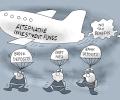
Alternative investment funds (AIFs) - pooled investment vehicles catering to high net worth individuals (HNIs) - saw a 30 per cent increase in investment commitments during financial year 2022-23 (FY23). At the end of March 2023, the total investment commitments raised stood at Rs 8.33 trillion, up Rs 1.92 trillion from Rs 6.41 trillion at the end of March 2022. A commitment is the money clients are willing to put into AIFs.
Indian start-ups are disrupting the world and women-based entrepreneurship is one of the vehicles for realising a more equal society, Niti Aayog CEO Amitabh Kant said on Monday. Addressing an event organised by FICCI Ladies Organisation (FLO), Kant further said India at present has more than 61,000 start-ups and 81 unicorns. "Indian start-ups are disrupting the world especially in new emerging areas of health, nutrition and agriculture," he said.

Billionaire Mukesh Ambani's children -- Isha, Akash and Anant -- on Monday were appointed on the board of his energy-to-technology conglomerate Reliance Industries Ltd, in what is seen as a clear path of succession planning at India's most valuable company.

Lauding India's ambitious space programme, The New York Times has said the country, currently witnessing an 'explosive' growth in space-tech start-ups, is set to 'transform the planet's connection to the final frontier' and can emerge as a 'counterweight' to China.

The recovering valuations, will lead to enhanced optimism among investors about funding startups.

Catamaran, the family office of Infosys founder Narayana Murthy, is targeting 15 per cent returns on its portfolio investments per annum as it shifts focus from early-stage investments to growth and late-stage bets. This would double the firm's assets under management (AUM) from the current $1 billion to $2 billion over the next five years. "For direct investments, we are focusing on growth-stage investments and very selectively on early stage," Deepak Padaki, president, Catamaran, told Business Standard. "(This is) primarily because the early-stage space in India, in the last three-four years, has completely changed. "There has been a huge influx of capital in the last two years. It has become a very crowded space for early-stage investment," he said.

We have the workforce, now we need to ensure that we take full advantage of game-changing technologies and geopolitical openings, suggests Jayant Sinha, chairman, Parliament's Standing Committee on Finance.

Sriram Krishnan, an Indian-origin technology executive, is "helping out" Twitter's new owner Elon Musk as he revamps the social media giant following its acquisition by the billionaire entrepreneur.

Investments by private equity and venture capital funds doubled to a record high of $9.5 billion in July mainly driven by higher investor interest in the e-commerce sector, a report said on Monday. Private equity (PE) and venture capital (VC) investments stood at $4.1 billion in the year-ago period. The activity was higher by 77 per cent when compared to June's $5.4 billion, the report on monthly PE/VC investment activity by industry lobby IVCA and consultancy firm EY said.

Nearly 9 out of 10 ultra-high-net-worth individuals in India saw an increase in wealth during in 2022, and the super rich expect their wealth to grow further this year, according to a Knight Frank survey. In its latest 'The Wealth Report: Outlook 2023', real estate consultant Knight Frank has revealed the findings of the global survey. Among Indian respondents, the consultant said 88 per cent saw a rise in UHNWI's (ultra-high-net-worth individuals) wealth in 2022.

The government has brought in changes to the investment pattern for non-government provident funds, and superannuation and gratuity funds, enabling them to invest up to 5 per cent in the units of Category I and Category II alternative investment funds (AIFs), subject to some caveats. The development is part of the central government's strategy to channelise domestic savings and improve their returns to attract more investment in the said sectors. At present, these funds typically invest a minimum 45 per cent in government securities, besides new instruments, such as exchange-traded funds and real estate investment funds, while a portion in equity-related instruments.

Meet Nilima Kalra, 79, Manju Roy, 80, Sumita Maan, 79, and Gurpreet Kaur, 75.

At least 14 of the top 20 venture capital (VC) and private equity (PE) funds in India reduced new deals with start-ups by a fifth in 2022. The number fell from 572 in 2021 to 456 this year, according to data from Venture Intelligence. Sequoia Capital, a leader in investments, retained its top slot but its number of deals fell from 110 in 2021 to 70 this year.

Companies don't have to be in the field to nudge people to return money they owe lenders.

Serena has backed early stage companies for nearly a decade.

As much as 35 per cent to 40 per cent of all vehicles sold in the country across segments will be electric by 2030, up from a mere 2 per cent this year, says a Bain & Co report released today. This translates to 14-16 million new electric vehicles (EVs) selling in a year. The inflexion point, which is now being seen month on month in many segments (such as two-wheelers which hit around 4-5 per cent in December), will be more than visible in 2026, when 4-5 million EVs across segments are expected to be sold, accounting for 15-20 per cent of the total sales, says the report.

Several Opposition leaders, including former Congress chief Rahul Gandhi, on Wednesday attacked the government over a media report claiming that a key Adani group investor is also co-owner with the conglomerate in a defence firm.

PEs and VCs are taking a closer look at their bouquet of investments. Leading voices in the sector are categorical that cash-burn rates -- that's blowing up equity to acquire market share -- as a business model can't continue to be the polestar.
The Indian economy has witnessed the creation of 28 unicorns, or startups valued over $1 billion, this year on the back of a series of reforms unleashed by the government, Finance Minister Nirmala Sitharaman said. Addressing a virtual conference organised by the Indian Private Equity and Venture Capital Association (IVCA), the minister said the Indian economy has witnessed a spur of unprecedented growth in the form of startups in the last two decades. The Department for Promotion of Industry and Internal Trade (DPIIT) has recognised more than 56,630 startups across districts throughout India, IVCA said in a statement quoting the finance minister.

There seems to be no dearth of funds to fuel this growth, report Peerzada Abrar and Shivani Shinde.
Deepening the funding crisis that startups have been witnessing for some time, the October inflows plunged 75 per cent on-year to $3.3 billion across 75 deals, including six large deals worth $2.2 billion, according to an industry report. Exits touched half of the inflows at $1.6 billion across 15 deals in the reporting months, a significant improvement over the previous month which saw just $653 million worth of exits across 24 deals, but 69 per cent lower on-year basis, according to the numbers collated by EY for the Indian Private Equity & Venture Capital Association, the umbrella body the PEs and VCs. However, the report said, on a month-on-month basis, the inflows continued to grow, clipping at 60 per cent over the September numbers.

Family offices are increasingly looking to invest directly in start-ups rather than through investment in venture capital (VC) firms. The shift is happening because of multiple reasons. Next-generation scions of wealthy families are conversant with how the start-up world works after they have spent time in Silicon Valley; start-up investment is rising to 10-15 per cent of family offices' portfolios from single digits; and they do not want to share gains of investment with VC firms. "While earlier they would prefer to invest in this asset class via venture capital (VC) funds as LPs (limited partners), now they are making direct investment in start-ups.

'India has the potential to do a lot more to take advantage of the time today where we stand to gain, geopolitically and in terms of market attractiveness.'

Investments by private equity and venture capital funds into Indian entities fell by 69 per cent to $3 billion during July, a report said on Wednesday. The investments in July are the lowest for any month in a year, and lower than the $4.9 billion recorded across 118 deals in the preceding month of June, the report by industry lobby IVCA and consultancy firm EY said. Going by the number of deals, July 2022 recorded 74 deals, as against 134 deals in the year-ago period, the report said.

'Should we shortchange our investors by exiting early?'
The drop was the result of the change in FDI rules, which was amplified by the border standoff between India and China.
On a cloudy Monday this month, Mohammed Irshad flew from Kochi to Gurugram to attend an exclusive investor networking event. Among a handful of founders selected for the event, Irshad was to pitch his peer-to-peer learning start-up Notespaedia for funding in front of top venture capital investors such as AngelBay, Elevation Capital, and Inflection Point Ventures. He failed to woo them, but the feisty entrepreneur was determined to continue his hunt.
