
China itself is now a point of concern for aluminium producers globally, including India.

We call it Nano, they don't have to, says vice-chairman Ravi Kant

India ranks 44th in the world in the IT industry competitiveness index 2008, moving 4 notches up from its 2008 ranking of 48 in the index.
The world's second-fastest growing economy may also see negative inflation for the next 3-6 months triggering expectation of rate cuts by banks, the research arm of London-based Economist added.
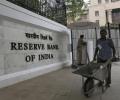
While RBI's foreign exchange reserves have swelled to over $400 billion, it has a 'sell' position of $981 billion.
Describing himself as "aam aadmi", Prime Minister Manmohan Singh says he has reached the top post because of his education which plays an important role in moulding one's life. "I am an aam aadmi (common man). If I can become the Prime Minister, then so can you.
The Economist Intelligence Unit survey, commissioned by Dubai Holding, found that almost 60 per cent respondents believe that capitalism is entering a new era of lower risk tolerance, higher regulation and slower growth.
The LTTE certainly did not expect to fade into oblivion, their leader Velupillai Prabhakaran a fugitive. A couple of years ago, the Tigers were rampant, scoring victories on land and sea, and terrorising Colombo with their makeshift air force. What turned things around? Probably much covert aid from governments, including India's, wary of the Tigers' propensity for redrawing boundaries by force
Although more economic research has been done in the past 25 years than ever before, the economists whose names are most frequently referenced today, such as Hyman Minsky and John Maynard Keynes, are from earlier generations.
India needs to work on economic parameters to outpace China.

'India is the largest stomping ground in the world for impact investing as we have an extraordinary combination of entrepreneurial drive with huge, absolute demand for all kinds of social services,' IDFC First Bank's chief Rajiv Lall tells Anjuli Bhargava.

Gambhir also took a dig at Qureshi's emphasis on a "new Pakistan" under Khan, saying while the Indian delegation had come to listen to Pakistan's "new" foreign minister outline the vision of a new Pakistan, "what we heard is a 'New Pakistan' cast in the mold of old."

Several factors force women out of the workforce. But mainly it's lack of good childcare facilities.
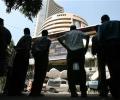
The 30-share Sensex ended down 224 points at 28,442 and the 50-share Nifty ended down 101 points at 8,606.
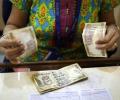
Average policy rate over the next three years should be around 7.4%
Indian economy is expected to grow between 7 and 7.4 per cent in the three months up to September 2008, as against 9.3 per cent in the year-ago quarter, five top economists of the country told Business Standard. The government is slated to release the quarterly numbers on Friday.

'The civil war in Islam has just got worse and the existential crisis facing it more threatening.'
The world needs more regulation today, not a return to autarky
Allocations for new projects have diminished in relative importance, but policy pronouncements continue to have an impact. To come straight to the point on outlays, the table shows that against the country's requirement of $100 million per annum (as per the 11th Five-Year Plan), the Union Budget is able to provide only about 5-6 per cent of the requirement in 2008-09. How does this 5-6 per cent come about?
India is the largest recipient of remittances, which touched $23.4 billion in 2006.
Sadly, the WTO is not in a position to stop the damage caused by dominant players due to its namby-pamby pilots!
There is abundant evidence that the Indian economy is not overheating. So stop the presses from broadcasting this now absurd conclusion.

He noted that it would take a long time for turn around the current situation in India

Senior bureaucrats say the government has planned a 'feel-good' Budget after the 'pain' of demonetisation.
Arvind Panagariya's recent book, though remarkable, has been one-sided in some respects.
The World Bank's statisticians have changed the economic facts. Under these circumstances, Keynes, the economist, would have us change our opinions, while the great scientist, Einstein, would have us tamper with the facts especially if they clash with our theoretical priors. Which should it be? A little bit of both, it seems.

Very high GDP growth which is driven by lots of concessions to large corporates.
A club of the world's leading nations is starting to look hollow without China - the fourth-largest economy in dollar terms, according to the World Bank

'We have 100,000 students going abroad every year.' 'So, we have room for at least 100 universities of very high quality to service those 100,000 students.'
Economists urged FM to rationalise indirect taxes and impose Tobin tax.

In IT, the two-way flow of investments and intellect has been central to the growing linkage, which provides a great opportunity for both nations to improve the quality of life of their citizens, says Raman Roy.
India's economic growth rate is expected to moderate to 7.8 per cent in 2008-09, mainly on account of a global slowdown, says the Economist Intelligence Unit (EIU), an arm of London-based magazine Economist.Despite moderation in growth, India would continue to remain the second-fastest growing economy in Asia, said senior economist and Asia Editor of the EIU Anjalika Bardalai while briefing reporters ahead of the 13th business round table with government officials.
In an economically buoyant India, expensive jewellery is the in-thing.

If Mr Modi and his team expect to win the 2019 elections, groundwork for improved performance in their second term should be done now.
Now, economists are famous for having a wide array of views, with most of them being wrong, but it is difficult not to notice that economists working for companies that will benefit the most from -- and, in some cases, desperately need -- lower interest rates are the ones that are screaming most loudly about how terrible things are and how the US Fed needs to cut, cut, cut rates.
Asia Pacific countries are giving a tough competition to the US and Europe when it comes to attracting and nurturing talent says the Index developed by executive search firm Heidrick and Struggles and the Economist Intelligence Unit.
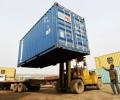
Exports in February fell to $21.55 billion compared with $25.35 billion a year ago
In an interview to CFO Asia, a publication of The Economist Group, Montek Singh Ahluwalia said the general public was opposed to privatisation of state-owned enterprises although they feel that public sector was inefficient and corrupt.
In the event of a dramatic tightening of credit, some of the sources of capital like Foreign Institutional Investors, Foreign Direct Investment and External Commercial Borrowing, could dry up.

Silicon Valley venture capitalist Vinod Khosla has earned a year's worth of bragging rights -- he is the only person of Indian origin to feature in Vanity Fair's annual power list of 100 most influential people.
 © 2026 Rediff.com - Advertise with us - Disclaimer - Privacy Policy - Sitemap - Feedback - About us - Terms of use - Grievances