
The Reserve Bank of India (RBI) on Wednesday kept its policy interest rate unchanged at 5.5 per cent for the second consecutive time, citing concerns over tariff uncertainties.

From the Sensex firms, HCL Tech, Infosys, Power Grid, Tata Consultancy Services, HDFC Bank, Hindustan Unilever, Bharti Airtel and ICICI Bank were among the major laggards. However, Titan, Larsen & Toubro, Maruti and Axis Bank were among the gainers.

China's ruling Communist Party is holding its annual leadership conclave to discuss the new five-year plan, the impact of US President Donald Trump's tariff war, and the ongoing anti-corruption crackdown in the military.

The Gems and Jewellery Export Promotion Council (GJEPC) has urged the Centre to provide immediate relief measures as the tariffs imposed by the United States have started hitting the industry. US tariffs of 50 per cent on Indian goods came into effect on August 27.

Trump's post on Truth Social comes a day after the US asked G7 countries to impose tariffs on countries purchasing oil from Russia.

The rupee, which was the worst performing Asian currency in 2025 and also in January, was the best performing Asian currency on Tuesday.
Former White House official John Bolton suggests that tariffs imposed on India by the US for purchasing Russian oil may have unintended consequences, potentially driving New Delhi closer to Beijing and Moscow.
The US has temporarily permitted India to accept Russian oil already on ships to ensure energy supplies amid the conflict with Iran. This short-term measure is not expected to significantly benefit Russia financially.

Foreign Portfolio Investors (FPIs) remained in a selling mode in January, withdrawing nearly Rs 36,000 crore (about $3.97 billion) as global uncertainties persisted. Meanwhile, a higher securities transaction tax (STT) proposed in the Union Budget may weigh on overseas investor participation in the near future.
On August 7, the US president announced doubling tariffs on Indian goods to 50 percent for India's purchases of Russian crude oil, but gave a 21-day window to negotiate an agreement.

'The biggest point of contention is market access for US agricultural and dairy products.'

Greer said that India has taken down some digital services taxes and is moving tariffs down.

The statement did not name any country. But the US has often blamed India and China for purchasing Russian oil even when there are no tariffs on Beijing for it.

Foreign portfolio investors (FPIs) withdrew a substantial amount from Indian equities in the first half of March, driven by geopolitical tensions, rupee depreciation, and concerns about crude oil prices.

United States President Donald Trump has brushed aside French President Emmanuel Macron's call for an emergency G7 meeting amid escalating tensions over Washington, DC's push to acquire Greenland, while Europe has warned of retaliatory trade action against US tariff threats.

The European Union (EU) has suspended export benefits to sectors such as textiles and plastics under a preferential scheme for India and two other countries from January 1, a move that will impact the country's shipment to the 27-nation bloc. The development is important as the two sides are likely to announce the closure of negotiations for a free tarde agreement (FTA) on January 27.

India will maintain multiple sources for crude oil purchases and diversify them to ensure stability in the supply chain with national interests remaining the "guiding factor" for the procurement, Foreign Secretary Vikram Misri said.
'It's important for India to think about areas where it wants the US to move.' 'We can be far more innovative in what we ask the US.' 'Given that there's a package deal, why not do it?'
"India was charging us tremendous tariffs, about the highest in the world," Trump said adding that the US was therefore not doing much business with India.

Among Sensex firms, Tech Mahindra, HCL Tech, Eternal, Axis Bank, Maruti, Tata Steel, HDFC Bank and Asian Paints were the gainers. However, Adani Ports, Trent, Tata Motors, Hindustan Unilever and NTPC were among the laggards.

Uttar Pradesh's leading export hubs are reeling under the impact of a steep 50 per cent tariff imposed by the US on Indian imports, with exporters warning of job losses, stalled orders and shrinking market access. Industry leaders from Noida, Kanpur and Varanasi said the tariff has put years of painstaking market-building at risk, even as protests and demonstrations erupted in several districts last week.

The United States action of levying 25 per cent additional tariff on Indian goods is 'unfair, unjustified and unreasonable', India said on Wednesday in a firm reaction, signalling increasing tensions between the two strategic partners over New Delhi's energy ties with Moscow.

Stock market benchmark indices Sensex and Nifty surged in early trading session on Tuesday after India and the US agreed to a trade deal under which Washington will bring down the reciprocal tariff on Indian goods to 18 per cent from current 25 per cent.

President Trump is celebrating the US-India trade deal as a landmark achievement, with a major focus on boosting American coal exports to India and other trade partners.

The textile and apparel sector is India's second-largest employment provider, after agriculture, and it is now caught in a wave of uncertainty following the Donald Trump administration's tariff policy.

Meeks, a ranking member of the House Foreign Affairs Committee Democrats, on Wednesday (local time) underscored "Congress' support for the US-India partnership," following his meeting with Indian Ambassador to the US Vinay Mohan Kwatra.

India's merchandise exports experienced a slight decrease in February, while imports surged due to increased gold and silver purchases, leading to a widened trade deficit. The West Asia crisis is expected to further impact trade in the coming months.
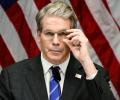
United States Treasury Secretary Scott Bessent has warned that the secondary tariffs on India could go up if 'things don't go well' during talks between President Donald Trump and Russian President Vladimir Putin in Alaska on Friday.

India has been on an FTA-signing spree of late. Since 2021, it has signed eight trade agreements, three of which -- with the UK, Oman and New Zealand -- were finalised in 2025 alone.
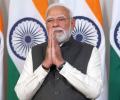
Modi's remarks came hours after the US and India agreed on a trade deal under which Washington will bring down reciprocal tariff on Indian goods to 18 per cent from current 25 per cent.
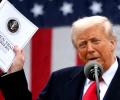
Chief Economic Advisor V Anantha Nageswaran on Thursday said he expects that a solution to the tariff issues with the US is likely to be arrived in the next eight to ten weeks.
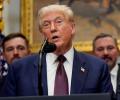
The United States announced a 25 per cent tariff on India as the White House released an expansive list of duties that Washington, DC will impose on exports from countries around the world.

Sitharaman in her budget speech said that the customs proposal "aim to further simplify the tariff structure, support domestic manufacturing, promote export competitiveness, and correct inversion in duty".

Ukrainian President Volodymyr Zelenskyy has backed the imposition of tariffs on countries maintaining economic ties with Russia, saying it is the 'right idea' in the face of continued aggression by Moscow.

US President Donald Trump greeted India on its 77th Republic Day, highlighting the historic bond between the two democracies amid ongoing trade tensions.

Exporters of gems and jewellery have said the free-trade agreement (FTA) has brought relief to their sector because this opens up the world's second-largest market and brings them on a par with China and Thailand, which face zero tariffs on shipments to Europe.

Customs regimes can lead to labyrinthine legal disputes. Budget 2026 must recognise that an excessively defensive Customs posture can itself become a trade barrier, point out Mukesh Butani and Shankey Agrawal.

India's economy experienced a growth of 7.8 per cent during the October-December quarter of 2025-26, according to the new series of national accounts with 2022-23 as the base year.
According to the Economic Survey 2026, the appropriate stance for 2026 is therefore one of strategic sobriety rather than defensive pessimism.

In the wake of the FTA between India and the European Union, the United States has described the Europeans as 'very disappointing', saying they were unwilling to join Washington, DC in putting tariffs on New Delhi for its purchases of Russian oil because of this trade deal.
