
Once the OS layer is opened to the State, it doesn't close, notes Lieutenant General Prakash Katoch (retd).

Top Indian military commanders highlight the success of Exercise Trishul in enhancing jointness and interoperability among the Army, Navy, and Air Force. The exercise, culminating in Amphex 2025, involved 30,000 troops, multiple aircraft, and naval vessels, including INS Vikrant.
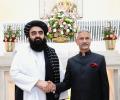
Developing relations with the Taliban is needed, but plunging headlong into Afghanistan without due thought will be akin to the rooster entering a KFC outlet, warns Lieutenant General Prakash Katoch (Retd).
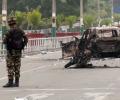
Having control over both digital media and NGOs, it was easy for the US to topple the government and destabilise Nepal -- to undercut Chinese influence and pressure India, argues Lieutenant General Prakash Katoch (retd).
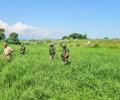
'Why have we failed to address the issue of ensuring a requisite buffer zone in J&K, given that cross-border links of some J&K politicians are known?', asks Lieutenant General Prakash Katoch (retd).
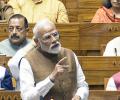
What was the aim of Operation Sindoor? Why was the operation halted so soon? asks Lieutenant General Prakash Katoch (retd).
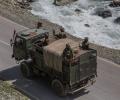
The strengthening of the Mountain Strike Corps is part of the steps taken by the force to rebalance its focus more towards the Chinese border from the western front with Pakistan.
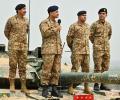
United States President Donald Trump will host Pakistan Army chief Asim Munir for lunch at the White House on Wednesday.

'India has gone some way to meeting its objectives because it has established a deterrent value that Pakistan will have to take into account when it plans future terrorist attacks.'

While the new Strike Corps is being raised, equipped and trained, the government must make vigorous efforts to speed up the completion of infrastructure projects. Otherwise, the army will have a new Strike Corps and not be able to launch it effectively, says Gurmeet Kanwal

The new 17 Strike Corps with 80,000 troops and a budget of Rs 64,000 crore will provided the much-needed offensive capacity against China. R S Chauhan reports.

Terrorism and insurgency in J&K had subsided when India demolished East Pakistan -- for the simple reason that Pakistan understands power. We need to follow Chanakya's dictum of Saam, Daam, Dand, Bhed for strategising against Pakistan, asserts Lieutenant General Prakash Katoch (Retd). The ground truth is that unless we are prepared to acknowledge our shortcomings, including massive intelligence failures, punish those responsible and take corrective actions, we will continue in the same vein, asserts Lieutenant General Prakash Katoch (Retd).

'The necessity of a Mountain Strike Corps is well understood. The problem is in implementing the intention.'
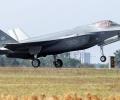
We need to equip the Indian Armed Forces, not 'commercial' as Trump wants, but 'operationally' looking at growing Chinese military capabilities, asserts Lieutenant General Prakash Katoch (retd).

However, flow of funds, would naturally rest on economic growth, reports Ajai Shukla.
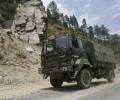
China has reacted cautiously to India's proposal for the establishment of mountain strike corps along the Sino-Indian border, while the official media in Beijing ignored the development.

'Our politicians solely depend on bureaucrats who are unaccountable and follow their own agenda.' 'Our politicians would dare not dream of establishing a DOGE,' argues Lieutenant General Prakash Katoch (retd).

China does not have to give up what it took in 2020, it will never give up its claim to Arunachal Pradesh, Ladakh and other areas, and it has all the time now to plan its next surprise, points out Lieutenant General Prakash Katoch (retd).
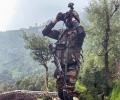
Pakistan may want to undertake a 'false flag' operation in J&K to divert attention from the situation in Balochistan and Khyber Pakhtunkhwa but infiltrating one SSG battalion into J&K and having two SSG battalions waiting to follow suit means war, which Pakistan cannot afford in its current economic crisis, notes Lieutenant General Prakash Katoch (retd).

'With continued focus on votes, upcoming by-polls and purchasing politicians, the political hierarchy has little time for national defence.' 'They would do well to heed a veteran scholar, who says, "There will be war with China in the next few years. The next full scale war will have the involvement of Pakistan and terror elements, insurgents and intelligence assets operating inside India",' warns Lieutenant General Prakash Katoch (retd).

Disengagement from the LAC will remain a chimera because China has given enough indications that the PLA will not move back any more. China has even deployed drones to monitor and deny any patrolling by Indian troops even in the buffer zones which are all in Indian Territory, explains Lieutenant General Prakash Katoch (retd).

'It is in the interest of China and Pakistan to give a bad name to the Indian Army and remove AFSPA 'completely' from the north east.' 'Hopefully, better sense will prevail and the ground realities of the army countering insurgency in the north east acknowledged,' asserts Lieutenant General Prakash Katoch (retd).

'China will do everything to hamper our ability to be a competitor.' 'China wants every country in the region to be subservient and we are the biggest stumbling block.'

DRDO's failures over the decades have contributed significantly to India becoming the world's biggest weapons importer, points out Lieutenant General Prakash Katoch (retd).
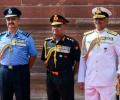
India has allocated Rs 1.72 trillion, or 27.67 per cent of the total defence budget to cater to modernisation of the country's arsenal. Modern militaries spend up to 50 to 60 per cent of their total defence budget so that they go into combat with superior weaponry and equipment.

The Taliban government in Afghanistan is not going anywhere. That being the case, why is the hesitation to establish formal diplomatic relations with the Taliban? asks Lieutenant General Prakash Katoch (Retd).
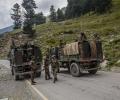
The military standoff with China has been going on for over two years now when the Chinese side attempted to change the status quo unilaterally by moving troops in large numbers against Indian positions.

In all likelihood, the next conventional Chinese attack on India would be preceded by a massive cyber attack designed to cripple Indian networks and interfere with our disaster-relief programmes.
Army Chief Gen Bikram Singh is expected to take up the issue of raising an offensive Corps including around one lakh soldiers along the China border in a presentation soon to Prime Minister Manmohan Singh on the shortages faced by the 1.3 million-strong force.
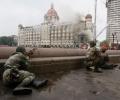
In the book 10 Flashpoints: 20 years that is set to be released on December 2, the former union minister has looked back at the security situations that have impacted India in the last two decades.

Until last month more than two-thirds of the Indian Army was deployed against Pakistan. Of 14 army corps, just four-and-a-half faced China, while more than twice that number was ranged against Pakistan.

16 Indian Army divisions face China, 20 face Pakistan and two divisions are reserves. This powerful signal can hardly be missed in China or Pakistan, notes Ajai Shukla.

His attack on the government came days after Indian Army personnel clashed with Chinese soldiers in the Tawang sector in Arunachal Pradesh.

The army has long been deficient in artillery, the modern battlefield's most lethal killer, says Ajai Shukla.

Keeping the contents of the BBC documentary aside, Rishi Sunak's response needs to be viewed in the backdrop of Britain's historically close relations with Pakistan, argues Lieutenant General Prakash Katoch (retd).
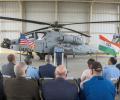
Its advanced Longbow radar picks up enemy armoured vehicles and then destroys them with anti-tank missiles, air-to-surface rockets or a chain gun that sends 625 rounds per minute ripping into the targets.


'Dear Adhir Ranjan Chowdhury dada, the screenshots of the tweets addressed to Defense Minister Rajnath Singh below hope address your concern and criticism also'

Gen Naravane said that the Indian Army did not hide casualties during Galwan clash in eastern Ladakh as the Chinse have done.

Ahead of Director-General of Military Operations-level talks next week, an elite Strike Corps of the Indian Army carried out wargames near the India-Pakistan border involving over 15,000 troops and over 100 tanks.
 © 2026 Rediff.com - Advertise with us - Disclaimer - Privacy Policy - Sitemap - Feedback - About us - Terms of use - Grievances