
'Why have we failed to address the issue of ensuring a requisite buffer zone in J&K, given that cross-border links of some J&K politicians are known?', asks Lieutenant General Prakash Katoch (retd).
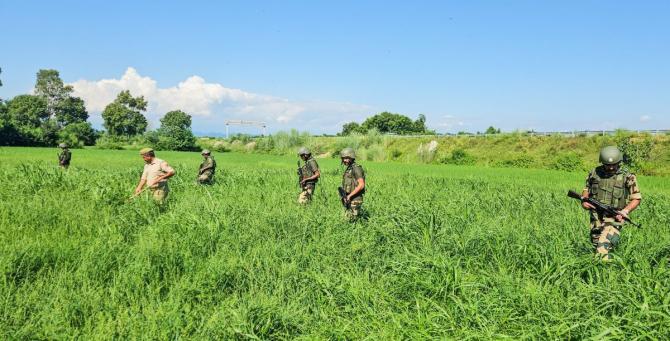
Addressing a two day workshop on the Vibrant Village Program on August 26, 2025, Union Home Minister Amit Shah urged collectors/district magistrates of border districts to take appropriate action to remove illegal encroachments within a 30 km radius of the border, including religious structures that often come up as 'part of a deliberate design' to alter demography surrounding areas.
Shah cited Gujarat, saying it had cleared numerous encroachments along both the maritime and land borders.
The workshop was reportedly attended by Minister of State for Home Bandi Sanjay Kumar, senior home ministry officials, Intelligence Bureau Director Tapan Deka, chief secretaries of border states covered under the VVP, director generals of Central Armed Police Forces deployed on the border and collectors of border districts.
Prime Minister Narendra Modi, during his Independence Day speech from the Red Fort on August 15, 2025, had flagged demographic changes in border villages caused by illegal immigration.
Amit Shah drew attention of the attendees at the VVP workshop to the population rise in Arunachal Pradesh border villages since the launch of the VVP, saying locals would not seek to migrate if they got facilities and employment opportunities in their own village.
If initiatives like homestays were extended to border villages and state tourism departments made proper arrangements for bookings, Shah said every household would have employment.
The problems of illegal immigration leading to demographic changes is all pervasive, not limited to the north eastern states and Gujarat, which India has been confronted with over the past several decades, with adverse effects in insurgency-prone areas, as well as inimical actions by such illegal immigration.
Nine Bangladeshi nationals, who entered India illegally, were arrested from Meghalaya in February 2025, as reported in the media.
Subsequently, media reports of August 10 stated that some Pakistani and Bangladeshis were arrested in Meghalaya from border villages.
Now Assam's Chief Minister Himanta Biswa Sarma says elements from Bangladesh are provoking unrest around the Chicken's Neck area.
The VVP workshop and Amit Shah's dictum to not allow illegal immigration and demographic changes within 30 km of the border has raised questions why this has not been implemented along our western borders, particularly in Jammu and Kashmir.
The response to this from a veteran army officer on social media reads as follows: 'It's not even funny. These guys have settled down close to the Line of Control along the nullahs. Some have wives across the border and also on the Indian side around the Uri sector.
'Yours truly was tasked to go around Baramulla district and find out the number of Ex Servicemen.
'Mind you of the 120 men, about 48 had served in the Pakistan army.'
Such a state of affairs can hardly be taken lightly. Why has this not been addressed all these years?
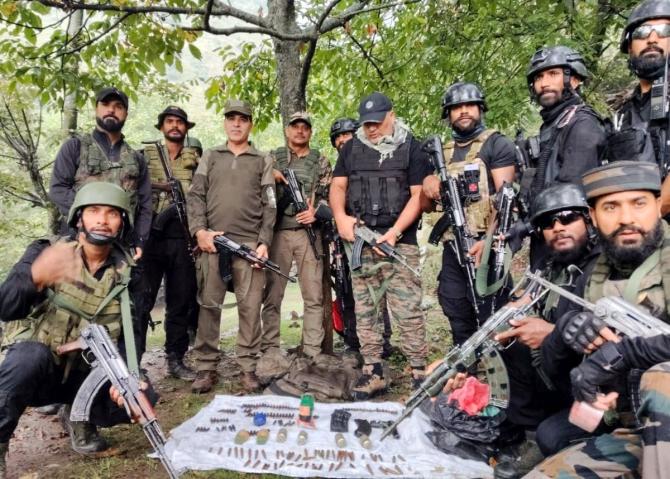
J&K also has the problem of isolated houses close to the Line of Control that are used by Pakistani infiltrators as transit, especially in adverse weather conditions.
In addition are few villages proximate to the border, which are periodically infested by terrorists because of the availability of support bases/sympathisers.
In 2000, Farooq Abdullah, then the J&K chief minister, while addressing a premier educational institution for senior military and civil officers in New Delhi, was asked by a foreign military officer as to why such villages that harbour terrorists because of their proximity to the border have not been moved into the hinterland in order to provide a safe buffer zone against cross-border infiltration.
Abdullah's reply was he had told the central government that Rs 100 crore is required to shift one such village but there was no response from the government.
J&K has been under governor's rule periodically, the Bharatiya Janata Party has been part of a coalition government in J&K, then there has been lieutenant governor's rule, even now overshadowing the state government.
So, why have we failed to address the issue of ensuring a requisite buffer zone in J&K, given that cross-border links of some J&K politicians are known?
Won't the expenditure on a buffer zone be compensated by reduced deployment of security forces within J&K?

Take our border with Bangladesh. There has been proof in the past of the ease with which Bangladeshis enter India illegally.
A recent video clip reconfirms how easy it is to infiltrate the India-Bangladesh border (external link).
Why is this happening with the BSF manning the border, which is directly under the home ministry, and all the noise about technology being optimised for counter-infiltration?
Are the prime minister and home minister blaming only state governments for the illegal infiltration? Is money aiding illegal infiltration?
What is the accountability of the BSF, the Intelligence Bureau, the Research and Analysis Wing, the home ministry and the Centre?
Finally, it should be more than evident that merely passing a general order to counter illegal immigration leading to demographic changes and removing illegal encroachment within 30-km radius of the border, following concerns raised by the prime minister about demographic changes in border villages caused by illegal immigration, is hardly a solution if we are serious about national security.
The requirement is of a holistic assessment of what needs to be done, along with a timed plan for implementation.
Lieutenant General Prakash Katoch (retd), PVSM, UYSM, AVSM, SC is a former Special Forces officer.
He is a third generation army officer and participated in the 1971 India-Pakistan War and in Operation Bluestar.
He commanded a Special Forces Battalion in Sri Lanka, a Brigade on the Siachen Glacier, a Division in Ladakh and a Strike Corps in the South Western Theatre.
Feature Presentation: Aslam Hunani/Rediff.com








 © 2025