The second such dialogue is aimed at discussing ways to enhance investments and business engagement between the two of the fastest growing economies, significantly at a time when the western world is in deep crisis.

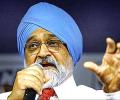
Montek welcomes investment in infrastructure; deals worth over $5 billion signed at the 2nd India-China Strategic Economic Dialogue.

The memoranda of understanding were signed during a day-long 2nd India-China Strategic Economic Dialogue in New Delhi.

India and China will be holding the second Strategic Economic Dialogue in Delhi later this month with an aim of enhancing business engagement between the two of the fastest growing economies, significantly at a time when the western world is facing crisis.

As China's ruling CPC appointed 'fifth generation' leaders headed by Xi Jinping, high-level Sino-India contacts are set to resume this month starting with the Strategic Economic Dialogue, which would be followed by a likely visit of National Security Advisor Shivshankar Menon in Beijing.
Holding their first comprehensive Strategic Economic Dialogue (SED) in Beijing on Monday, India and China have reached an understanding to deepen bilateral investment cooperation, further open up markets to each other and improve the investment environment.

Both India and China are in Phnom Penh to participate in the two-day East Asia Summit, an offshoot of the Asean meet. China and India, along with the US, Russia, Australia, New Zealand, Japan and South Korea are participating countries in EAS, besides the 10 Asean members.
More than 200 Indian companies have invested in China.
Chinese Premier Wen Jiabao on Monday proposed collaboration between India and China in global fora like World Trade Organisation and G-20 and in the financial sector, as top planners of the two countries had a "productive" round of talks at the first Strategic Economic Dialogue in Beijing.
China's surplus foreign exchange reserves and India's long-term fund requirement complement each other.

Ahluwalia said India is also interested in stepping up cooperation with China on railways development.

This will be the fourth visit of Modi to China after he came to power in 2014.

In the October-December quarter, India's economy grew below expectations at 4.7 per cent on falling output in the manufacturing sector.
Under Railways, the two sides agreed to pursue specific collaboration arrangements in heavy haul, station redevelopment and raising speed of existing trains in India.

However, there will be no bilateral meetings between Swaraj, Sitharaman with their Pakistani counterparts.
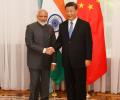
'The fact that Modi and Xi exuded confidence to accelerate the negotiations for a border settlement alone underscores that the Russia-India-China triangle has become very dynamic,' notes Ambassador M K Bhadrakumar.

India and China ties are likely to enter into a "new age of cooperation" especially in trade in view of Prime Minister Narendra Modi's knowledge of Chinese investment promotion and his plans for economic reforms, according to an official think-tank in Beijing.
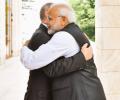
Modi said India and Russia have been friends for a long time and thanked Putin for inviting him for the first-ever informal meeting at Sochi.

India and China met and spoke a lot this year, but failed to produce any meaningful results.
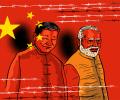
'An opportunity is at hand to think big and recast the India-China relationship on a new template, which would help the pursuit of our country's dream of major power status,' says Ambassador M K Bhadrakumar.

There are still a few lingering issues towards the progress of India-China bilateral relations, the approach for dealing with each other seems to be quite different. With Modi-Xi bonhomie strengthening, it seems that India and China are ready to recalibrate their approaches towards each other, says Sana Hashmi.

Prime Minister Narendra Modi had gone to China with a bagful of initiatives, but not all seems to have been fulfilled given China's reluctance to go the whole hog with him
 © 2026 Rediff.com - Investor Information - Advertise with us - Disclaimer - Privacy Policy - Sitemap - Feedback - About us - Terms of use - Grievances