
Equity benchmark Sensex slumped 400 points on Wednesday tracking losses in index majors HDFC twins, Kotak Bank and TCS amid a weak trend in global markets.

Accenture's Q1 FY22 results have sent a wave of cheer among analysts, as the company raised its revenue guidance and said it expects double-digit growth in outsourcing, up from single digit to low double-digit growth expected earlier. Accenture's financial year ends on August 31. The company raised its revenue outlook for FY22 to 19-22 per cent in local currency, up from 12-15 per cent earlier.

'If Covid peaks at around 250,000 cases, I don't see the market fall much. If it becomes uncontrollable and goes up to 600,000 a day, then the market may fall.'

Titan, NCC, Delta Corp, Karur Vysya Bank, Aptech, and Jubilant Life Sciences are among stocks in Jhunjhunwala's portfolio that have taken a severe hit, falling more than 50 per cent during the period.

The stellar rise in corporate earnings in financial year 2021-22 (FY21) and FY22 did not result in a corresponding boom in capital expenditure (capex), with listed companies' investment in fixed assets rising just 2.3 per cent year-on-year (YoY) in FY22, growing at the slowest pace in the last six years. In comparison, the firms' combined net profit jumped 63.5 per cent YoY in FY22, while net sales increased 31.1 per cent - the fastest pace in over a decade. The 955 non-financial companies in Business Standard's sample reported combined net profit of Rs 7.18 trillion in FY22, compared with Rs 4.39 trillion in FY21 and Rs 2.59 trillion in FY20.

The flows may stem and redemptions pressure increase following the market meltdown of Monday amid mounting cases of coronavirus infection globally.

Infrastructure funds, which bet on stocks closely linked with infrastructure development in the country, have emerged as one of the best-performing categories over the past year. They have generated an average return of 90.63 per cent - the third-best, after technology funds and small-cap funds. Of the 21 schemes in the category, seven have given a return of more than 100 per cent in a year.

Investor wealth surged Rs 602,001.9 crore in two days of market rally which was supported by positive global cues. The 30-share BSE index on Tuesday closed at 50,136.58, an increase of 1,128.08 points or 2.30 per cent. During the day, it gained 1,259.95 points to touch 50,268.45. On Friday, the benchmark had closed 568.38 points higher. Markets were closed on Monday for Holi. Driven by the rally, the market capitalisation of BSE-listed companies soared Rs 602,001.9 crore to Rs 2,04,77,472.33 crore in two trading days.
So far in 2017, the Nifty has gone up by 22.4 per cent.

Investor wealth slumped by Rs 3.7 lakh crore on Monday, as the equity market recorded its biggest single-day fall in two months.

Investors who cannot manage an asset-allocated portfolio or rebalance regularly, or do not have an advisor, may opt for these funds, but only after a detailed study of their strategy, suggests Sanjay Kumar Singh.

From hitting the 1,000-mark on July 25, 1990 to reaching the 60,000-mark for the first time on Friday, it has been a historic and memorable journey for the benchmark index Sensex. It has taken a little over 31 years for the Sensex to traverse from 1,000 level to the famed 60,000 level now. Over the years, the frontline index has climbed several record levels. The index had reached the 10,000-mark for the first time on February 6, 2006.

Mid- and small-cap indices have outperformed the frontline benchmarks - the S&P BSE Sensex (up around 10 per cent) and the Nifty50 (13 per cent) - in the first half of calendar year 2021 (H1-CY21) by rallying 26 per cent and 39 per cent, respectively. The trend, analysts believe, is likely to continue in H2-CY21 as well. The outperformance in H1-CY21 comes on the back of improved earnings and strong inflows from the foreign portfolio investors (FPIs) in Indian equities. However, good monsoon so far, gradual opening up of the economy and the pick-up in the pace of vaccination provides support to the market.

Avoid investing in a new ELSS scheme each year. Stick to one well-chosen scheme to avoid clutter in your portfolio.

After a stellar November that saw companies mop up over Rs 36,000 crore from the primary market via initial public offers (IPOs) and offers for sale (OFS), the current month, analysts said, will test investor's willingness to stay on with their investments as the one-month mandatory lock-in period for anchor investors begins to loosen. A note by Edelweiss Alternative Research suggests that in calendar year 2021 (CY21), 51 companies went public. Of these, 41 issuances' anchor selling dates are already over.

Mid-cap and small-cap indices continued to be on investors' radar.

'It really doesn't matter that investors getting allotments sell their IPO stock holdings on listing day because a new set of investors are entering.' 'This explains the continued rise in stock prices even after the first day of listing.'

Even though stocks may remain volatile in the run-up to the polls, as political parties stitch up alliances, the long-term trajectory for the markets remains bullish.

Omkeshwar Singh, Head, Rank MF, a mutual fund investment platform, answers your queries.
This amount does not include losses suffered indirectly through investment in mutual funds (MFs) and insurance companies.

The initial public offering (IPO) market has come to a grinding halt due to sharp correction in the broader markets and uncertain outlook created by the Russia-Ukraine offensive. So far this year, only three companies have managed to launch their maiden share sales. In comparison, close to 10 companies were able to come out with their IPOs during the same period last year. Investment bankers say it will be challenging to launch a single deal in March as large institutional investors have turned extremely risk-averse and don't wish to commit any capital.

New fund offers collection in the current calendar year was the highest in a decade, with 13 of the 70 equity schemes cornering 75 per cent of the amount raised.

Omkeshwar Singh, Head, Rank MF, a mutual fund investment platform, answers your queries.
Titan was the top laggard in the Sensex pack, shedding 1.39 per cent, followed by HDFC, Axis Bank, Kotak Bank, HCL Tech and Tech Mahindra. On the other hand, Asian Paints, SBI, M&M, TCS, Bajaj Finserv and ICICI Bank were among the winners, spurting as much as 3.25 per cent.

They have returned 62 per cent this year.

'Markets are factoring in a good show by India Inc in Q2.'

Equity flows have been under pressure since the second half of 2018, after the IL&FS crisis sent shockwaves in both equity and debt markets.

Neelesh Surana, who manages Mirae Asset Tax Saver and Mirae Asset Emerging Bluechip, remains constructive on Indian equities from a three to five-year time frame.

Omkeshwar Singh, head, Rank MF, a mutual fund investment platform, answers your queries.

'Thankfully, most investors in India have now seen through this false narrative and are once again deploying their hard-earned money.
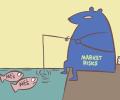
Do a proper asset allocation and invest through systematic investment plans where one can benefit.

Omkeshwar Singh, Head, Rank MF, a mutual fund investment platform, answers your queries.
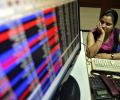
Though the markets have lost ground since the past few sessions, analysts do not seem worried.

Investors may increase exposure to mid and small-cap stocks as their risk-reward profile is more attractive currently, suggest Nitin Singh and Vinay Joseph.

Equity mutual funds attracted an all-time high net inflow of Rs 28,463 crore in March, on continued interest by retail and HNI investors, who used market correction as a good buying opportunity.

2019 appears a story of two halves for Indian equities - a more difficult first half might precede a stronger second half, said Abhiram Eleswarapu, bottom, left, Head of India Equity Research, BNP Paribas in an interview with Ashley Coutinho.

The silver lining is that after two years, e-commerce has emerged as the top sector with $689 million in investments across 15 deals, accounting for 43 per cent of all investments in January 2021.

The stock market regulator's definition of large, mid, and small-cap companies has irked mutual fund managers, reports Samie Modak.
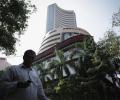
PowerGrid was the top laggard in the Sensex pack, shedding over 2 per cent, followed by HCL Tech, ONGC, M&M, Axis Bank, TCS, Reliance Industries and Infosys. On the other hand, Asian Paints, Titan, Tata Steel, Bajaj Finance and Bajaj Auto were among the gainers.

A weak economy coupled with rising Covid-19 cases and inflation that is above RBI's comfort zone, geopolitical developments, and upcoming India Inc's second quarter results for FY21 could impact sentiment, analysts say.
 © 2026 Rediff.com - Investor Information - Advertise with us - Disclaimer - Privacy Policy - Sitemap - Feedback - About us - Terms of use - Grievances