
China's deteriorating economy is a serious concern. Xi Jinping and China's new premier will have a difficult task ahead of them after the 20th party congress, notes Jayadeva Ranade, the retired senior RA&W officer and China expert.

Noting that terrorism is haunting the Asian and Central Asian regions, Prime Minister Manmohan Singh on Tuesday underlined the need for "genuine" cooperation among countries on a global scale to resolutely defeat the menace.

The people will view it from their viewpoint, their immediate interest, historical experiences, their insecurities, he said.

'From what evidence has come up, General Bajwa somehow managed to tell the Americans that I was anti-American.' 'And so, it [the plan to oust me] wasn't imported from there. It was exported from here to there.'

Noting that terrorism is haunting the Asian and Central Asian regions, Prime Minister Manmohan Singh on Tuesday underlined the need for "genuine" cooperation among countries on a global scale to resolutely defeat the menace.

During the meeting, President Xi addressed the ministers and discussed the bilateral issues among the countries and the issues affecting the South-Asian regions.
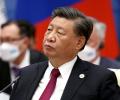
Xi Jinping's recent actions in South Asia have amply demonstrated the disastrous impact of China's embrace, observes Jayadeva Ranade, the retired senior RA&W officer and China expert.
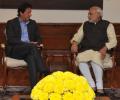
It is also learnt that Khan congratulated Modi on his election victory during their first face-to-face interaction.

India invited leaders of the BIMSTEC countries as well as Kyrgyz President Jeenbekov, the current chair of the Shanghai Cooperation Organisation, and Mauritius PM Jugnauth for the Modi's swearing-in.
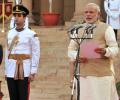
President of the Kyrgyz Republic, who is the current Chair of the SCO, and the PM of Mauritius, who was the chief guest at this year's Pravasi Bhartiya Divas, have also been invited, the MEA said.

The PM said that countries sponsoring, aiding and funding terrorism must be held accountable.

External Affairs Minister S Jaishankar and his Chinese counterpart Wang Yi met in Moscow on Thursday amid hopes of a possible breakthrough in reducing tensions along the Line of Actual Control (LAC) in eastern Ladakh.
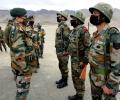
India and China have agreed to soon hold the 10th round of Corps Commander-level talks to take forward the de-escalation process in eastern Ladakh, the Ministry of External Affairs (MEA) said on Thursday.
"India has consistently articulated its desire to play a more constructive and meaningful role as an observer at the SCO," External Affairs Minister S M Krishna said, addressing the 10th summit of the forum in the Uzbek capital of Tashkent.
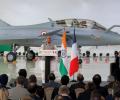
Five Rafale fighter aircraft arrived in India from France on July 29 and have started extensive training within 24 hours of touching down in the country. The French-origin fighter aircraft are part of the 17 Golden Arrows squadron of the Indian Air Force.
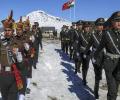
There was no breakthrough on the disengagement of troops from the friction points in eastern Ladakh during the seventh round of military talks on October 12. "The eighth round of military talks is likely to take place this week," said a source on Tuesday.

Dr Singh and Zardari shook hands after they posed for a group photo with leaders of other Shanghai Cooperation Organisation member nations -- Russia, China, Kazakhstan, Tajikistan, Kyrgyzstan, and Uzbekistan.
Declaring India's readiness to contribute to global efforts to overcome the economic crisis, Prime Minister Manmohan Singh arrived in Yekaterinburg on Monday night to attend the Summits of Shanghai Cooperation Organisation and Brazil-Russia-India-China.

Chinese Foreign Minister Wang Yi arrived in India Thursday evening in the highest-level visit between the two countries after the ties came under severe strain following the eastern Ladakh standoff nearly two years ago.
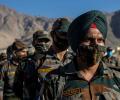
India on Thursday said that ensuring a comprehensive disengagement of troops in all the friction areas in eastern Ladakh is the 'immediate task', remarks that came ahead of another round of military talks with China on the border standoff.
In the midst of a spat between India and China, an official Chinese newspaper on Friday spoke of a possible meeting between the prime ministers of the two countries next week in Thailand.

In the midst of a war of words between the two countries, Chinese Premier Wen Jiabao on Wednesday expressed his desire to meet his Indian counterpart Manmohan Singh.The Chinese leader's remarks come a day after Beijing raked up its claim over Arunachal Pradesh, questioning Prime Minister Singh's visit there on October 3. India hit back on Wednesday, reacting strongly to Chinese plans to get involved in projects in Pakistan-occupied-Kashmir.
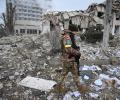
Reconstruction efforts after the Russia-Ukraine war will be dominated by the heft of the membership of major nations across international organisations. India is hamstrung because it does not play host to any major global institution nor does it hold positions of significant influence in the ones in which it has membership. As a result, the world's sixth largest economy is obliged to follow the rules set by most of them.
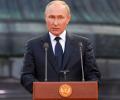
'When the war against Ukraine that Putin started is not going the way he was expecting it to and his military options are getting onerous, a bit of nuclear sabre rattling is what he hopes will turn things around for him and Russia.'
Apart from emphasising the importance of India's economic development, and its re-integration into the global economy, Dr Singh has repeatedly emphasised the importance of the ideas that define the Indian civilization and the Indian Republic for global peace, security and challenges, ranging from terrorism to pandemics.

Afghanistan witnessed a series of terror attacks in the last few weeks as the US aimed to complete the withdrawal of its forces from Afghanistan by August-end, ending a nearly two-decade of its military presence in the war-ravaged country.
Addressing the Shanghai Cooperation Organisation (SCO) Summit in Yekaterinburg (Russia), Prime Minister Manmohan Singh on Tuesday said that India is seeking an external environment conducive to its sustained high economic growth which is necessary to meet its developmental objectives.

In the first top-level contact since the Mumbai terror attacks, Prime Minister Manmohan Singh met President Asif Ali Zardari on Tuesday during which he is understood to have made it clear that Pakistan should take concrete action against terrorism directed against India.
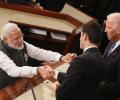
The maiden bilateral meeting between President Joe Biden and Prime Minister Narendra Modi on Friday will further strengthen the US-India strategic ties and allow the leaders to discuss the situation in Afghanistan and how the two countries can work together to fight terrorism, a senior White House official has said.
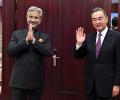
China is ready to take "conciliatory steps" in order to avoid new violations of the obligations on the India-Chinese border, Chinese Foreign Minister Wang Yi said on Friday, a day after holding a crucial meeting with External Affairs Minister S Jaishankar over the current standoff in Ladakh. Speaking during a joint press conference with Russian Foreign Minister Sergey Lavrov, Wang said troops and equipment should be withdrawn from the Line of Actual Control (LAC).
In the first top-level contact between India and Pakistan after Mumbai attacks, Prime Minister Manmohan Singh and Pakistan President Asif Ali Zardari will meet in Russia on the sidelines of a multilateral summit next week to break ice in the bilateral ties.
The Shanghai Cooperation Organisation is still a developing entity and it is essentially due to Russian and Chinese efforts. The moot question is can India benefit by attending it?
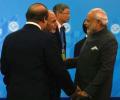
India, which has an Observer status for the past 10 years, will technically become the member by next year.
The two sides have already held seven rounds of Corps Commanders level talks to discuss the entire issue of transgressions in the Eastern Ladakh sector.

India says it cannot accept a project that ignores its core concerns on sovereignty and territorial integrity.
The MEA said there has not been any change in India's position on the LAC and the mutual redeployment as a result of the disengagement process should not be misrepresented.

India, the world's third biggest oil consumer, meets more than 80 per cent of its oil needs through imports.
'Terrorism continues to be the overwhelming threat to security and stability in the SCO region and therefore Dr Jaishankar strongly pitched for 'collective action',' observes Dr Rajaram Panda.
Pakistan turned to China after the US refused it a civilian nuclear agreement.
Stating that Pakistan can serve as a 'hub of economic activity' in the region by developing energy corridors, President Pervez Musharraf has offered to extend the proposed multi-billion-dollar Iran-Pakistan-India gas pipeline to China.\n\n
 © 2026 Rediff.com - Advertise with us - Disclaimer - Privacy Policy - Sitemap - Feedback - About us - Terms of use - Grievances