
'Whenever it hears the term SCO, Delhi faces an existential dilemma -- of its own making.'

After a gap of over two-and-half months, India and China on Sunday held the ninth round of military talks specifically focusing on ways to move forward on the long-negotiated disengagement process in eastern Ladakh as thousands of their troops remained deployed at friction points under freezing conditions.

The Ministry of External Affairs said the two ministers discussed the outstanding issues related to disengagement from all friction points along the Line of Actual Control in eastern Ladakh.
If one concentrates solely on areas of concern, one will develop an unduly pessimistic attitude. If one looks only at the galloping trade and proliferating exchanges of visits, there could be unwarranted over-optimism. There is a need for a balanced perspective.
The idea of a Russia-India-China triangle was first floated in 1998 by the then premier Yevgeny Primakov.

However, the details of the meeting were not officially confirmed.

The habitats have been provided with proper heating facilities as the region receives up to 40 feet of snow after November every year while temperatures fall up to minus 40 degree Celsius in the winter months.
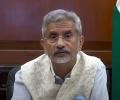
The external affairs minister said the broad principle around which his position would be constructed would be about the importance of maintaining peace and tranquility along the border for the overall development of ties which has been reflected in the last 30 years of the relationship.

Russia made the commitment during the meeting between defence minister Rajnath Singh and his Russian counterpart Gen Sergey Shoigu in Moscow, sources said.

At least 3,000 soldiers from China, Russia, Kazakhstan, Tajikistan, Kyrgyzstan, India and Pakistan participated in the drill.

Atmar briefed Jaishankar about the situation in the war-torn country amid growing security concerns over the Taliban fighters rapidly seizing control of a large number of areas, forcing many countries to scale down their presence there.
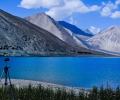
The capture of the Chinese soldier comes in the midst of an eight-month-long bitter border standoff between the two armies in eastern Ladakh.
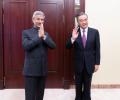
The effort made to define the larger picture by focussing on history and the wish not turn differences into disputes and conflicts is welcome. In the obtaining circumstances today, nothing more could have been possible, observes Ambassador T P Sreenivasan.

'Washington appears to be playing the long game, and making the argument to India that over the longer term, Russia -- sanctioned, cash-strapped, isolated by the West -- will no longer be a viable defence partner for India'

Singh, who arrived in Moscow on Wednesday on a three-day visit to attend a crucial meeting of the Shanghai Cooperation Organisation (SCO), pressed for expediting supply of a number of weapons systems, ammunition and spares to India by Russia under contracts which were concluded earlier.

The Indian Army had said the Chinese soldier had "strayed" across the LAC in Demchok sector.

Corporal Wang Ya Long was handed over to the Chinese military on Tuesday night at Chushul-Moldo border point in eastern Ladakh, the sources said in New Delhi.

'The Chinese are retaining geostrategic pressure on India by keeping troops there and building infrastructure continually.'

The armies are working to schedule their seventh round of talks to take steps towards "early and complete" disengagement of troops along the LAC in eastern Ladakh.

On being asked about the Swaraj-Qureshi meeting, the MEA sources said the two leaders only exchanged pleasantries.
"All temporary structures and other allied infrastructure created in the area by both sides have been dismantled and mutually verified. The landform in the area has been restored by both sides to the pre-standoff period," the Army said in a statement.

"When we have something to share, we will share. Discussions are ongoing," External Affairs Ministry Spokesperson Anurag Srivastava said replying to a volley of questions on whether India and China are working on specific proposals to resolve the over six-month-long row in eastern Ladakh.

The two leaders shook hands and exchanged pleasantries at the end of the media briefing which was addressed by Chinese President Xi Jinping. China is the host and chair of the SCO.

The last round of Corps Commander-level talks had taken place on October 12 but there was no breakthrough on the disengagement of troops from the friction points.
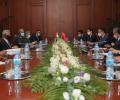
In a meeting on the sidelines of the summit of the Shanghai Cooperation Organisation (SCO) in Dushanbe on Thursday, the two foreign ministers exchanged views on the current situation in the region and agreed that military and diplomatic officials of both sides should meet again and discuss resolving the remaining issues at the earliest.
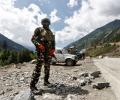
The Indian Army said the soldier, a Corporal in the Chinese People's Liberation Army(PLA), has been identified as Wang Ya Long and he will be returned to the Chinese military at the Chushul-Moldo border point after completion of formalities.

'Both Russia and the USA seek New Delhi's friendship, because for both -- Russia and the USA -- India is a certain counterbalance to China.'
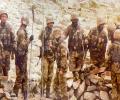
Speaking at a virtual conference of the World Economic Forum, the external affairs minister, at the same time, said the border row happens to be one part of the larger issue of how India and China adjust to each other when both are rising.

The sources said the soldier was handed back to China at the Chushul-Moldo border point in eastern Ladakh at 10.10 am.
In a written reply to a question in Lok Sabha, Minister of State for External Affairs V Muraleedharan gave a brief account of the four-month-long standoff and said the Chinese side attempted to transgress the Line of Actual in several areas of the western sector since mid-May.

'Pleasure to meet FM Sergey Lavrov, this time in person. Excellent talks that reflect our Special and Privileged Strategic Partnership. Value our exchanges on the international situation,' Jaishankar tweeted after talks with his Russian counterpart on the sidelines of the SCO meeting.
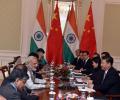
External affairs ministry spokesperson Vikas Swarup also asserted that India's participation in the NSG would have further strengthened nuclear non-proliferation regime and made global nuclear commerce more secure.
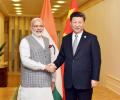
The meeting, which lasted for nearly 50-minutes, comes in the backdrop of stiff Chinese opposition to India's entry into the NSG, which looks after critical issues relating to nuclear sector, including trade and export of nuclear technology.

India requested Pakistan to let Modi's aircraft fly over its airspace to Bishkek in Kyrgyzstan.
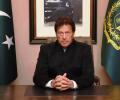
This is the second time after Modi was re-elected to power that the Pakistani premier has expressed his desire to work together with India for the betterment of their peoples.
 © 2026 Rediff.com - Advertise with us - Disclaimer - Privacy Policy - Sitemap - Feedback - About us - Terms of use - Grievances