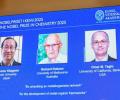
The Royal Swedish Academy of Sciences has awarded the 2025 Nobel Prize in Chemistry to Susumu Kitagawa, Richard Robson, and Omar M Yaghi for their pioneering work in the development of metal-organic frameworks (MOFs), Al Jazeera reported.

The Royal Swedish Academy of Sciences announced on Monday that it has decided to award the Nobel Prize in Economics 2025 to Joel Mokyr, Philippe Aghion, and Peter Howitt "for having explained innovation-driven economic growth." The 2025 Sveriges Riksbank Prize in Economic Sciences in Memory of Alfred Nobel goes to the trio, with one half awarded to Mokyr "for having identified the prerequisites for sustained growth through technological progress" and the other half jointly to Aghion and Howitt "for the theory of sustained growth through creative destruction."

'Professor Kitagawa is an exceptional researcher, a good teacher and above all a great person.'
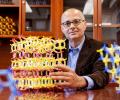
'It was from him I learnt that if you gave the student the freedom to find his own path, he would be more courageous to experiment.'

The 2024 Nobel Prize in Physics has been awarded to John Hopfield and Geoffrey Hinton for foundational discoveries and inventions that enable machine learning with artificial neural networks, the Royal Swedish Academy of Sciences announced on Tuesday.

The Royal Swedish Academy of Sciences on Monday has decided to award the 2024 Nobel Prize also known as the Sveriges Riksbank Prize in Economic Sciences to Daron Acemoglu, Simon Johnson and James A. Robinson "for studies of how institutions are formed and affect prosperity."

The Royal Swedish Academy of Sciences on Monday has decided to award the 2024 Nobel Prize also known as the Sveriges Riksbank Prize in Economic Sciences to Daron Acemoglu, Simon Johnson and James A Robinson 'for studies of how institutions are formed and affect prosperity'.

The 2024 Nobel Prize in Chemistry has been awarded to David Baker, Demis Hassabis, and John M Jumper, the Royal Swedish Academy of Sciences announced on Wednesday.

The Royal Swedish Academy of Sciences on Wednesday awarded the Nobel Prize in Chemistry 2022 to Carolyn R Bertozzi, Morten Meldal and K Barry Sharpless.

In her oeuvre, Han Kang confronts historical traumas and invisible sets of rules and, in each of her works, exposes the fragility of human life.

American economic historian and labour economist Claudia Goldin won the 2023 Nobel Economics Prize for her work examining wage inequality between men and women, the Royal Swedish Academy of Sciences said on Monday. The Sveriges Riksbank Prize in Economic Sciences in Memory of Alfred Nobel 2023 was awarded to 77-year-old Claudia Goldin "for having advanced our understanding of women's labour market outcomes" the prize-giving body said in a statement. Goldin will receive 11 million Swedish kronor, or around $1 million, as the sole winner of this year's prize.

Last year, Syukuro Manabe, Klaus Hasselmann and Giorgio Parisi won the Nobel Prize for Physics, "for groundbreaking contributions to our understanding of complex physical systems."

The Royal Swedish Academy of Sciences has decided to award the Sveriges Riksbank Prize in Economic Sciences in Memory of Alfred Nobel 2021 with one half to David Card "for his empirical contributions to labour economics" and the other half jointly to Joshua Angrist and Guido Imbens "for their methodological contributions to the analysis of causal relationships". Card is the Class of 1950 Professor of Economics at the University of California, Berkeley and Director of the Labor Studies Program at the National Bureau of Economic Research. Angrist is an Israeli American economist and Ford Professor of Economics at the Massachusetts Institute of Technology. Imbens is Professor of Economics at the Stanford Graduate School of Business since 2012. After earning his Ph.D. from Brown University in 1991, he taught at Harvard University, UCLA, and UC Berkeley.

Arthur Ashkin in the US, Grard Mourou in France, and Donna Strickland in Canada will share the prize announced by the Royal Swedish Academy of Sciences in Stockholm on Tuesday.

On Monday, the Royal Swedish Academy of Sciences announced that Abhijit Banerjee, Esther Duflo and Michael Kremer had won the 2019 Nobel Prize for economics "for their experimental approach to alleviating global poverty". The research conducted by them has considerably improved the ability to fight global poverty. In just two decades, their new experiment-based approach has transformed development economics, which is now a flourishing field of research, said the Royal Swedish Academy of Sciences. Here are some interesting facts about the Indian-origin Abhijit Banerjee.

The Nobel Assembly on Tuesday said in a tweet, 'The Royal Swedish Academy of Sciences has decided to award the 2020 Nobel Prize in Physics with one half to Roger Penrose and the other half jointly to Reinhard Genzel and Andrea Ghez.'

David Julius and Ardem Patapoutian jointly won the 2021 Nobel Prize for Physiology or Medicine for their discoveries of receptors for temperature and touch, announced the award-giving group on Monday.

The three physics laureates -- Pierre Agostini, Ferenc Krausz and Anne L'Huillier have created flashes of light that are short enough to take snapshots of electrons' extremely rapid movements.

The Sveriges Riksbank Prize in Economic Sciences in Memory of Alfred Nobel was on Monday awarded to Ben S Bernanke, Douglas W Diamond, and Philip H Dybvig for their research work on bank regulation and how financial crises should be managed.

French economist Jean Tirole won the 2014 economics Nobel Prize for his analysis of market power and regulation, the RoyalSwedishAcademy of Sciences said on Monday.

French and American scientists win Nobel Physics Prize

All three scientists have played a leading role in the Laser Interferometer Gravitational-Wave Observatory, or Ligo, experiment, which made the first historic observation of gravitational waves in September 2015.

This year's Laureates have shown how the problem of global poverty can be tackled by breaking it down into a number of smaller - but more precise - questions at individual or group levels, he Royal Swedish Academy of Sciences said.
The 2011 Nobel Prize in chemistry was awarded to Israeli scientist Daniel Shechtman on Wednesday for his discovery of quasicrystals, a mosaic-like chemical structure that researchers previously thought was impossible.
Three American scientists won the 2013 economics Nobel prize on Monday for research that has improved the forecasting of asset prices in the long term and helped the emergence of index funds in stock markets, the award-giving body said.

The trio used the same principles of evolution -- genetic change and selection -- to develop proteins used in a range of fields.

United States-born scientists Saul Perlmutter, Brian Schmidt and Adam Riess were on Tuesday named for the Nobel Prize in Physics for their studies of exploding stars that revealed that the expansion of the universe is accelerating.

They won for their analysis of markets with search frictions.

The trio were awarded for their study of the structure and function of the ribosome, one of life's core processes.

Isamu Akasaki and Hiroshi Amano of Japan and US scientist Shuji Nakamura won the Nobel Prize in physics on Tuesday for the invention of blue light-emitting diodes, a breakthrough that spurred the development of LED technology used to light up computer screens and modern smartphones.

The Royal Swedish Academy of Sciences on Monday announced that American Paul Krugman has won the Nobel economics prize "for his analysis of trade patterns and location of economic activity."
American Yoichiro Nambu of the University of Chicago won half of the prize for the discovery of spontaneous broken symmetry in subatomic physics. Makoto Kobayashi and Toshihide Maskawa of Japan shared the other half of the prize for discovering the origin of the broken symmetry that predicts the existence of at least three families of quarks in nature.
Free trade proponents to be tapped for Nobel economics prize
The Nobel Prize for Economics was awarded to Edmund S. Phelps of the United States, the Royal Swedish Academy of Sciences announced on Monday.
Take the Rediff Biz Quiz and find out how much you know about the Nobel Prize in Economics.
The Karolinska Institute cited his studies of the molecular basis of eukaryotic transcription in awarding him the 10 million kronor (1.37 million dollar) prize.

The winners will split an eight million Swedish kronor (USD 924,000) award funded by the Swedish central bank.
The pair won the prize "for having enhanced our understanding of conflict and cooperation through game-theory analysis," the Royal Swedish Academy of Sciences said.
Peter Agre and Roderick MacKinnon have won for discoveries concerning channels in cell membranes.

"He's made economics more human," the Nobel jury said
 © 2026 Rediff.com - Investor Information - Advertise with us - Disclaimer - Privacy Policy - Sitemap - Feedback - About us - Terms of use - Grievances