
Richard Holbrook, the former United States Ambassador to United Nations, is likely to be appointed envoy to Pakistan, Afghanistan and related matters by the new Obama administration after Hillary Clinton was sworn in as the secretary of State earlier today.Former Senate Majority Leader George Mitchell is likely to be announced as Middle East Envoy, the Washington Post reported, quoting sources close to the Obama administration.
United States Special Representative for Afghanistan and Pakistan Richard Holbrooke on Wednesday said that Pakistani leaders brought up the issue of India's alleged involvement in Balochistan, but did not give any credible evidence to support their claim.
Two days after his statement on Kabul attack which did not go down well with authorities in New Delhi, US Special Envoy on Afghanistan and Pakistan Richard Holbrooke on Friday regretted any "misunderstanding" caused by his comments that Indians were not the target of the terror strike.

Special United States Representative to Afghanistan and Pakistan Richard Holbrooke, who was once speculated to be US President Obama's trouble-shooter to Kashmir, is so sensitive to creating an uproar in New Delhi if he speaks about Kashmir, that he doesn't even want to say the 'K word.'
United States President Barack Obama is sending a team of officials led by Richard Holbrooke, his special envoy for Pakistan and Afghanistan, to visit refugee camps housing lakhs of people who have been displaced by the military offensive in Swat and adjoining areas of the North Western Frontier Province. Holbrooke is expected to have a first hand assessment of the situation and then recommend how best the US can accelerate relief measures.

Holbrooke's statement is contrary to India's position that the entire state of Jammu and Kashmir is an integral part of the country; which has its physical boundary with Afghanistan.
Obama Administration's top diplomat for Afghanistan and Pakistan Richard Holbrooke, who has already visited New Delhi twice to brief Indian leaders of President Obama's AfPak strategy, on Tuesday said that due to elections India had not gotten fully engaged in the regional approach that is an integral part of the US strategy.
"Now if the Indians were supporting those miscreants that would be extraordinarily bad (and) really dangerous. But they're not. There is no evidence at all that the Indians are supporting the miscreants in the Federally Administered Tribal Areas or North West Frontier Province or Waziristan. None," he said.
President Asif Ali Zardari has assured the United States that the Pakistan government will not allow anybody to challenge its writ or run a parallel administration in any part of the country. Zardari gave the assurance to US Special Envoy for Pakistan and Afghanistan Richard Holbrooke during a telephonic conversation, the Daily Times reported on Friday.
The Barack Obama administration is facing a dilemma with respect to Pakistan as unlike Afghanistan, it cannot send its troops there to fight Al Qaeda and Taliban and needs to find other means, top United States Special Envoy for the region Richard Holbrooke has said. "The dilemma is that the leadership of both the Al Qaeda and the Taliban are in a neighbouring country (of Afghanistan) where our troops cannot fight. And therefore we have to find other means," he said.
The United States has asked Pakistan to prove its seriousness in fighting terrorism by matching their rhetoric with that of action on the ground than by mere "verbal commitment".
Identifying Afghanistan and western Pakistan as one of the most dangerous parts of the world, special US envoy for Af-Pak on Monday said, the region poses a great threat to not only the United States, but also India and Western Europe.
The Pakistan President Asif Ali Zardari has acknowledged that the Taliban, with whom his government reached a truce deal in the restive Swat valley days ago, are "murderous thugs and militants" who "pose a danger to Pakistan, the United States and India".
"We are troubled and confused in the sense about what happened in Swat, because it is not an encouraging trend," Richard Holbrooke, the Special US Representative for Pakistan and Afghanistan told the PBS news channel in an interview.
In a stern warning to Pakistan, President Barack Obama on Tuesday asserted that his administration will not allow "safe havens" for Al Qaeda and Taliban terrorists operating with "impunity" in tribal areas bordering Afghanistan. "My bottom line is that we cannot allow Al Qaeda to operate. We cannot have those safe havens in that region," Obama said in his first press conference after assuming office on January 20.
After the announcement of the South Asia visit of the United Staes special envoy to Afghanistan and Pakistan, Richard Holbrooke, the US state department on Friday announced that the US Secretary of State Hillary Clinton would also visit South Asia.
In the first high-level contact between India and the new United States government, National Security Adviser M K Narayanan is expected to meet Richard Holbrooke, special envoy for Afghanistan and Pakistan, in Munich during his three-day visit that began on Friday.
Special United States Representative for Afghanistan and Pakistan Richard Holbrooke said he would soon head towards the troubled region in South Asia to have a first-hand assessment of the situation on the ground.In his acceptance speech, soon after he was appointed as the Special US Representative for the troubled region by Secretary of State Hillary Clinton, Holbrooke termed the Pakistan situation as extremely complex.

"There seems to be a growing recognition that the Taliban and other miscreants, to use the Pakistanis own word for this, are a threat to the entire country and are alien to the spirit of Muhammad Ali Jinnah and the founders of Pakistan," Holbrooke said at a press conference after the meeting of Friends of Democratic Pakistan at the UN headquarters in New York on Thursday.
Holbrooke is currently in Afghanistan after completing a two-day visit to Pakistan. He is said to have told the Pakistani leadership during his visit that there was a need to keep India informed about developments taking place in Pakistan and Afghanistan.
Holbrooke declared before the House Foreign Affairs Committee on Tuesday, "We do not think that Pakistan is a failed State. We think it's a State under extreme test from the enemies who are also our enemies and who have the same common enemy -- the United States and Pakistan. It just isn't (a failed State). But it is a State under enormous social, political and economic pressure. And India is always a factor."
With regard to the sale of the new 18 F-16's that Pakistan has requested -- the C/D block 50/52s combat aircraft, he said, "We have not come to a final decision on how to proceed with this, and I know your body is looking at it very carefully," Holbrooke told Congressman Gary Ackerman, the chairman of the House Foreign Affairs Subcommittee on South Asia.
Amid differences with America on the issue of drone attacks against high-value terrorist targets on it soil, Pakistan on Tuesday said it would not give any "blank cheques" to the United States and not accept foreign troops in its territory in the ongoing war to root out the Al-Qaeda and Taliban.
"As the ISI tries to rein in those militant proxies that have slipped from Islamabad's grasp, it will likely try to regain their support by redirecting their attention away from Pakistan and toward India, an enemy on which both Islamabad and the militants can agree. As a result, it is likely India will come under attack again," Stratfor warned.
The foreign ministers from Pakistan and Afghanistan are arriving in Washinton D.C next week for consultations, as part of United States' efforts to contact high-level leaders from the region to frame its new Afghan policy.
"References made by President Obama did seem to suggest that there is some kind of a link between the settlement on Pakistan's western border and the Kashmir issue. Certainly that had caused concern," he told Karan Thapar's India Tonight programme. "I do think that we could make President Obama understand, if he does have any such views then he is barking up the wrong tree," he said.
'It is going to get worse if Indians continue to deny it by refusing to talk about it,' says Richard C Holbrooke.

The US spent $1.5 million a day since 2001 fighting the opium war in Afghanistan. After hundreds of airstrikes failed to curtail the Taliban's $200-million-a-year opium trade, the US military quietly ended the campaign when the Trump administration officials engaged in direct peace talks with the Taliban, notes Atanu Biswas.

The United States long-suspected Pakistan of sheltering Mullah Omar and even confronted then President Asif Ali Zardari in 2011

Former Pakistan Foreign Minister Khurshid Mahmood Kasuri on Monday claimed that India had considered carrying out surgical air strikes at the headquarters of terror outfits JuD and LeT near Lahore.
'The hardliners in Delhi are in for a big disappointment,' predicts Ambassador M K Bhadrakumar.

'The US-India relationship is in a different league altogether,' Obama administration officials tell Aziz Haniffa/Rediff.com in Washington, DC.

Robin Raphel, a former US diplomat now under a counter intelligence investigation, has spent much of her professional life dealing with Pakistan and defending it against criticism as she doled out billions in aid to the "frenemy".

''There is the perennial worry in the Indian mind regarding the US 'hyphenating' India and Pakistan. Frankly, this is a completely nonsensical hypothesis. The US has always 'hyphenated' India and Pakistan and it couldn't have been otherwise,' says Ambassador M K Bhadrakumar.
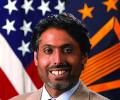
Vikram J Singh, the highest-ranking Indian American at the Pentagon is quitting his administration job to head up the national security division at the Center for American Progess -- a Washington, DC progressive think tank with close links to President Obama -- which has at its helm another Indian American, Neera Tanden.

The start of Indian lobbying in the US can be traced back to Pakistan's anti-India lobbying. Policy wonk Ashok Sharma documents this journey and its catalytic role in transforming the US-India relationship.
'Both India and Pakistan are now, for the first time in history, very closely allied and connected with the US -- economically and politically.'

On Thursday, November 6, the Washington Post newspaper reported that controversial American diplomat, Ambassador Robin Raphel, had her office and home searched by the FBI. This most unusual development likely raised much cheer at India's ministry of external affairs, in whose flesh Raphel had been a thorn through much of her tenure in the first Bill Clinton administration in the early and mid-1990s by her anti-India and pro-Pakistan stand. Seventeen years ago, as she was about to step down as Assistant Secretary of State for South Asian Affairs, Raphel granted an exclusive interview to Aziz Haniffa and India Abroad, the leading Indian-American weekly newspaper, which is now owned by Rediff.com The July 1997 interview, which provoked a raging controversy in both capitals, Washington, DC and New Delhi, is reproduced here...
 © 2026 Rediff.com - Investor Information - Advertise with us - Disclaimer - Privacy Policy - Sitemap - Feedback - About us - Terms of use - Grievances