
India is the largest recipient of remittances, which touched $23.4 billion in 2006.
The remittance is limited to 12 transactions a year per sender, with a maximum amount of Rs 50,000 per transaction with a normal transaction fee of Rs 50 for an amount less than Rs 5,000 and Rs 75 for amount above Rs 5,000. It will be implemented by commercial banks under the national electronic fund transfer system.

While Indians are increasingly using mobile platforms and technology for various financial transactions and purchases like bill payments, ticket bookings, entertainment, travel and banking transactions, cross border mobile remittance is yet to see the light of the day.
A hassle-free electronic remittances gateway, enabling non-resident Indians to send money back home, will be launched during the three-day Pravasi Bharatiya Divas opening in Hyderabad on January 7.
Remittances towards gifts and donations have been brought under the ambit of remittance scheme of individuals up to $1,00,000.

Remittances are estimated to exceed $600 billion in 2015.

India leads global remittances in the year 2013 with a whopping $70 billion in its kitty, of which USD 65 billion were earned from the country's flagship software services exports, the World Bank reported.
Indian Bank on Tuesday launched IndRemit, an online money transfer service that allows Non-Resident Indians in the United States to make online money remittance to India.
According to the World Bank's latest Migration and Remittances Factbook 2011, remittance flows to developing countries is expected to reach $325 billion by the end of this year, up from $307 billion in 2009.

High frequency indicators, like vehicles sales, air traffic, steel consumption and GST E-way bills, point towards a sequential pickup in momentum of economic activity during the second half of the fiscal 2024-25 and sustain moving forward, RBI Bulletin said on Wednesday. However, a strong dollar, driven by US economic resilience and trade policy pivots, could exacerbate capital outflows from emerging economies, push risk premiums higher, and intensify external vulnerabilities, said an article on 'State of the Economy' published in RBI's February bulletin.

The police went to Robin Uthappa's house to issue a notice. Since he does not reside at that address at present, a warrant has been executed for the former cricketer.

With the Reserve Bank of India (RBI) allowing people to receive money more than twice a month from abroad, the companies facilitating transfer services are set to cash in, too.

Other large recipients are China ($64 billion), the Philippines ($28 billion), Mexico ($24 billion), Nigeria ($21 billion), Egypt ($18 billion), Pakistan ($17 billion), Bangladesh ($15 billion), Vietnam ($11 billion) and Ukraine ($9 billion).

One fact is irrefutable: Nepal's recent political history tells us that the route to a return of monarchy cannot go through India despite friends in high places, asserts Aditi Phadnis.

India received $55.9 billion in remittances in the year 2010-11.
The slowdown in global remittance flows that became evident in the last quarter of 2008 has continued in the first half of 2009. However, South Asian countries like India, Pakistan and Bangladesh have continued to post strong growth till now because of remittances from the Gulf region.

Enforcement Directorate officials said on Friday they are probing a 'complex network' of agents and facilitators in India, Canada and the US who help Indians illegally enter the US via 'bogus' admissions in Canadian colleges.

ED and Directorate of Revenue Intelligence have detected a significant increase in the outflow of Indian money, specifically into four countries --Thailand, Dubai, Singapore and Hong Kong.
About 13 per cent of the funds remitted by Non-Resident Indians (NRIs) in 2006 were invested in equity and real estate. While 20 per cent of the funds are parked in bank deposits.

Developing countries received $414 billion worth of remittances in 2013.
.jpg)
The World Bank in its report said the relative importance of remittances as a source of external resources is expected to increase further.
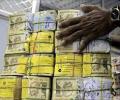
For 2011-12, there were 7,56,741 foreign remittances made from India with money worth Rs 3,56,461 crore (Rs 3,564.61 billion) going out of India
With a rising population of more than 215 million international migrants in the world, remittances received by developing countries, is estimated to be $325 billion in 2010, states a World Bank study.

The remittances increased from $26.37 billion duringthe same period in the previous year, as India provided much better returns.

Other than India, China and Mexico, the top 10 recipients of remittances include the Philippines, Poland, Nigeria, Romania, Egypt, Bangladesh and Vietnam. Remittance flow to South and East Asia has continued to post strong growth, largely on the fact that the gulf countries, a major destination for Asian migrants, have not significantly reduced hiring migrants.
Overseas Indian workers are located in two regions -- the Middle East and developed countries such as the US, UK and Canada, ADB said. Those in the Middle East are mostly unskilled labour employed in construction and oil-related services while overseas Indians in the developed countries include skilled labour in the banking and information technology industry. 'Consequently, it is almost inevitable that remittances will decline,' the report said.

Remittances by non-resident Indians (NRIs) saw a 27 per cent jump at $ 6.5 billion (Rs 39,991.9 crore in present valuations) between January and September this year, as against 7 per cent growth during the same period last year.

India needs another shot of difficult reform, of the kind only possible at gunpoint. Mr Trump holds that gun to our heads now. A drastic reduction in tariff protection, other elements of sarkari wet-nursing will force entrepreneurial India to become competitive again, argues Shekhar Gupta.

The Reserve Bank of India (RBI) will launch the Unified Lending Interface (ULI) nationwide in due course, aiming to transform India's lending sector, similar to how the Unified Payments Interface (UPI) revolutionised the payments ecosystem, Governor Shaktikanta Das said on Monday.

The Enforcement Directorate (ED) is investigating a complex network of agents and facilitators in India, Canada, and the US who assist Indians in illegally entering the US through fraudulent admissions to Canadian colleges. Over 8,500 financial transactions are under scrutiny by the ED in a case related to money laundering, stemming from a 2023 Gujarat Police crime branch FIR. The investigation includes international financial companies involved in remittances abroad, with the ED conducting 35 searches in the past year and seizing assets worth Rs 92 lakh. The issue has gained significant attention following the deportation of 104 Indians from the US on Wednesday. The investigation is linked to the tragic death of an Indian family in January 2022, who perished while attempting to cross the Canada-US border illegally. The ED has identified a network of agents and facilitators who manage and facilitate the stay, transportation, visa arrangements, and legal matters of illegal immigrants who gained admission to Canadian colleges through fraudulent means. The investigation has revealed that the fees paid to Canadian colleges were remitted back to individuals' accounts, with around 8,500 transactions identified between September 2021 and August 2024. The ED suspects that approximately 370 individuals have entered the US using this illegal immigration scheme. The agency has recorded statements from parents and guardians of students enrolled in Canadian colleges and continues its investigation.
100-150 NRKs are returning from the Gulf sector every week.
India is more vulnerable than it appears. Most of what RBI calls remittances could be disguised capital flows.

The prospect of further falls in remittances is a hindrance for the Reserve Bank of India, as it seeks to bullet-proof the economy against sudden capital outflows

How have aspirations, ambitions and hopes broken down for these young men from the most advanced parts of India? asks Mihir S Sharma.
The inward remittances to India has more than doubled from about $12.89 billion in 2000 to $27 billion in 2007. In 2006, inward remittances were $25.43 billion, while the outward flow constituted around $1.58 billion. Rich countries are still the main source of remittances with the United States leading the pack.
Indians working abroad sent a whopping $21.7 billion to their kin in 2004, making the country the highest recipient of remittances worldwide

NRIs remittances jumped 19 per cent to $66 billion in the last fiscal compared to the previous financial year because of a sharp decline in the rupee value against dollar, Assocham said in a study.
