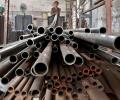
Given wild swings, investors are wondering where the metal market is going. There was a strong uptrend in industrial metal through much of the last three years due to fears of supply chain issues - first due to Covid-19 and then due to the Ukraine War. That uptrend broke down as it became apparent that global growth would moderate as inflation rose and Western Europe (the EU plus the UK) went into a near-recession and China was in a rolling lockdown.

When Life Insurance Corporation (LIC) of India gets listed on the bourses next month, it will be among the biggest listed life insurers globally in terms of market capitalisation (m-cap), assets, and revenue, but will also be among the least profitable and capitalised among its peer group. A big gap between LIC's m-cap, profits, and networth (shareholder capital) will make it one of the priciest insurers globally, in terms of price-to-earnings (P/E) multiple and price-to-book value (P/B) ratio. LIC also lags behind its Indian listed peers in terms of profit and networth.

The reopening of China has led to an ongoing readjustment of the global metals and commodities markets. China has a massive production capacity surplus to its own domestic demand. At the same time, it also has high domestic demand. China is also becoming carbon sensitive.

There seems to be no respite for Adani Group companies from the market carnage. All 10 stocks belonging to the conglomerate came under a fresh bout of intense selling pressure on Wednesday as the group's debt levels and repayment capabilities continued to plague investors. Analysts said investors are also concerned about whether the group will be able to maintain its pace of growth, given the current turmoil that has wiped out over Rs 12 trillion in market capitalisation (m-cap) since the start of the year.

Antonio Watson won a thrilling World Championship 400 metres gold on Thursday.
HDFC Bank Q4 review: HDFC Bank's January-March quarter (Q4) results, for financial year 2022-23 (FY23), brought no cheer to investors as elevated costs, and merger-related uncertainties continue to dent the sentiment. Moreover, analysts fear that merger-related costs may put pressure on margins and cost to income ratio in the near-term, while the return on equity could moderate owing to low leverage of the parent. Analysts, therefore, opine that the stock's re-rating may be some time away. "While the risk of a de-rating on a standalone basis appears to be quite low given that the business performance is holding up well, we believe a re-rating in the stock would happen as and when more clarity emerges on the smooth transition (merger)," said a report by Sharekhan.

After lagging behind other segments in the automotive (auto) space over the past few years, two-wheelers are expected to reverse their volume underperformance. After witnessing a 36.3 per cent volume decline over the 2018-19 (FY19) through 2021-22 (FY22) periods, the sector staged a recovery in 2022-23 (FY23), with volumes rising 17 per cent. While volumes are still a quarter lower than the FY19 peak of 21 million units, a double-digit growth trajectory is expected to prolong.

'What can a teacher do that ChatGPT cannot?'
 © 2026 Rediff.com - Advertise with us - Disclaimer - Privacy Policy - Sitemap - Feedback - About us - Terms of use - Grievances