
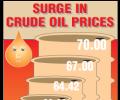
The Reserve Bank on Wednesday said that global crude oil prices, which are nearing the $100 a barrel mark, could impact inflation in India. "High and volatile crude oil prices in the international markets pose a major risk to domestic price stability," the RBI said in its report on 'Trend and Progress in Banking'.

Crude oil has fallen about 40 per cent since mid June and the price on Monday touched its lowest level since mid 2009 before US oil prices posted their biggest one-day gain in two years overnight.

Quarterly earnings of corporates, trading activity of foreign investors and inflation data are the key factors that are expected to drive the momentum in the equity markets this week, analysts said.

Soft oil prices are expected to persist in 2015 and will be accompanied by significant real income shifts from oil-exporting to oil-importing countries.

India's export of fuels like diesel to the European Union jumped 58 per cent in the first three quarters of 2024, with a bulk of them likely coming from refining discounted Russian oil, according to a monthly tracker report. The EU/G7 countries in December 2022 introduced a price cap and an embargo on the imports of Russian crude oil in a bid to cripple Kremlin's revenue and create a vacuum in its funding for the invasion of Ukraine.

From February to mid-March, oil prices receded rapidly.
High crude oil prices, widening current account gap and political uncertainty may keep the rupee weak in the near term.

The spurt in rates, caused by the rally in international oil prices, has led to the oil ministry asking the finance ministry for a cut in excise duty in the Union Budget 2018-19, to be presented in Parliament next week.

'Even now, investors are not bothered about the war but are more concerned whether it will remain localised or not.' 'In case things are contained, markets can stage a bounce back in the next few days.'
Petroleum Minister Ram Naik on Wednesday hoped the high international crude oil prices will ease as soon as the winter season demand for oil in western countries is over.

India is the world's fourth-largest importer of natural gas, accounting for six per cent of the global market.

The current trend in crude oil prices gives cause for much concern and if this persists, many of the calculations indicating further recovery and improved growth for the economy can be nullified.

For the current fiscal, the import bill has been pegged at $66 billion at an average import price of $48 per barrel
India, the world's third largest oil consuming and importing nation, bought crude oil worth 49 billion euros from Russia in the third year of Moscow's invasion of Ukraine, a global think tank said. India, which has traditionally sourced its oil from the Middle East, began importing a large volume of oil from Russia soon after the invasion of Ukraine in February 2022.

Foreign investors turned net sellers in October, withdrawing shares worth Rs 58,711 crore in the month so far owing to escalating conflict between Israel and Iran, a sharp rise in crude oil prices, and the strong performance of the Chinese market. The outflow came following a nine-month high investment of Rs 57,724 crore in September. Since June, Foreign Portfolio Investors (FPIs) have consistently bought equities, after withdrawing Rs 34,252 crore in April-May.
Global crude oil prices slipped below $45 a barrel in early Asian trade on Monday after the Organization of Petroleum Exporting Countries cartel decided not to cut production.

Rising oil prices, sharp slowdown in mutual fund inflows and steep valuations remain the key risks for Indian investors going ahead.

Security experts have warned that using Signal for discussions of this nature violates every established protocol for handling classified information.

'Geopolitical stability could remove the crude oil risk premium.'
Maintaining that the Indian economy was resilient to oil price shocks, Reserve Bank of India Governor Y V Reddy on Wednesday said the oil prices needed to be closely monitored, though it is not a disturbing factor.

Foreign investors turned net sellers in October, offloading shares worth Rs 27,142 crore in just the first three days of October due to intensifying conflict between Israel and Iran, a sharp rise in crude oil prices, and improved performance of Chinese markets. The outflow came after FPI investment reached a nine-month high of Rs 57,724 crore in September. Since June, Foreign Portfolio Investors (FPIs) have consistently bought equities after withdrawing Rs 34,252 crore in April-May.

The year is not yet over and a few more duty hikes are not ruled out.

However, copious oil supplies amid growing global output and slowing Chinese oil consumption will put India in a better bargaining position with Gulf suppliers.

A sharp correction in stock prices, signs of rural recovery, and lower raw material costs have not been enough to change brokerages' cautious stance on the top-listed paint companies. Concerns over rising competition and weak demand continue to weigh on sentiment.

From the 30-share blue-chip pack, Adani Ports jumped over 5 per cent. NTPC, Tata Steel, Bajaj Finserv, Zomato, Bajaj Finance, Tata Motors, State Bank of India, IndusInd Bank and Maruti were among the other big gainers. From the 30-share pack, Hindustan Unilever, Titan, Tata Consultancy Services, Infosys and UltraTech Cement were the other laggards.
If the global economy slows down or slips into a recession due to high oil prices, that will eventually hurt all of us.

This means lower losses on fuel sales by Indian oil companies and a shrinking oil subsidy bill for the government.
Suddenly, demand-supply mismatch is no longer offered as the standard plausible explanation.
Corporate margins and profits in India remain vulnerable to changes in crude oil prices in the international market. Historical quarterly data from listed companies (excluding banks, finance and insurance, oil and gas, and power sectors) indicate an adverse correlation between corporate margins and crude oil prices.
Government will review fuel pricing scenario in October, Petroleum Secretary M S Srinivasan said on Thursday. The petroleum secretary further said, "Situation will be revisited in October when we will take stock of the scenario emerging out of international oil prices." Global crude prices touched a record $145 a barrel, which is expected to push India's oil import bill this year higher by nearly 76 per cent to $110-120 billion.
The interest of the poor can be protected by providing targeted subsidy, Planning Commission's Deputy Chairman Montek Singh Ahluwalia said, adding that increased energy cost would have to be shared by the consumers as the burden is currently being largely borne by public sector oil companies.

According to the 'American Express Business Travel Monitor' which tracks and analyses published airfares on a quarterly basis, 'although fares moderated in the fourth quarter, the influences of rising oil prices and economic growth in the region are too strong to keep prices steady'.
Finance Minister P Chidambaram on Monday said the surge in international oil prices is a matter of grave concern and it was for the petroleum ministry to take a call on retail pricing of petroleum products.

Despite the recovery to above $40 levels after hitting $28-29 in Jan, worries of over-supply in the face of weak demand remain.

Pushing a barrel of oil back to around $100 would require a reduction of production of about two million barrels a day - a cut that would fall predominantly on Saudi Arabia.
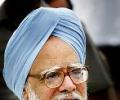
Amid concerns over price rise, Prime Minister Manmohan Singh on Wednesday said inflation will come down to 6.5 per cent by March-end if the international oil prices soften and commodity prices do not rise further.
