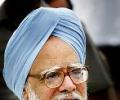
Amid concerns over price rise, Prime Minister Manmohan Singh on Wednesday said inflation will come down to 6.5 per cent by March-end if the international oil prices soften and commodity prices do not rise further.

Investors' sentiments will be guided by a host of domestic and global macroeconomic data announcements this week, along with the trading activity of foreign investors and trends in world stocks, analysts said. Besides, the rupee-dollar trend and movement of global oil benchmark Brent crude will also be crucial in dictating terms in the market, experts added.

"We have the toughest sanctions ever imposed. But on oil, we want to go a little bit slow because I don't want to drive the oil prices in the world up," Trump told reporters.

'Future market gains will likely depend primarily on earnings growth.'

The policy review observed that the moderation in inflation, excluding food and fuel, that was witnessed in the first quarter of 2017-18 has "by and large, reversed".

Low fuel prices to help oil marketing and refining sectors but upstream players will stay under pressure.


US President Donald Trump on Thursday addressed the World Economic Forum where he offered business leaders low taxes if they manufacture their products in the US, while threatening them with tariffs if they don't. Addressing the forum's Annual Meeting in Davos through video conferencing, Trump also said he is going to ask Saudi Arabia and OPEC to bring down oil prices and asserted that if prices come down Russia-Ukraine war will end immediately.

Retail inflation softened to 6.71 per cent in July due to moderation in food prices but remained above the Reserve Bank's comfort level of 6 per cent for the seventh consecutive month. With retail inflation continuing to remain high despite a fall in prices of vegetables and edible oils, among other commodities in July, the Reserve Bank of India (RBI) might go for another rate hike in September. The Consumer Price Index (CPI) based retail inflation was at 7.01 per cent in June and 5.59 per cent in July 2021. It was above 7 per cent from April to June this fiscal.

Modi made a strong case for a partnership between the producers and consumers in the oil market as it exists in other markets.
Indian Oil Corporation has approached the petroleum ministry with a proposal to raise oil prices by Rs 5.29 a litre and diesel by 4.54 a litre in line with the price band formula worked out by the government.\n\n

The real benefits can be seen when prices stabilise, preferably at levels acceptable to both consumers and producers.
Crude oil price of $50 a barrel in the international market would pull down India's GDP growth by 0.4 per cent and push up inflation by 1.5 per cent, a FICCI study has said.

India, the world's third largest oil consuming and importing nation, in July bought $2.8 billion worth of crude oil from Russia, second only to China which remains the largest importer of Russian oil, a report said. Russia emerged as India's biggest supplier of crude oil, which is converted into fuels like petrol and diesel in refineries, after Russian oil was available on discount following some European nations shunning purchases from Moscow over its invasion of Ukraine in February 2022.
Finance Minister P Chidambaram on Tuesday said that surging global oil prices may pull down India's economic growth by 0.5 per cent but expected stable interest rates to spur investment.

The dollar devaluation has seen revenue loss incurred by state-run oil firms on fuel sales trimming to about Rs 96 crore per day.

'The biggest near-term risk to Indian equities is the outflow of investments to China as tactical trades by foreign investors.'

Making sense of the international crude market is incredibly hard.

'As matters stand, Russia and Saudi Arabia, two of the world's biggest oil producers, are set for a hard landing as they didn't diversify their economies as much as they should have when the oil prices were booming.'

Foreign portfolio investors (FPIs) have net sold domestic shares worth over $10 billion so far this month amid a shift to China, which not only offers attractive valuations compared to India but has also announced several measures to support the economy and the stock market in recent weeks. If the trend doesn't reverse, this will be the first time that overseas funds will yank out more than $10 billion from Indian equity markets in a month.
"This year (2009-10), our WPI is low and I don't see any problem on the horizon which could destabilise us except oil prices which remain a question," said Rajya Sabha MP and former Reserve Bank Governor Bimal Jalan. On the high fiscal deficit, Jalan said he did not think stimulus packages posed a problem. On taxation, he said it would not be good for the country not to have a reasonable rate of tax on profit and dividend.
Merrill Lynch warned that oil prices could fall as low as $25 a barrel next year if the recession affecting the US, Europe and Japan extended to China, the main driver of demand growth in commodity markets in recent years.
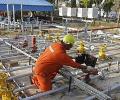
The Consumer Price Index-based inflation rose to 5.11% in January

The oil industry experienced three upheavals between 1973 and 1991, which seem to be etched in the memory of the industry's decision makers. Naturally, at the sign of a new crisis, the decision makers like to dip into those tumultuous decades to find ways to deal with the new shock, in addition, of course, to expert reports and forecasts. So, the industry bigwigs turned the pages of history to get a peek into the future of oil price movements after Russia invaded Ukraine in 2022, Israel attacked Gaza in 2023, Iran-linked Houthi rebels pounded tankers crossing the Red Sea in support of Palestine the same year, and Iran rained missiles on Israel in 2024.

Global head of equity strategy at Jefferies, Christopher Wood, has cut his exposure to Indian equities by one percentage point in the Asia-Pacific ex-Japan relative-return portfolio, and Australia and Malaysia by half a percentage point each in favour of China, which has seen a hike in exposure by two percentage points. The rally in China has been fast-forwarded by the approach of a seven-day holiday with the CSI 300 Index up 8.5 per cent on Monday, and 25.1 per cent in five trading days, he said.
OPEC, which has oil reserves that constitute 80 percent of the total global reserves, is unwilling to increase output to bring down oil prices. This makes OPEC too responsible for the rising oil prices, apart from the weak dollar. OPEC has said that world oil demand this year is forecast to grow by 1.2 million barrels daily to an average of 87 million barrels per day. As OPEC's output remains insufficient to cover rising demand from Asian region, oil prices will tend to rise.

The task of Union Finance Minister Arun Jaitley to keep inflation under check, even when the country reeled under severe drought for two years in a row, and reduce the current account deficit, was made easier by low crude oil prices.
The wide-ranging sanctions imposed by the US on the Russian oil sector have started to dent near-term oil flows to India with state-owned Bharat Petroleum Corporation Ltd (BPCL) saying not enough cargoes are available for March.
As global tensions put pressure on the cost of crude oil, sending petrol prices above 1 a litre across the UK, This is Money investment writer Philip Scott investigates how investors can profit from rising oil prices.

The country's GDP grew at the fastest pace in seven quarters at 7.7 per cent in the January-March period, retaining the fastest growing major economy tag on robust performance by manufacturing and service sectors as well as good farm output.
Rising crude oil prices along with hardening interest rates in the domestic market have taken a toll on India Inc's growth outlook in the first quarter of the current fiscal.

Godrej Consumer Products Ltd (GCPL) reported a 2 per cent year-on-year (Y-o-Y) increase in consolidated revenue to Rs 3,670 crore. Organic revenue growth in constant currency was up 14 per cent Y-o-Y. Consolidated operating profit was up 5 per cent to Rs 760 crore, profit before tax grew 10 per cent Y-o-Y to Rs 710 crore, and adjusted net profit grew 12 per cent Y-o-Y to Rs 490 crore.

From the Sensex pack, Tech Mahindra, HDFC Bank, Larsen & Toubro, ITC, Infosys, IndusInd Bank, Kotak Mahindra Bank, Titan and HCL Technologies were among the gainers. Maruti Suzuki India, Tata Steel, Bajaj Finance, UltraTech Cement, Nestle India, Axis Bank and Tata Consultancy Services (TCS) were among the laggards.

From the 30-share pack, Hindustan Unilever, Tata Motors, Axis Bank, Nestle India, Asian Paints, ITC, Reliance Industries, Mahindra & Mahindra, IndusInd Bank and State Bank of India were among the laggards. Larsen & Toubro, Tata Steel, JSW Steel, HDFC Bank, Adani Ports, Kotak Mahindra Bank, Bharti Airtel and PowerGrid were among the gainers.
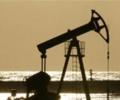
The drop in oil to around $50 a barrel this year has triggered steep cutbacks in production of US shale oil

Investors' wealth on Monday surged Rs 4.21 lakh crore as markets bounced back after five days of fall. The BSE Sensex jumped 602.75 points or 0.76 per cent to settle at 80,005.04. During the day, it surged 1,137.52 points or 1.43 per cent to 80,539.81.

On a five-day rolling basis, FPI selling is the highest in 24 years.
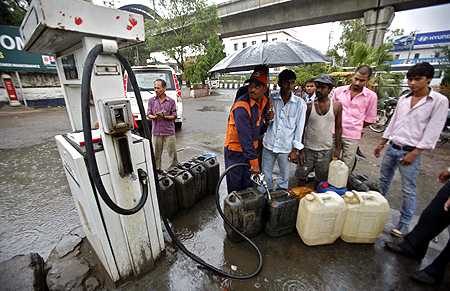
Global supply is staying in excess of demand.
