
The Reserve Bank of India (RBI) has started winding down its short position in the dollar forward book, after a gap of seven months, on the back of a softening dollar, while infusing funds via open market operations (OMOs) to counter the resulting liquidity drain.

From the Sensex pack, HCL Tech, Bajaj Finserv, HDFC Bank, Bajaj Finance, Infosys, Titan, ICICI Bank, Sun Pharma, Reliance Industries, Larsen & Toubro, Tech Mahindra and NTPC were among the biggest laggards. Among gainers, IndusInd Bank jumped over 5 per cent while Zomato ended marginally higher.

Murali Deora, Minister of Petroleum & Natural Gas has urged the need for sustainable international oil prices stating that the high oil prices are neither in the interest of oil importing countries nor beneficial to the exporting nations.

With crude palm oil prices on the rise, companies have started to jack up rates of soaps and edible oils in order to pass on the hike to consumers. Crude palm oil, one of the main ingredients in the manufacture of some consumer goods, saw a price rise of 45.2 per cent in the last three months. One of the country's largest consumer companies, Hindustan Unilever, said it has already started to take price increases in the skin cleansing category.
Worried about the possibility of oil prices' pushing up inflation, the Reserve Bank on Tuesday said chances of prices going up in the coming days need to be viewed against this background.

'We are not incentivising the old tax scheme. These taxpayers will also shift to the new regime after comparison.'
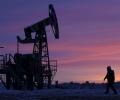
International oil prices jumped to the highest level since 2014, topping $87 a barrel but domestic petrol and diesel prices remained unchanged for the 74th day in a row - a freeze that may be linked to ensuing assembly elections in states like Uttar Pradesh and Punjab. Brent - the key global oil benchmark - soared to $87.7 per barrel mostly due to rising geopolitical tensions and supply-side disturbances due to Yemen's Houthi group's attack on oil facilities in the United Arab Emirates. Also, global inventories are waning. The attack, some analysts believe, may lead to more hostile behaviour between the two power centres in the Middle East - Iran and Saudi Arabia.

Tata Steel was the biggest loser in the Sensex pack, sliding 8.59 per cent, followed by Tata Motors, Larsen & Toubro, Adani Ports, IndusInd Bank, Tech Mahindra, Reliance Industries, Sun Pharmaceutical, HCL Technologies, Tata Consultancy Services, Infosys, and NTPC, were the major laggards. On the other hand, Bajaj Finance, HDFC Bank, Nestle India, ICICI Bank, ITC, Asian Paints and Axis Bank were among the gainers.

The US Fed interest rate decision, global trends, tariff-related developments and trading activity of foreign investors will drive the equity market movement this week, analysts said. Among macroeconomic data announcement, WPI inflation for February is scheduled to be announced on Monday.
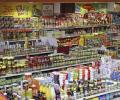
The volume growth of India's FMCG industry has slowed down in the March quarter to 5.1 per cent, driven by increased consumer purchases of small-value packs, according to the latest report from data analytics firm NielsenIQ. Volume growth is slowing across categories, and non-food segments are still outpacing food in the FMCG sector.

Marico reported consolidated revenue growth of 20 per cent year-on-year (Y-o-Y) during the January-March quarter (Q4) of FY25. Domestic revenue surged 23 per cent Y-o-Y, while volume growth was 7 per cent. International growth stood at 11 per cent (16 per cent in constant currency growth).

The current oil prices at nearly $83 a barrel, which are slightly above the $70-80 band, are ideal for producers and consumers and are at sustainable levels, Saudi Arabia Minister of Petroleum and Mineral Resources Ali Al-Naimi has said in a news report.

Ahead of a meeting of oil producers' cartel OPEC, India on Tuesday said the current oil prices are "very challenging" and rates need to be a "little bit sober" lest they impact a consumption-led recovery of the global economy. Oil Minister Dharmendra Pradhan, who last week again urged OPEC to phase out its production cuts, said India is a price-sensitive market and it will buy oil wherever it gets competitive rates. The rebound in international oil prices from lows hit last month on the back of demand recovery has led to a spike in petrol and diesel retail prices in India.

From the Sensex pack, IndusInd Bank, Infosys, Bajaj Finserv, Mahindra & Mahindra, Zomato, Hindustan Unilever, Power Grid, Axis Bank, UltraTech Cement, Adani Ports, and Tata Consultancy Services were among the laggards. On the other hand, Sun Pharmaceuticals, ICICI Bank, Bharti Airtel, HCL Technologies, Maruti Suzuki India, Larsen & Toubro, Reliance Industries, Kotak Mahindra Bank and Titan were the gainers.

In an eventful week ahead, stock markets may face volatile trends before the RBI's interest rate decision and the US inflation data announcements, as investors continue to assess the broader implications of US tariffs on global economy and inflation, analysts said. Investors fear that a full-blown trade war will impact global trade and economic growth, according to market experts.

At the end of the day, for many worldwide, the ongoing mutual attacks between Israel and Iran would seem a contest devoid of any moral high ground and only a bout between two ordinary adversaries, one that nevertheless risks spinning out of control into a larger conflagration, notes Shyam G Menon.
Rising crude oil prices are alarming, says PM. He considers all possible options to deal with it.

With India making it clear that the US doesn't have enough spare capacity for crude oil, Washington, DC, now wants India to sign fixed-term liquefied natural gas (LNG) contracts with American producers, multiple sources in the know said.

Investors lost Rs 24.69 lakh crore in market valuation in the last four days of severe drubbing in the equity market. Spike in global crude prices, unabated foreign fund outflows, a strong US jobs data diminishing early rate cut expectations, and the rupee logging its steepest single-day fall in nearly two years dampened investors' sentiment.

United States President Donald Trump on Sunday warned of new and significantly higher tariffs on Chinese goods if Beijing does not withdraw a recent 34 per cent retaliatory tariff hike, threatening to end all ongoing talks with China.
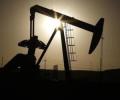
OPEC's move to cut output has pushed up oil prices. From here it could go either way: oil could reach $100/barrel or an analysis of demand and supply might follow, say Abheek Barua & Bidisha Ganguly.

Foreign exchange reserves of the oil producers have increased by $1.1 trillion over the past decade.

Air passengers might have a reason to smile this Diwali season as average airfares on many domestic routes have dropped 20-25 per cent compared to the year-ago period, according to an analysis. Increased capacity and the recent fall in oil prices are considered to be among the factors for the fall in air ticket prices. The analysis by travel portal ixigo showed that average airfare on the domestic routes have declined in the range of 20-25 per cent.
Petroleum Minister Mani Shankar Aiyar on Monday hoped that international crude oil prices will ease in the near future and said India was in a comfortable position to sustain prices at around $50 a barrel.
The Planning Commission on Thursday said the surge in global oil prices should be passed on to customers, but favoured having some provisions to safeguard the interests of vulnerable sections of the society.
RIL is doing better than the regional benchmark due to its ability to process heavy and sour crude, coupled with the higher product prices of petroleum products in the overseas markets. The company's GRMs were $13.6 a barrel in Q2 FY08. Analysts at domestic brokerage houses are estimating the GRMs of Reliance Industries at $14-$15 a barrel compared with the regional benchmark Singapore refining margin of $8 a barrel last month.

The US Fed interest rate decision, inflation data and FIIs are the key factors that are expected to drive stock markets this week, analysts said. Global trends will also be tracked by investors for further cues, they added. "The Indian stock market's future trajectory will be influenced by a blend of global and domestic factors.

Moody's said it expects exposure to low oil prices to shave off 0.8 per cent from real GDP growth on average across oil exporting countries in 2016.

Retail inflation dipped marginally to a nearly six-year low of 3.34 per cent in March due to a decline in prices of vegetables and protein-rich items. The Consumer Price Index (CPI) based inflation was 3.61 per cent in February and 4.85 per cent in March last year.

India, the world's third largest oil consuming and importing nation, spent 112.5 billion euro (about Rs 1.5 lakh crore) on buying crude oil from Russia since the start of the Ukraine war, a European think tank said on Thursday. The Centre for Research on Energy and Clean Air (CREA) released a report on payments to Russia for fossil fuels since February 24, 2022. "According to our estimates, since the beginning of the war, Russia earned EUR 835 billion in revenue from fossil fuel exports," it said.

Investors should avoid making drastic changes to their asset allocation during a market correction.

While OPEC has been unable to agree on an output freeze in an effort to support prices, Iraq was the latest Middle East producer to raise its exports quota
Reserve Bank of India Governor Bimal Jalan said on Friday that current crude oil price levels were not a cause for worry.

An analysis of year-wise movements of average global crude oil prices versus India's GDP reveals no inverse correlation, contrary to wide belief.
India, which imports 73 per cent of its oil needs, has been hit by the surge in international crude oil prices that touched $96 a barrel last week. State-run fuel retailers Indian Oil, Bharat Petroleum and Hindustan Petroleum are currently losing Rs 240 crore (Rs 2.4 billion) per day on selling petrol, diesel, domestic LPG and PDS kerosene as the government has not allowed them to raise retail prices in line with the surge in cost.
Crude oil prices in July last year rose to a historic high of $147 and then plumetted to four-year low of $37 per barrel, all in just four months time. The minister said the global financial crisis which was the primary reason for the slump in international oil prices, has forced India to revise growth targets.
Dan Denning analyses the correlation between the soaring oil prices and banking rates in the Western world.
