
Chennai-based SKASports Investments Private Ltd has signed an agreement with a Singapore club to develop a regional sports ecosystem that would tap the large pool of footballers and coaches from India.
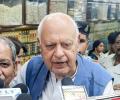
Veteran politician Farooq Abdullah survived an assassination attempt at a wedding in Jammu, raising concerns about security protocols for high-profile individuals. Abdullah attributes his survival to divine intervention and the bravery of his security detail, while calling for a thorough investigation into the incident and the apparent lack of police presence.
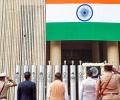
Maharashtra Chief Minister Devendra Fadnavis on Wednesday paid floral tributes at the city police headquarters to those who made the ultimate sacrifice while fighting terrorists during the 2008 Mumbai terror attacks.

The enduring relationship between the two countries have survived the disintegration of the erstwhile USSR in 1991, the end of the Cold War and the regime change in both countries, points out Rup Narayan Das.

Stunning images featuring NSG commandos using death-defying spider-man technique for intervention to an insight into anti-hijacking operations are shot by ace photographer Pravin Talan and his associate Rupali Saagar.
Government sources said amendments were being considered to the Atomic Energy Act to allow private sector participation and the Civil Liability for Nuclear Damage Act to limit the liability on suppliers of equipment to build atomic energy plants.

China, while blocking India's entry into the NSG previously, has called for a two-step plan that stipulates the need for the NSG members to arrive at a set of principles for the entry non-NPT states and then move forward discussions of specific cases.
A lowdown on why NSG membership is important for India

Stating that India's entry into Nuclear Suppliers Group will "shake strategic balance in South Asia and even cast a cloud over peace and stability in the entire Asia-Pacific region", an article in the state-run 'Global Times' however said China could support India's inclusion in the 48 member nuclear club if it "played by rules".
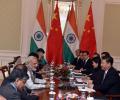
External affairs ministry spokesperson Vikas Swarup also asserted that India's participation in the NSG would have further strengthened nuclear non-proliferation regime and made global nuclear commerce more secure.
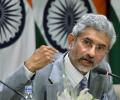
The visit comes ahead of the NSG plenary meeting in Seoul on June 23 and 24.

China's official media on Tuesday went public over India's Nuclear Suppliers Group bid for the first time, saying New Delhi's membership of the elite club will not only touch a "raw nerve" in Pakistan and increase a nuclear arms race in the region but also "jeopardise" China's national interests.

India on Thursday secured Mexico's backing in its bid to become member of the Nuclear Suppliers Group as it aggressively scouted for support ahead of a crucial meeting of the 48-nation nuclear trading bloc in Vienna.

China's state media on Tuesday defended Pakistan's nuclear record, saying it was A Q Khan who was responsible for atomic proliferation which was not backed by the government and argued that any exemption to India for Nuclear Suppliers Group entry should also be given to Pakistan.

According to the Dawn, Pakistan submitted its membership application on May 19, a week after India, which applied on May 12.
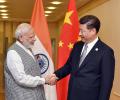
Chinese chief negotiator Ambassador Wang Qun told ANI on Friday, "NSG will not take up India's case as of now. There are differences on admitting non-Nuclear Non-Proliferation Treaty members. Signing the NPT first is one of five criteria (for membership). These have not been set by China, but by group as a whole."

"It's [part of] a greater design," Janjua said at a seminar on 'Pakistan's case for NSA membership' on Tuesday.

Beijing now fears that the fallout of the NSG outcome could have an impact on a crucial verdict expected soon from the Permanent Court of Arbitration in The Hague in a case brought by the Philippines concerning China's territorial reclamation activities in the South China Sea.

Pakistan's National Security Adviser Nasser Janjua has alleged that America's efforts to include India in the Nuclear Suppliers Group was part of a "greater design" to contain China and prevent the resurgence of Russia.

The draft of the proposal for the India-specific exemption at the Nuclear Suppliers Group has undergone further changes which include a provision for regular information by its head about New Delhi's adherence to its guidelines on global atomic trade, a move aimed at pacifying countries having reservations over the waiver to India.
China on Monday said differences remain among members of the Nuclear Suppliers Group over the inclusion of new countries and the issue was not even on the agenda of the grouping's meeting in Seoul this week, a day after External Affairs Minister Sushma Swaraj asserted that Beijing was not opposing India's entry

Immediate NSG membership will not help India realise its nuclear ambitions any faster. It could have easily left the process take its own course, instead of running a high-stakes campaign to get in, says B S Raghavan.

A panel for informal consultations on India's membership has also been set up by the NSG and it will be headed by Argentine Ambassador Rafael Grossi.

Reports from Vienna said that China was leading the opposition to India's membership. Turkey, New Zealand, Ireland, South Africa and Austria are said to be backing the Chinese stand.

Foreign Secretary F Jaishankar rushed to Seoul ahead of the crucial plenary meet even as China said that India's bid was not on the agenda.

Chinese foreign ministry spokesperson, Hua Chunying said China-Pakistan cooperation is in accordance with the 48-member nuclear club, which supervises global nuclear commerce.

The bilateral relations have maintained sound momentum of growth, thanks to the mutual visits of the leaders by the two countries, Chinese foreign ministry said.
Russia on Friday assured that India would continue to enjoy the waiver it received in 2008 from the Nuclear Suppliers Group's export ban and Moscow wants New Delhi's full participation in the 45-nation grouping that regulates global atomic commerce. Russia's assurance came after India objected to the new guidelines adopted in June by the NSG on the export of nuclear enrichment and reprocessing equipment.

Criticising the strong reactions from India over China blocking its bid to enter NSG, a state-run daily on Monday said India is "still stuck" in the 1962 war mindset as it called for a more objective evaluation of Beijing's stand.
"US is still working on the revised draft and India is still demanding 'clean and unconditional' waiver. While there is still a distance to go, the proposal to give India a clean exemption from global nuclear trade standards is in deep trouble," Daryl Kimball, the Executive Director of the Arms Control Association, has said."It is vital that these and other states stand their ground," Kimball maintained.
Non-proliferation specialists and non-government organisations have asked the foreign ministers of the Nuclear Suppliers Group to reject the US proposal to exempt India from long-standing global nuclear trade standards.

Making nuclear exemptions for India, says Senator Edward Markey, 'only infuriates Pakistan and leads them to further increase their own nuclear capacities.'
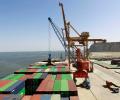
The customs officials, based on an intelligence input, halted a Malta-flagged merchant ship -- CMA CGM Attila -- at the port en route to Karachi on January 23 and inspected the consignment, which included a Computer Numerical Control (CNC) machine, originally manufactured by an Italian company.
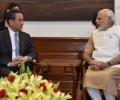
Wang and Swaraj also discussed issues relating to annual BRICS summit which will be hosted by India in Goa in October.
He admitted that some member countries of the 45-nation grouping have expressed concerns about the deal and 'we have talked to a lot of those various states'. "I am not going to name them, but we have talked to a lot of them. They have announced themselves publicly. You can look it up and what their concerns are," McCormack said.
Addressing the media jointly with Modi after hour-long talks at the White House, Obama said it was natural for India and the US, two biggest democracies, to 'deepen and broaden' partnership.

The Hague Code of Conduct against Ballistic Missile Proliferation is a toothless mechanism, but it may well end up serving India's interests, says Ajay Lele.

The IAF has already set up a dedicated operations direction centre for coordinating various aspects of the arrangements with security agencies concerned, they said.

Although the credit for acquiring the technological skill must be given to India's outstanding nuclear scientists, the decision to go nuclear was a political one that entailed clarity of vision, courage and resolve, points out Rup Narayan Das.

India on Monday got the backing of Switzerland in its bid to become a member of the Nuclear Suppliers Group.
 © 2026 Rediff.com - Advertise with us - Disclaimer - Privacy Policy - Sitemap - Feedback - About us - Terms of use - Grievances