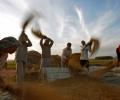
Farmers with land sizes less than 0.01 hectare have an average annual income of Rs 54732 and annual consumption of Rs 61296, thereby, a debt of Rs 6564 each year. Compare this with the minimum pay for a government employee, says Devanik Saha.

There is lack of scientific basis in computing the poverty line, says govt.

One popular strategy is to hire contract workers.
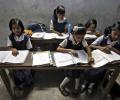
With India lagging behind on several human development indices including healthcare and education, the Union government's decision to up the spending on these sectors is a step in the right direction. However, much more needs to be done in the way of increasing accountability and arresting corruption if headway is to be made on these fronts, says Devanik Saha.

Utkal Tubers is selling potato seeds in new areas and seizing the opportunity to create a Rs 100-crore firm.
Utkal Tubers is selling potato seeds in new areas and seizing the opportunity to create a Rs 100-crore firm.

'The Indian economy has been subsidised by the poor.'
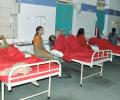
Taking away free healthcare facilities, as recommended by the Aayog, would place a huge burden on the people, especially in rural areas, says Devanik Saha.

21st century may have witnessed expansion of higher educational institutions, but who can afford it? Sushree Panigrahi & Jeet Singh look at the numbers.
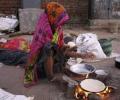
The World Bank said improved infrastructure, specifically rural electrification, has had far-ranging effects

With India poised to become the largest economy in the world by 2030, it cannot afford to leave half of its workforce behind.
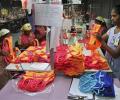
Reasons include include dropping out of education, raising children and family pressure
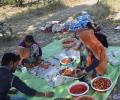
'To bring about a paradigm shift in farmers's income, we need to change our approach to agriculture, and transit from the narrow prism of cultivation to a full-fledged enterprise, by building all associated supply chain linkages.' 'This alone will make the farmer an entrepreneur in his own right.'

States spent much more in the first three months of the current financial year compared to the corresponding period last year.
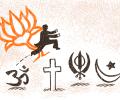
'One one hand, the BJP puts Uniform Civil Code as a goal in its manifesto, and on the other, it pushes massive discrimination against Hindus.' 'This is not sabka saath, sabka vikas. Rather it is "Haj ka saath, church ka vikas",' argues Sankrant Sanu.

China's Xiaomi to unveil its first India-made phone on Monday
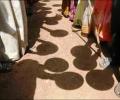
Majority of 'Bimaru' states register faster fall in rural poverty, while pace mostly other way round for others
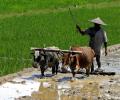
During the UPA government's second term in office, rural India's consumption expenditure grew at a faster pace than urban India's - for the first time since 1991.

With a rise in the clout of Muslims in western Uttar Pradesh, fearful Hindus are being radicalised.

After helping the government in policymaking since October 2014, Chief Economic Adviser Arvind Subramanian is returning to academics and will be teaching at Harvard Kennedy School on a visiting position. In an interview to Dilasha Seth and Somesh Jha, he says the ease of doing business agenda needs to move forward and India must try to integrate with the global value chains. Edited excerpts.

'The cash part is the lower hanging fruit compared to the other sources.' 'To attack the cash part of black money, I can't think of anything else but demonetisation.'

The estimates of national income and growth do not pass the 'smell test'.
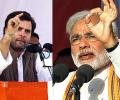
A Narendra Modi administration would believe more in decentralisation than would a Rahul Gandhi administration, says Arvind Panagariya.

The underclass voted heavily in favour of AAP, which led to their victory

This could be a major drag, not just on the empowerment of women but on the India growth story as well.

'This is India, bhai. This kind of country does not exist anywhere in the world.'

Several states that imposed prohibition in the past lifted it once revenue loss began to pinch

'We eat first, they later; we sit on chairs and they on the floor; we call them by their names and they address us by titles,' writes Tripti Lahiri, author of Maid in India.
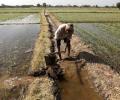
The average land given to the rural landless is small and falling, from 0.95 acres in 2002 to 0.88 acres in 2015 - a 7.4 per cent drop over 13 years-and a slowdown is evident in the process of taking land away from rich landlords, the RTI data reveal.

Only three percent of Indians pay income tax; our tax-GDP ratio is among the lowest in the world. This must change. Our elites must realise that India's poverty has damaging consequences for them, and that they can help decrease it. The food security bill, with all its limitations, will hopefully contribute to generating such awareness, says Praful Bidwai.

With facts and figures, the CAG report has highlighted how Gujarat was far from a role model for states across India, and that the progress made in this province in western India in improving agriculture, education, healthcare and empowerment of women and children, was not exactly creditable, says Paranjoy Guha Thakurta.
