
In the wake of the recent hostilities, both sides have moved from weapons to words, with India dispatching several delegations to visit more than 30 capitals across the world. A similar effort by Pakistan is set to start on Jun 2.

Top military officials from India and Pakistan highlighted their views at the Shangri-La Dialogue in Singapore, billed as Asia's premier defence forum, amid heightened tensions between the two sides following last month's military confrontation.

'War is not an answer. War is not a solution.' 'Deterrence is a solution. We should have the stick with us with which we can beat Pakistan.'
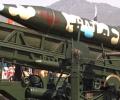
'The Indian gung-ho leadership may like to think about it, there should never ever be a doubt in anyone's mind, friend or foe, that Pakistan's operationally ready nuclear capability enables every Pakistani leader the liberty, the dignity and the courage to look straight into the Indian eye and never blink.'

Pakistan on Monday successfully test fired the nuclear-capable Babur cruise missile with a range of 700 km that could hit targets deep inside India, with the military saying the launch had consolidated and strengthened the country's deterrence capability.

A new bill passed by the Pakistani parliament may snatch the remote control of the country's nuclear bombs from President Asif Ali Zardari.
Pakistan expressed concern over what it described as India's "massive" induction of advanced weapon systems and adoption of "offensive" military doctrines and said it would not compromise on the maintenance of a credible minimum nuclear deterrence.

Pakistan President Asif Ali Zardari has transferred control of nuclear weapons to Prime Minister Yousuf Raza Gilani.
Chief of Army staff General Deepak Kapoor on Sunday said it was important to ensure that the control of Pakistan's nuclear weapons command does not go to "wrong hands".
Commenting on news reports that the United States had proposed to accredit an official deployed at the American embassy in Islamabad to the NCA, Foreign Office spokesman Mohammad Sadiq said, "Delegations and individuals do meet the members of the NCA, but it is not possible to accredit an official to the NCA." The NCA comprises the President, Prime Minister, Foreign Minister, Defence Minister and top civil and military officials.
The ordinance, issued late in the night, gives a more structured character to the NCA, which was originally set up in February 2000 to address concerns about the safety of the nuclear arsenal. Under the original set-up, the chief of the NCA was the head of the government or the Prime Minister. The ordinance, issued by Musharraf, names the President as the chairman of the NCA and the prime minister as the deputy chairman.
This is in contrast to India, where the control is with the civilian authority headed by prime minister.
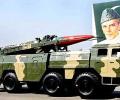
Pakistan military has appointed Lt Gen Zubair Mahmood Hayat as the new chief of the Strategic Plans Division, which manages and secures the country's nuclear arsenal.

Pakistan on Thursday said its nuclear assets are completely safe and dismissed the world's suspicions as "baseless" at a meeting of the National Command Authority chaired by Prime Minister Nawaz Sharif.

He said Pakistan was working with the international community to ensure the security of its nuclear installations, which were always in safe hands.

The country's top security body "concluded that India has committed uncalled for aggression to which Pakistan shall respond at the time and place of its choosing," it added.

This will be the fifth time that Prime Minister Sharif will pick the top commander of the country's nearly 550,000 ground troops.

'Any conventional conflict could trigger a nuclear war with results that neither India nor Pakistan could survive easily.' >A revealing excerpt from Shuja Nawaz's The Battle For Pakistan: The Bitter US Friendship And A Tough Neighbourhood.
It currently has between 140 and 150 nuclear weapons in its control and stockpiled around 200 to 300 kilogram of plutonium.
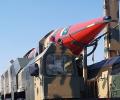
Pakistan will not delegate "advance authority" over nuclear weapons to military unit commanders even in the event of a crisis with India, according to a media report.

'Pakistan's security establishment, despite its appallingly immoral approach to conflict, has worked with limited resources to maximise its national defence resources to continue bleeding India,' says Ajai Shukla.

Obama seeks reduction of nuclear arsenal in India and Pakistan while Pakistan seeks NSG membership

General Qamar Bajwa, his colleagues say, is a firm opponent of extremism and terrorism. He may prove even more forceful in the fight against terrorism than his predecessor, who is credited with launching Operation Zarb-i-Azb, which helped lower the frequency of terrorist attacks.
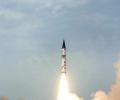
DRDO's latest test towards developing an anti-ballistic missile shield, to protect Indian targets against nuclear-tipped ballistic missiles fired from Pakistan or China will provide a technology that is akin to striking a bullet with a bullet, say Ajai Shukla

Experts trace the reasons for the 26/11 attacks to the Pakistan's military interest in three key areas: Kashmir, Afghanistan and nuclear armaments.

Indian policymakers must incorporate in their nuclear doctrine a realistic response to tactical nuclear warheads, says Ajai Shukla.
 © 2026 Rediff.com - Investor Information - Advertise with us - Disclaimer - Privacy Policy - Sitemap - Feedback - About us - Terms of use - Grievances