
India has accumulated experience organically and in public, through blood, sweat and toil -- one commissioning and one agreement at a time -- and is called a regional power. China has accumulated hulls, by misdirecting its industrial capacity, and is mistakenly called a superpower. The Indo-Japan defence agreement pushes this theory to its limits without ever naming the dragon in the room, points out Dr Abhishek Puri.

India and Japan have signed a Memorandum of Arrangement on maritime security cooperation, committing to deepen defence ties and oppose unilateral actions that impede freedom of navigation in the Indo-Pacific, a move seen as directed at China's increasing military presence.

Notwithstanding the economic complementarities and the host of agreements for deepening economic relation on a host of areas, both sides share common viewpoints on the foreign policy domain and seek common grounds to serve as a counterweight to China, notes Dr Rajaram Panda.

The goal of the CDS' visit was to emphasise the rising significance of defence collaboration between India and Japan while reiterating strategic cooperation
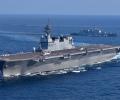
Here are some of the glimpses of the exercise held in the North Arabian Sea.
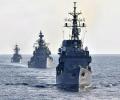
The Indian Navy is also ramping up its operational cooperation with various friendly naval forces like the United States Navy and Japan Maritime Self Defense Force in view of the fast evolving regional security landscape, they said.

Malabar 2016 -- a trilateral maritime exercise involving the Indian Navy, the Japan Maritime Self-Defense Force and the US naval forces in the Indo-Asia-Pacific -- concluded on June 17.

The compulsion behind India and Japan to deepen security cooperation is in response to China's growing political and economic clout and its assertive behaviour in disputed areas. This has been the key driver for bringing both India and Japan closer in the domain of security cooperation, explains Dr Rajaram Panda.

The 19th edition of the Malabar naval exercise saw the Indian, US and Japanese maritime forces participated jointly in the routine.
"Relevant countries should abandon the obsolete Cold War mentality and narrow-minded geopolitical rivalry concept and view correctly and respect people's aspiration in the region and do more things conducive to regional solidarity and cooperation," Chinese foreign ministry spokesman Zhao Lijian said.

The India-Japan joint naval exercises are a strategic signal for China, observes Dr Rajaram Panda.
National Security Advisor Ajit Doval on Thursday called for seamless coordination among various agencies involved in protecting India's maritime interests in the face of emerging security challenges and increasing rivalries and competitions in the Indian Ocean.

The navy has significantly expanded its deployment in the Indian Ocean Region deploying a plethora of warships and submarines to create pressure points on China as the maritime space around the Malacca Strait is very critical for its supply chain through sea routes.
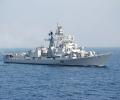
The Indian ships' participation in MALABAR-16, a maritime exercise with the US Navy and Japan Maritime Self-Defense Force, reflects the vital strategic importance of the region to India.

Curtains will fall on the Rim of the Pacific 2016, the world's largest international maritime exercise, on August 4.
China's behaviour in the post-pandemic geopolitical landscape which may determine the Quad's future trajectory, notes former foreign secretary Shyam Saran.
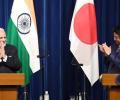
During the 13th annual summit, the two prime ministers reviewed developments in bilateral relations and explored new areas of cooperation, focusing on shared vision for peace and prosperity in the Indo-Pacific, where China is flexing its muscles.

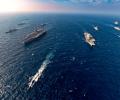
95 aircraft, 16 ships and 2 submarines from 3 countries are taking part in Malabar exercise.

New Delhi's growing defence partnership with Tokyo could take wing with the US-2 (Utility Seaplane Mark 2), a one-of-a-kind amphibious aircraft that has Indian naval planners goggle-eyed.

When a Chinese warship entered Japanese waters, the Indian commander called on China to maintain discipline at sea. Dr Rajaram Panda explains the significance of the Malabar exercises between India, Japan and the US.

Japan has the capital and needs to pull out of China, which has been its major destination. India, on the other hand, desperately needs capital especially for infrastructure, argues Rajeev Srinivasan.
