
Rising mercury levels in Madhya Pradesh are causing discomfort for residents as night temperatures fail to provide relief, disrupting sleep patterns and daily routines.

Rising mercury levels in Madhya Pradesh are causing sleepless nights for residents as minimum temperatures remain high. Doctors report an increase in sleep-related issues, allergies, and fatigue due to the heat.

Large parts of India are experiencing a severe heatwave, with temperatures soaring to dangerous levels. Authorities have issued alerts and health advisories as the heatwave intensifies across multiple states.
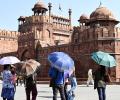
In Rajasthan, Pilani recorded 44.9 degrees Celsius, Phalodi and Churu touched 43.8 degrees Celsius and 43.5 degrees Celsius respectively, while Bikaner and Jaipur registered 43.4 degrees Celsius and 43 degrees Celsius.
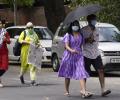
The India meteorological department said heatwave conditions will persist for at least two more days.
India is expected to experience hotter-than-usual temperatures from April to June, with more heatwave days in central and eastern India and the northwestern plains, the IMD said. Most parts of the country will see higher-than-normal maximum temperatures, except for some areas in western and eastern India where the temperatures are expected to be normal. Minimum temperatures will also be above normal in most regions. The IMD has warned that landslides could occur in parts of Kerala and Karnataka in the Western Ghats and that northeastern states might face flooding in April.

Ten to 20 days of heatwave are expected against the normal of four to eight days in the entire April-June period.

Heatwave conditions are expected over northwest India during the next five days, with Punjab, Haryana, Rajasthan and Delhi predicted to bear the maximum impact, the India Meteorological Department (IMD) said on Thursday.

Among the fatalities recorded on Friday, the maximum 17 were from Uttar Pradesh, 14 from Bihar, five from Odisha and four from Jharkhand, where officials said more than 1,300 people are hospitalised with heatstroke conditions.
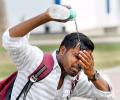
Heatwave conditions have been prevailing in Odisha since April 15 and the Gangetic West Bengal since April 17, according to the MeT department.

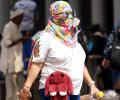
Temperatures remained above 45 degrees Celsius in large parts of Rajasthan, Haryana, Delhi, Chandigarh and Uttar Pradesh, affecting daily life as many chose to remain indoors in the afternoon.

The threshold for a heat wave is met when the maximum temperature of a weather station reaches at least 40 degrees Celsius in the plains, 37 degrees in coastal areas, and 30 degrees in hilly regions, and the departure from normal is at least 4.5 notches.

The heat wave is likely to impact parts of Jammu and Kashmir, Himachal Pradesh, Uttarakhand, Punjab, Haryana, Delhi, Rajasthan, Madhya Pradesh, Jharkhand, Odisha and Gangetic West Bengal, the Met office said.

According to an IMD forecast issued on Thursday, a heatwave spell will persist over northwest and central India during the next five days and over east India during the next three days.
'The intensity and frequency of heatwaves will be much higher than in previous years over Punjab, Haryana, Rajasthan, Gujarat, Madhya Pradesh and Odisha.'
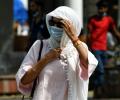
No part of northwest, central and east India is likely to record a heatwave over the next five days, the MeT office said.
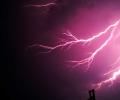
Lightning claims more lives in India annually than any other extreme weather event. Between April and July this year alone, 1,621 people died due to lightning strikes.

The mercury breached the 46-degree Celsius mark in several places such as Allahabad (46.8 degrees Celsius) and Jhansi (46.2 degrees Celsius) in Uttar Pradesh; Sports Complex (46.4 degrees Celsius) in Delhi; Ganganagar (46.4 degrees Celsius) in Rajasthan; Nowgong (46.2 degrees Celsius) in Madhya Pradesh; and Maharashtra's Chandrapur (46.4 degrees Celsius).

Lakhs of voters will have to bear the searing heat when they step out to exercise their franchise in the second phase of the Lok Sabha elections on Friday.

A fresh spell of heatwave is likely to begin over northwest India from May 7 and over central India from May 8, the India meteorological department said on Thursday.
'If you look at the entire 60-day period of March and April, you see that temperatures were soaring more than 3.5 degrees Celsius above the maximum temperature.' 'Normally, events like this happen only for a short period.'

A study shows that the country has experienced 706 heatwave incidents from 1971-2019.

IMD data shows in the 24 hours between September 1 and 2, Haryana received 806 per cent more rainfall than normal, Punjab 759 per cent, Himachal Pradesh 510 per cent, Delhi 740 per cent, Chandigarh a staggering 1,638 per cent, and Rajasthan 193 per cent.

Above-normal heatwave days are predicted in most parts of central, east and northwest India during this period.

East and northeast India recorded 29 per cent rain deficit -- 141.5 mm against the normal of 199.9 mm -- from March 1 to May 3.

The IMD said heatwave conditions are likely to continue over the northern plains, and central and southern parts of the country for two more days and abate gradually.

The Met office has issued a "red" warning for Delhi, Haryana, Punjab and west Rajasthan, stressing the need for "extreme care for vulnerable people".

Parts of south, east and northeast India are expected to get some relief from the blistering heat, with the onset of monsoon expected to take place over Kerala on Saturday.

"We are expecting that the temperature will be higher than normal in the entire northwest India and the adjoining central India, starting with Gujarat, Rajasthan and up to east Madhya Pradesh and Chhattisgarh," he said at a virtual event on 'Building Climate Resilience for the Most Heat Vulnerable'.

The mercury at the Safdarjung Observatory is expected to breach the 43-degree mark on Thursday and touch 44 degrees Celsius by Friday, according to the India meteorological department.

The India Meteorological Department (IMD) has predicted above-normal rainfall for the upcoming monsoon season in India (June to September). The cumulative rainfall is estimated to be 105 percent of the long-period average. The IMD has also ruled out the possibility of El Nino conditions during the entire season. The monsoon is crucial for India's agriculture sector, which supports the livelihood of a significant portion of the population and contributes substantially to the country's GDP. However, while the prediction of normal rainfall brings relief, climate change is expected to cause variations in rainfall distribution.

Some India states are likely to record a significantly higher number of heatwave days, according to the national weather body.

Temperatures in 17 locations breached 48 degrees Celsius on Monday, with the relentless heat affecting health and livelihoods across large parts of northwestern and central India.

India is set to experience extreme heat during the April to June period, with the central and western peninsular parts expected to face the worst impact, the IMD said on Monday as the country prepares for seven-phase general elections from April 19.

Voting for the second phase of Lok Sabha polls will be held on Friday for 88 seats in 13 states with Congress leader Rahul Gandhi seeking a second-straight term from Wayanad in Kerala.

Government sources said Modi will also chair meetings to review the aftermath of the Cyclone Remal, especially in the north east region hit by natural disasters.

Intense heat swept through east India and parts of the southern peninsular region on Thursday, testing power grids and prompting the Kerala government to order closure of educational institutions till May 6.

Heavy rain in the first week of July compensated for the shortfall but caused flooding in many northeastern states.

The India Meteorological Department, which had issued a red colour-coded alert for north India for May 25-26 when the prevailing heatwave conditions are expected to peak, said dust and thunderstorms are likely to bring some relief on May 29-30.

Among the keenly watched contests are those involving former Uttar Pradesh chief minister Akhilesh Yadav (Kannauj, UP) and Union ministers Giriraj Singh (Begusarai, Bihar), Nityanand Rai (Ujiarpur, Bihar) and Raosaheb Danve (Jalna, Maharashtra).
