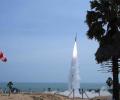
The fuel cost will come down if rockets are launched from Kulasekarapattinam as they will have a straight trajectory and need not have to avoid Sri Lanka, which is being done by rockets flown from Sriharikota.

India's Mars orbiter craft has completed eight years in its orbit, well beyond its designed mission life of six months. Plans on a follow-on 'Mangalyaan' mission to the Red Planet, however, are yet to be firmed up.

Lander Module of Chandrayaan-3 spacecraft comprising the lander and rover has successfully separated from the Propulsion Module, Indian Space Research Organisation said on Thursday.

The spacecraft will now prepare for separation of the lander module -- comprising the lander and rover -- from the propulsion module.
"Indeed, a satisfying feeling," K Radhakrishnan who as the then Chairman of Indian Space Research Oranisation (ISRO) led the Mars Orbiter Mission (Mangalyaan) team said on achieving the milestone.

As scientists of the Indian Space Research Organisation are decoding the data sent by Chandrayaan-1 from the moon, the space agency is confident that India's first lunar mission would reveal 'unexpected results and things'. "The data have been collected from unexplored area. We are well positioned with these data. We can tell the world that we have found many things, which no explorer has seen so far," Chandrayaan-I Project Director M Annadurai said on Saturday.
.jpg)
The final countdown for India's historic Mars mission kicked off at 6.08 am today.

The announcement comes two days ahead of the proposed historic launch of the ISRO's 100th satellite along with 30 others in a single mission from Sriharikota.

Data provided by the satellites helps experts predict the level of rains till then, what to expect in the next few hours and even about the situation in the forests and the water reservoirs.
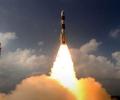
Research and markets estimated in May that the global opportunity for small and mini satellites would grow nearly one and half times to $5.32 billion by 2021

A high power satellite, GSAT-15 is being inducted into the INSAT/GSAT system. GSAT-15 carries a total of 24 communication transponders in Ku-band as well as a GPS-Aided GEO Augmented Navigation (GAGAN) payload operating in L1 and L5 bands.

ISRO has an opportunity to be the one-stop shop for satellite manufacturing, and Alpha Design is just the booster it needed.

It has already tasted success with the moon mission and Mangalyaan. Is man in space the next frontier for ISRO?
 © 2026 Rediff.com - Investor Information - Advertise with us - Disclaimer - Privacy Policy - Sitemap - Feedback - About us - Terms of use - Grievances