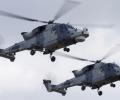
The sources further suggested that the two choppers remained in the Indian territory for about 10 minutes before heading back.

The two sides held diplomatic talks through video conference on the border standoff in midst of fresh details emerging that China has strengthened its position in several areas in eastern Ladakh including Galwan Valley where a violent clash on June 15 left 20 Indian soldiers dead.
In an address at the annual general meeting of industry chamber FICCI, Singh said the 'unprovoked aggression' on India's Himalayan frontiers is a reminder of how the world is changing and how existing agreements are being challenged.
Special Representatives of China and India have held 19 rounds of talks to resolve the boundary issue.

The incident had taken place at a time when the Indian Foreign Minister, S Jaishankar, was in Moscow for the Shanghai Cooperation Organisation meeting, where he met his Chinese counterpart to address the border issues.

The ministry of home affairs has recommended a ban on 54 Chinese mobile applications that pose a threat to the country's security, officials sources said on Monday.

The shelters were installed in locations near Tashigong, Manza, Hot Springs and Churup among others, in reflection of simmering tensions between the two sides in the region.
The field commanders have also been told that while patrolling their respective areas of responsibility or accomplishing any task, there should not be any extra display of strength or overuse of force, government sources told ANI.
China and India have agreed to work to maintain peace along the Line of Actual Control and resolve the border standoff through talks while implementing the consensus reached between the two countries' leadership that 'differences' do not escalate into 'disputes', a top Chinese official said.
The army said senior commanders of the Indian and Chinese military reviewed the progress on implementation of the first phase of disengagement and discussed further steps to ensure complete withdrawal of troops in the region.
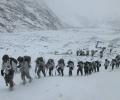
The Indian side has an edge over their Chinese counterparts in terms of battling the weather as a large number of them have already done duty in the Ladakh sector, including the Siachen glacier or other high altitude positions, sources said.
Singh said a meeting between senior Indian and Chinese military leaders has been scheduled for June 6 even as he asserted that India is not going to back off from its position. Asked about the current situation in sensitive areas in eastern Ladakh, he said Chinese have come up to what they claim is their territory while Indians believed it is theirs.

The officials said the focus of the talks was on 'full and enduring restoration of peace and tranquillity' along the border and also better coordination to ensure avoidance of such incidents in future.

The US president previously offered to mediate between India and Pakistan, a proposal rejected by New Delhi which maintains that there is no role for any third party in bilateral issues.

Top commanders of the Indian Army on Monday carried out a comprehensive review of the country's security challenges, including in eastern Ladakh and other sensitive areas along the Line of Actual Control (LAC) with China, on the opening day of a four-day conference, people familiar with the developments said.
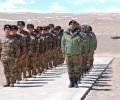
The fresh round of Corps Commander talks are scheduled to start at 10:30 AM at Moldo border point on the Chinese side of the Line of Actual Control in eastern Ladakh, they added.

Prime Minister Narendra Modi was not present at the all-party meeting convened by the government.

It has been argued that India should have held back on disengagement from the Kailash Range, using that as a trump card to force Chinese concessions in areas such as Depsang, where they hold the advantage.

The Army has also further bolstered overall surveillance mechanisms in all areas along the Line of Actual Control (LAC) in eastern Ladakh after foiling China's fresh attempt to occupy an area on the southern bank of Pangong lake, they said.

Congress leader Adhir Ranjan Chowdhury aid that India must tackle Chinese aggression using all necessary means.

A start-up firm in Noida said soon after the Galwan Valley clash, it was tasked by the Indian security forces to provide them equipment to be able to tackle the Chinese and they have provided them solutions in the form of non-lethal weapons inspired by the traditional Indian weapons like the 'Trishul' of Lord Shiva.
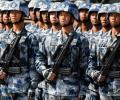
Asked about the continued tensions along the border and whether the PLA troops action was anyway related to the disagreements with the Indian government's plan to lure business out of China, Chinese Foreign Ministry spokesman Zhao Lijian said both the countries were in diplomatic contact over the face-off between their troops.

At least a couple of Chinese military helicopters were spotted flying close to the un-demarcated Sino-India border in the area after the fierce face-off on May 5 following which a fleet of Sukhoi-30 jets of the Indian Air Force too carried out sorties there, the sources said.
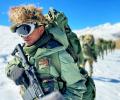
Referring to the developments in Ladakh in the wake of Chinese aggression, he said disengagement with People's Liberation Army was completed from various areas in a peaceful manner and efforts are on through dialogue for disengagement from other areas.

Every week, we bring you fascinating videos, chosen by you, through your likes.

Vice Chief of Army Staff Lieutenant General C P Mohanty on Thursday carried out a comprehensive review of India's military preparedness in eastern Ladakh on the first day of his three-day visit to the region where Indian and Chinese troops have been locked in a bitter standoff for over a year.
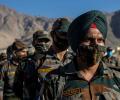
A day after the nearly 13-hour meeting, the two sides in a joint statement on Saturday reaffirmed that such a resolution would help restore peace and tranquillity along the Line of Actual Control (LAC) in eastern Ladakh and facilitate progress in bilateral relations.

The Indian side is expected to seek disengagement as soon as possible in the remaining friction points besides pressing for resolution of issues in Depsang Bulge and Demchok.

The two sides have also agreed for a joint mechanism to verify the progress in the disengagement process through delegation meetings as well as using unmanned aerial vehicles.

With the two armies again in a face-off at multiple points, there is apprehension of renewed clashes.
The Indian Army has been pitching for a faster disengagement process in areas like Hot Springs, Gogra and Depsang to bring down tension in the mountainous region.

'Once positions are hardened and troops start building defences, it is difficult for soldiers to step back.'
The BJP leader linked his claim to the beginning of construction of a Ram temple in Ayodhya following a Supreme Court judgment, and the abrogation of special status to Jammu and Kashmir under Article 370 of the Constitution.

'There was a wrong policy of government during the Congress regime. They didn't construct roads up to the border which left a buffer zone of 3-4 km which China occupied. Construction of new villages isn't a new thing, it's all inherited from Congress'

'There is a sense of realism in the Pakistan army that if they needled India during the Ladakh standoff, they would have seen a strong retaliation.' 'Pakistan was hoping that India would come out looking weaker in the region and get embarrassed, but that obviously has not happened.'
Jaishankar made these comments against the backdrop of the over five-month-long border standoff between India and China in eastern Ladakh where each side has deployed over 50,000 troops.
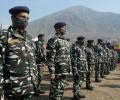
The CRPF has lost 108 personnel to COVID-19, the highest among the central forces that function under the command of the Union home ministry, according to data.
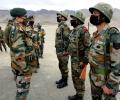
India and China have held several rounds of talks at the diplomatic and military-level to resolve the standoff that erupted in early May.

'Wang Yi said the border issue is important and we should stay committed to peacefully addressing it through consultation and coordination.'

The work on a link-road in Demchok in South-eastern Ladakh region has been stopped after objections were raised by the Chinese Army, barely months after repeated incursions by it in that area.
 © 2026 Rediff.com - Advertise with us - Disclaimer - Privacy Policy - Sitemap - Feedback - About us - Terms of use - Grievances