
'We must understand that the LAC is a political issue for China, so any action on the LAC will keep India focussed on the LAC which gives China the opportunity for any adventurism in the Indian Ocean.'
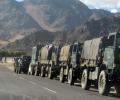
According to estimates, both India and China have deployed more than 50,000 troops in the Eastern Ladakh sector opposite each other despite the limited disengagement in the Pangong lake sector by both sides earlier this year.

Xi commended the battalion members for their remarkable efforts in guarding China's border region, noting that they have dedicated their youth to securing the country's territorial integrity and have accomplished their missions well, state-run Xinhua news agency reported.
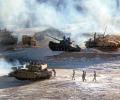
There was no visible forward movement in disengagement of troops in the remaining friction points as the Chinese side did not show flexibility in their approach on it at the 11th round of military talks.
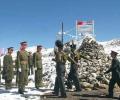
Since China began this buildup, the Indian side says Chinese troops will have to start the de-escalation. Only then will Indian troops go back. The June 6 meeting agreed to this roadmap.
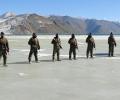
Last week, China's national legislature adopted the new law on the protection and exploitation of the land border areas, which could have bearing on Beijing's border dispute with India.
The Indian delegation led by Lt General Harinder Singh, the general officer commanding of Leh-based 14 Corps, and Commander of the Tibet Military District Maj Gen Liu Lin held an extensive meeting in Maldo on the Chinese side of the Line of Actual Control in eastern Ladakh on Saturday that began at around 11.30 am and went on till evening.

The disengagement process from both the north and south banks of Pangong Lake was completed by the two nations and further disengagement is underway at other friction points.
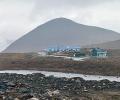
China's national legislature -- the National People's Congress (NPC) -- on October 23 adopted the new law on the protection and exploitation of the land border areas which drew sharp reaction from India as it was passed amid the protracted military standoff between the two sides in eastern Ladakh region.

Indian Army has deployed Pinaka and Smerch Multiple Rocket Launcher Systems (MRLS) at forward position near the China border to counter any threat arising across on the Line of Actual Control (LAC).

He said both sides reaffirmed to sincerely work towards complete disengagement of the troops along the LAC.
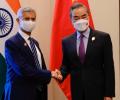
External Affairs Minister S Jaishankar on Thursday conveyed to his Chinese counterpart Wang Yi the need for an early resolution of all outstanding issues along the Line of Actual Control in eastern Ladakh, and asserted that bilateral ties should be based on mutual respect, mutual sensitivity and mutual interest.

'Both sides should, therefore, focus on easing tensions in the friction areas by refraining from any actions that may lead to an escalation in the situation'

'We can expect heightened belligerence from China.'

In a boost for the country's surveillance capabilities to monitor activities of both military warships and merchant shipping in the Indian Ocean Region (IOR), the 'Sindhu Netra' satellite developed by a team of young scientists from Defence Research and Development Organisation (DRDO) was successfully deployed in space on Sunday.

Military experts said the aim of constructing the bridge in the Khurnak area could be to ensure that the Chinese People's Liberation Army is able to quickly mobilise its troops in the region.

"India and China are in communication and negotiations on lowering the temperatures through military and diplomatic channels. No party should engage in any action that may escalate the situation at this point," Chinese Foreign Ministry spokesperson Zhao Lijian said during a briefing when asked about the Prime Minister's visit.
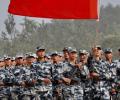
The Chinese action followed 'India's recent, illegal construction of defence facilities across the border into Chinese territory in the Galwan Valley region', a write-up in the state-run Global Times tabloid said, quoting unnamed military sources.
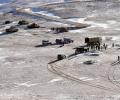
Both countries have reached a mutual agreement for disengagement of troops from the most contentious area of North and South Pangong Lake.
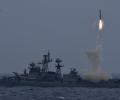
BrahMos Aerospace, an India-Russian joint venture, produces the supersonic cruise missile that can be launched from submarines, ships, aircraft, or from land platforms.

India's reaction came in response to Beijing announcing Chinese names for 15 more places in Arunachal Pradesh which the neighbouring country claims as South Tibet.
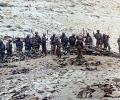
In the 15-year dataset, the researchers noted an average of 7.8 incursions per year even though the Indian government's estimates are much higher.

India has realised that one can only deal with China from a position of strength and that is not palatable to Beijing, observes Dr Rup Narayan Das.
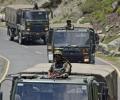
Front-line bases of the Indian army and the air force along the nearly 3,500 km de-facto border with China were Wednesday put on high alert in view of the worst border clash between Indian and Chinese troops in Galwan Valley in eastern Ladakh that left 20 Army personnel dead, official sources said.

'We must acknowledge China will use Pakistan against India.' 'We all need to know that these two countries are ready to destabilise India at all times.'

After his statement, opposition leaders will speak and if required Singh may give a clarification, the sources said.

Esper said Beijing was trying to use the coronavirus tragedy to their advantage for 'propaganda purposes'.

'We should not allow ourselves to be surprised in any manner in future on the border.'

The Indian troops guarding the nearly 3,500-km Line of Actual Control (LAC) maintained an assertive approach in sync with the broader national security doctrine and procured a variety of military platforms and weapons to enhance their combat capabilities.

However, the deployment in the frontline areas has remained the same and the troops from both sides remain in an eyeball to eyeball situation at several locations in that sector.
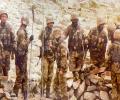
The Chinese numbers had surged significantly during the summer season as they brought in a large number of troops for summer training. They have now gone back to their rear locations.

The gap between the existing air bases in China close to the LAC for fighter aircraft operations was around 400 kms but this would be bridged with the operationalisation of the Shakche airfield.

A whopping Rs 62,476 crore has been "illegally" transferred by smartphone maker Vivo to China in order to avoid payment of taxes in India, the Enforcement Directorate said Thursday, as it claimed to have busted a major money laundering racket involving Chinese nationals and multiple Indian companies. This money is almost half of Vivo's turnover of Rs 1,25,185 crore, it said without stating the time period of the transaction. The crackdown on the leading Chinese company came after the federal probe agency found that three Chinese nationals, all of whom "left" India during 2018-21, and one other person from that country incorporated as many as 23 companies in India in which they were also helped by a Chartered Accountant, Nitin Garg.
Senior government sources told ANI that one such camp is coming up few kilometres inside the Chinese territory opposite the Naku La area in north Sikkim area, which is barely a few minutes distance from the area where Indian and Chinese troops had clashed last year when the confrontation started and also in January this year.

Both the Apache and Chinook helicopters have been pressed into service as part of the IAF's deployment along the LAC in view of the bitter standoff with China in eastern Ladakh, officials said.

India said it is strongly committed to ensuring its sovereignty and territorial integrity.
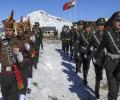
The two militaries are set to hold extensive talks on finalising modalities for restoring normalcy and bringing back peace and tranquillity in the region after the verification of the disengagement exercise is completed.

Nepal said it was confident that both its "friendly neighbours" India and China will resolve their border stand-off at the Line of Actual Control through peaceful means.
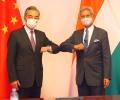
Jaishankar said full restoration and maintenance of peace and tranquillity in border areas was essential for the development of the bilateral ties.

The virtual meeting between the two leaders came in the midst of some disquiet in Washington over India's position on the Ukraine crisis as well as its decision to procure discounted Russian oil.
 © 2026 Rediff.com - Advertise with us - Disclaimer - Privacy Policy - Sitemap - Feedback - About us - Terms of use - Grievances