
'ISRO Chairman Dr. Somanath's leadership truly created history and we extend our hearty congratulations to him and his team,' Venugopal said on X, formerly Twitter.

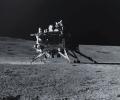
India is now on the Moon and the success of the lunar mission has sounded the bugle for the emergence of a developed nation, Prime Minister Narendra Modi said on Wednesday as Chandrayaan-3 landed successfully on the lunar surface.

Luna-25 may land on the lunar surface earlier than Chandrayaan-3.
'An important dimension that shone through was the enormous pride in India, a general belief that as Indians we are starting to count globally and we are at the forefront of the world.'

Modi addressed scientists at the Indian Space Research Organisation command centre in Bengaluru, who were involved in the Chandrayaan-3 mission and lauded them for their efforts.

Film folk like Akshay Kumar, Chiranjeevi, Jr NTR and Sunny Deol congratulated the country and the Indian Space Research Organisation (ISRO) on the historic achievement of Chandrayaan-3's landing on the Moon.

ISRO chairman S Somanath on Monday said instead of a success-based design in Chandrayaan-2, the space agency opted for a failure-based design in Chandrayaan-3, focused on what all can fail and how to protect it and ensure a successful landing.

'ISRO's style is a terrific example of being able to survive, acknowledge failures, and then most importantly of all, learn from them to ensure that subsequent missions are successful.'

The actor said his earlier tweet was referring to an old joke from the era of Neil Armstrong, the American astronaut and the first person to walk on the Moon in 1969.
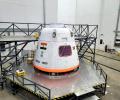
Modi gave these directions during a meeting to review the preparedness of the Gaganyaan mission and the first demonstration flight of the crew escape system test vehicle scheduled for October 21.

After the historic success of its Chandrayaan-3 lunar mission, Indian Space Research Organisation (ISRO) is going full throttle with its plans to send Indian astronauts for the first time to the Moon by 2040, ISRO Chairman S Somanath said.

A satellite placed in the halo orbit around the first Lagrangian point (L1) of the Sun-Earth system has the major advantage of continuously viewing the Sun without any occultation/eclipses, the IIA said.

Shifting the focus to its next space odyssey after successfully placing a lander on the moon's uncharted South Pole region, the Indian Space Research Organisation (ISRO) chief S Somanath on Saturday said that the country's maiden solar mission Aditya-L1 is ready and will be launched in the first week of September.

Foreign Office spokesperson Mumtaz Zahra Baloch during her briefing on Friday was asked to comment on the successful soft-landing of the Chandrayaan-3 mission on the Moon.
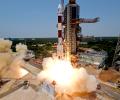
The successful launch of Aditya-L1 - the country's maiden mission to study the Sun - is expected to garner increased investor interest in the Indian space sector and trigger more funding for private players. Several private sector players, including Larsen & Toubro (L&T), MTAR Technologies, and Ananth Technologies, have played a pivotal role in the Indian Space Research Organisation's (Isro's) solar observatory mission. Aditya-L1 on Saturday set off on a 125-day journey on a PSLV-C57 rocket, in its attempt to study various elements relating to the nearest star from the halo orbit around Lagrange point 1 (L1) of the Sun-Earth system, which is about 1.5 million km from Earth.

'It's vital that over the next 10 years, that India, the US and the Artemis Accords family of nations come together to ensure that we not only return humanity to the moon, but that we build the technology that will allow us stay there permanently.' 'And then go on to Mars.'
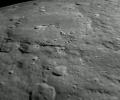
The team led by researchers from the University of Hawai'i (UH) at Manoa in the US discovered that these electrons in Earth's plasma sheet are contributing to weathering processes -- breaking down or dissolving of rocks and minerals -- on the Moon's surface.

From The New York Times to BBC and The Guardian to The Washington Post, the historic event in India's space programme on Wednesday made headlines across the globe.

While the actor did not specify the man in the cartoon, many social media users slammed the actor for making fun of former Indian Space Research Organisation chief K Sivan.

XPoSat or X-ray Polarimeter Satellite is India's first dedicated polarimetry mission to study various dynamics of bright astronomical X-ray sources in extreme conditions.

Deciphering its secrets will unlock the early history of not only our planet, but also of the star system, explains Kumar Abishek.
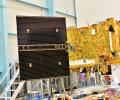
Aditya-L1 spacecraft is designed for providing remote observations of the solar corona and in situ observations of the solar wind at L1 (Sun-Earth Lagrangian point), which is about 1.5 million kilometres from the earth.

Meet Indian Space Research Organisation scientist Ningthoujam Raghu Singh, who was one of the bright sparks responsible for sending Chandrayaan-3 to the moon.
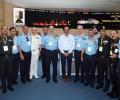
The space agency has redefined the mission in such a way that it will achieve success in the very first attempt.

'A person weighing 68 kilograms on the Earth would weigh only over 11 kg on the Moon'

'Vikram' with rover 'Pragyaan' housed inside is scheduled for a powered-descent between 1 am and 2 am on September 7, followed by its touchdown between 1.30 am and 2.30 am.
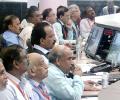
'The benchmark was set by Dr Sarabhai.' 'If there is a problem, everybody would be encouraged to come up with a solution.' 'The final solution will be the result of all the inputs.' 'This is passed on through time.' 'Even today, you see that nobody wants to take particular credit on a success.'
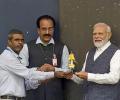
'Perhaps the government should explain how the same scientific temper, which authored a precise landing for Chandrayaan-3, finds the periodic table and the theory of evolution not good enough for inclusion in the educational curriculum,' asserts Shyam G Menon.
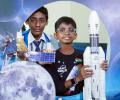
Mainstream American newspapers, many of which had been sceptical of India's space mission and sometimes even made fun of it through cartoons, noted the great Indian achievement.
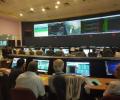
"Already, orbiter is in space and it should do an excellent job of mapping," Nair said.
The Indian space agency is all set to embark on its most complex mission.

The ISRO said that 90 to 95 per cent of the mission objectives have been accomplished, notwithstanding the loss of communication with the lander.

Using a comic strip, the ISRO tweeted, showing orbiter telling the lander 'Vikram' that it enjoyed its company before it separated on September 2 afternoon.

'All possible efforts are being made to establish communication with (the) lander,' the ISRO further said in a tweet.

Subramanian, 33, who was on Tuesday the toast of the astronomy world, managed what ISRO and NASA couldn't through his close examination of before and after images of the scheduled landing.

During the day-long debate, the lines between science and religion often got blurred with many invoking religious texts and the contribution of 'rishi munis' to highlight India's tryst with the extra-terrestrial world.
NASA's Lunar Reconnaissance Orbiter spacecraft has snapped a series of images during its flyby on September 17 of Vikram's attempted landing sight near the Moon's uncharted south pole.

The landing on the moon near the South Pole, an uncharted territory so far, would be on September 6 or 7, Sivan told reporters, as the Indian space agency is all set to embark on its most complex mission.
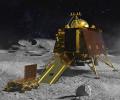
The ISRO had apparently suspended those operations 10 days ago following night fall on the Moon.
Asked if the lander was 'damaged' during the 'hard landing", Sivan said: "That we do not know".
 © 2026 Rediff.com - Investor Information - Advertise with us - Disclaimer - Privacy Policy - Sitemap - Feedback - About us - Terms of use - Grievances