
Or, what will the Indian policy process allow it to be, says Ajit Balakrishnan.

Instead of failing young Indians, the government should now focus laser-like on education, skilling, healthcare, and the environment, says Mihir S Sharma.

'The jobs that are being created now are the delivery boy jobs which are of extremely poor quality, or contractual jobs where you hire a person on a per piece basis.'

India's ranking is worst among the five BRICS countries

About 13 million first time car/two-wheeler buyers are entering the market every year. If employment creation is such a big issue, where are these people coming from, asks Mahesh Nandurkar.
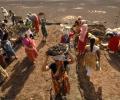
'If you solve it in one day, it will go after a day.' 'If it is there for 100 years or 1,000 years, reservation has to continue.'
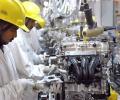
Almost all recent labour strikes were declared illegal by the labour department of Gujarat.

IMF, which has also lowered its global economic growth forecast for 2016 and 2017 by a marginal 0.1 per cent to 3.1 and 3.4 per cent respectively, recommended six 'reform priorities' for India

The work of reconstruction in the flood-ravaged Kashmir could get delayed by at least 6 months due to the mass exodus of migrant labour force in the wake of the natural calamity that hit the valley causing huge damage to infrastructure -- both public as well as private.

India's informal economy and service sector accounts for over three-fifths of its $1.8 trillion economy.

'I am buried under a mountain of debt. Wheat at Rs 2 and rice at Rs 3 is killing farmers.' 'We are tired of telling the government to help. Now what you want me to do? Commit suicide?'

In his first interview since becoming the chief economic advisor, Arvind Subramanian agrees the Narendra Modi government has taken some initial steps to revive private investments but says many more measures would be required to restore macroeconomic stability - reining in inflation and fiscal deficit - and bring the economy back on high-growth path. Subramanian, who has earlier worked in the research department of the International Monetary Fund, tells IMF Survey, an online magazine of IMF, that the Gujarat model is to be replicated across India but there also are macroeconomic problems at the national level that need to be addressed.
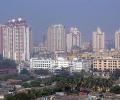
Here's what's buzzing in Mumbai if you are looking out for real estate appreciation...

The government must undo the damage inflicted by the flawed policies of globalisation, and India should be converted into a country where entrepreneurs can thrive and the entire population can participate in the economy, says Arvind Kumar.

The companies experienced a drop of 5,436 approved petitions (37 per cent) in 2016 as compared to previous year, a report by the National Foundation for American Policy, a Washington-based non-profit think-tank, said.

Contract workers are paid much less than regular workers. This year's Economic Survey estimates wages are on an average 20 times higher in the formal sector than in the informal sector. Arindam Majumder reports.

The more one thinks about it, the more difficult it is to see how India will be able to reap the benefits of a demographic dividend, says Aakar Patel.

Enabling labour to become more globally mobile can produce higher remittances with powerful 'brain gain' dividends.

'An isolationist US and a disintegrating European Union will create a power vacuum that only China is in a position to fill -- a conclusion that is uncomfortable but unavoidable,' says Nitin Desai.

The party's most important electoral challenge lies in whether it can meet the aspirations of the youth who were drawn by the promise of gainful work.

'Our first great challenge is to create 12 million new jobs each year, to make the demographic dividend an economic dividend.' 'We are nowhere near that,' points out Mohan Guruswamy.

'... for two reasons: the poor quality of education, and the low rate of female participation in the labour force.' 'Unless something is done quickly to remedy these problems, India will just have a large population of low-skill, low-wage, males trying and failing to feed their families adequately.'

India's per capita GDP of $5,238 in 2013 was 65 per cent lower than Iran, 54 per cent lower than Maldives, 44 per cent lower than Sri Lanka and 27 per cent lower than Bhutan, according to the Human Development Report 2015

The markets, at this point, have rallied on the view that the Fed will not budge from the zero-bound as long as inflation remains subdued

While demonetisation will benefit the organised sector, the government has to find a way to channel the upcoming revenue buoyancy towards job creation to balance out job losses in the informal sector, says Akash Prakash.

Exemptions, and the fact that farm income is outside the tax net, ensure that India's tax-GDP ratio stays low.
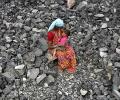
The World Bank's latest review of its purchasing power parity (PPP) baseline will reignite the poverty debate.

No country has achieved a faster, deeper modern transformation than China, says former ambassador Kishan S Rana.

Panagariya has advocated a more liberalised spending, arguing that greater capital expenditure could relax some of the infrastructure bottlenecks facing the country.

Prime Minister Narendra Modi has managed to pull off what was unimaginable a year back -- adopting a much-needed centre-left approach, says Devanik Saha.

The challenge ahead for central and state governments remains enormous.

The NITI Aayog's vice-chairman's charge holds ground.

The prospects for strong, sustained economic reforms do not appear to be promising in India.

Flexibly targeting inflation is consistent with a demand stimulus, says Ashima Goyal.
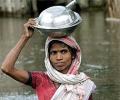
The local labour force is streaming out of the region, creating a vacuum that makes it easier for the Bangladeshis to fill in, says R N Ravi

'Each day, while interacting with scores of people, all with demands and expectations of their own, holding one's own fort is of paramount importance. 'One must always have the vision which will guide the journey,' says Dinesh Goel, a chemical engineer from IIT-B, co-founder and CEO, AasaanJobs.com, an online marketplace for entry-level and blue-collar job seekers.

Volkswagen mess costs Germany its strongest nation brand position.

Along with the US and China, India could be a big enough force in global manufacturing

'What the government should do to create jobs is to help revive the MSME sector.' 'This sector gives employment to lakhs of people.' 'The MSME sector provides more employment than the big industries.' 'So, what should be done immediately is to revive the MSME sector.'
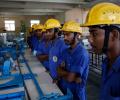
India only has 3.5 million workers undergoing skills courses a year, compared with 90 million in China
 © 2026 Rediff.com - Investor Information - Advertise with us - Disclaimer - Privacy Policy - Sitemap - Feedback - About us - Terms of use - Grievances