
A PhD from Chicago-Booth and a top-ranking IIT-IIM alumnus, Krishnamurthy Subramanian is one of the world's leading experts in banking, corporate governance and economic policy
The new Chief Economic Advisor Krishnamurthy Subramanian believes that more than unemployment, it is the quality of employment which needs to be focused on. In an interview with Arup Roychoudhury and Indivjal Dhasmana, Subramanian said that controlling inflation was the Modi government's biggest achievement.

Savitri and Narayanan Sitharaman arrived in a separate car in Parliament.

Chief Economic Advisor Krishnamurthy Subramanian said China imports a lot of components, parts, assembles and integrates and then exports them.

Krishnamurthy Subramanian listed land, labour, law, and liquidity as the key areas of big reforms.

'Given the 50 per cent or thereabouts increase in borrowing that has been announced, it is a reasonable estimate to say that at this time, an increase of 1.7-1.8 per cent on the 3.5 per cent budgeted fiscal deficit target is being anticipated,' Chief Economic Adviser Krishnamurthy Subramanian said on Friday.

The target of mopping up Rs 1.75 lakh crore from divestments of some of the public sector companies, including LIC and BPCL during the current fiscal, is on track and groundwork is being prepared for the goal, Chief Economic Advisor Krishnamurthy Subramanian said on Monday. On the COVID-19 pandemic, Subramanian said the impact of the second wave is lesser than that of the first one. In an interactive session, organised by Federation of Telangana Chambers of Commerce and Industry, the CEA said robust GST collections, over Rs one lakh crore per month for eight months in a row shows that consumption is picking up indicating positive signal for growth.

Claims of a spike in poverty and inequality in India during the Covid-19 pandemic are patently false as such claims are based on uncomparable different surveys, according to a paper co-authored by eminent economist Arvind Panagariya. The paper also noted that inequality fell in the country during Covid years, both in rural and urban areas as well as nationally. Panagariya, Columbia University Professor and former vice chairman of NITI Aayog and Vishal More of Intelink Advisors, New Delhi have co-authored a detailed paper 'Poverty and Inequality in India: Before and After Covid-19'.

Sitharaman, who was giving her 2021-22 Budget Speech, started off by giving a special shout out to what the Indian team
Chief Economic Advisor Krishnamurthy Subramanian said India's economy will witness a decline in the current fiscal, but the drop will be limited if there is an economic recovery in the October-March period.

Sitharaman is presenting the full Budget for 2019-20. She is carrying the Budget documents in a red silk bag with national emblem.

According to traders, Chief Economic Adviser Subramanian's comments practically ruling out a stimulus package for the economy weighed on investor sentiment.

The findings of the report showed consumer spending falling for the first time in over four decades in 2017-18.

If the prime minister says clearly there is going to be no NRC and that the Census will drop the NPR questions, the Census will proceed. He will not, observes Aakar Patel.

The country's economy will start witnessing a growth of 6.5 to 7 per cent from fiscal 2023 onwards, helped by various reforms undertaken by the government so far and also as COVID-19 vaccination drive progresses, Chief Economic Advisor Krishnamurthy Subramanian said. He said the second wave of COVID-19 is unlikely to have a very significant on the economy. The country's economy contracted by 7.3 per cent in fiscal 2020-21. "Together with the reforms and focus on vaccination, I expect growth to start hitting close 6.5 to 7 per cent from FY23 onwards and accelerate from there on," Subramanian said at a virtual event organised by Dun & Bradstreet.

Last year, Sitharaman had ditched the long-standing tradition of carrying budget documents in a leather briefcase and went swadeshi with a 'bahi-khata'.
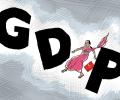
'There are some encouraging signs.' 'Notice that we have not said 7%-plus, we are keeping it at 6% to 6.5%.'

'When you plot the growth, -- 7.5 per cent for Q2, 0.4 per cent for Q3, 1.6 per cent for Q4 and 20.1 per cent for Q1 now -- all you see is a 'V'.' 'You don't see any other alphabet in the shape there.'
The economy could grow at 6-6.5 per cent this fiscal year (2019-20 or FY20), said Chief Economic Advisor Krishnamurthy Subramanian, revising his earlier estimate of 7 per cent in the Economic Survey. In an interaction with Arup Roychoudhury, he said supply-side measures, including corporation tax cuts, will boost consumption and demand, and non-tax revenue may make up for shortfall in tax revenues.

The panel has proposed lower rates of 10 per cent for annual income between Rs 5 lakh and Rs 10 lakh, 20 per cent for income between Rs 10 lakh and Rs 20 lakh. For income of Rs 20 lakh to Rs 2 crore, the suggested rate is 30 per cent.

India's sovereign credit ratings do not reflect the economy's fundamentals, the Economic Survey said on Friday and nudged the global agencies to become more transparent and less subjective in their ratings. The Economic Survey 2020-21, tabled in Parliament, said that sovereign credit ratings methodology must be amended to reflect economies' ability and willingness to pay their debt obligations, and suggested that developing economies must come together to address this bias and subjectivity inherent in sovereign credit ratings methodology. "Never in the history of sovereign credit ratings has the fifth largest economy in the world been rated as the lowest rung of the investment-grade (BBB-/Baa3). While sovereign credit ratings do not reflect the Indian economy's fundamentals, noisy, opaque and biased credit ratings damage FPI flows," the survey said.

'We expect a pick-up in the second half of the current fiscal. But before that, data is likely to show a further slowdown. The second quarter print is likely to be worse than the first quarter,' said a senior official.

Tuesday's meeting at the PM's residence, attended by all the five secretaries in the finance ministry besides top officials of other economic ministries and NITI Aayog, cleared a five-year vision plan for the government to make India a $5-trillion economy by 2024.

A key hindrance to a faster turnaround of these banks is the slow progress in the resolution of legacy bad loans and the need to build up provisions against those assets.

Credit to priority sectors as well as small and medium industries will be discussed to find ways to accelerate economic growth.

'This is a period of significant uncertainty, of unknown unknowns.'

The plan could mature into either an umbrella programme for urban youths similar to the Garib Kalyan Rozgaar Abhiyaan or a modified urban-focused version of MGNREGS.

Top gainers in the Sensex pack included Bharti Airtel, Tata Motors, IndusInd Bank, Kotak Bank, Hero MotoCorp, Asian Paints and PowerGrid, which rose up to 2.53 per cent.

This is not her first stint in North Block or in leading a major economic ministry. She started Prime Minister Narendra Modi's first term as minister of state for finance, was made the commerce minister, and then became the defence minister.
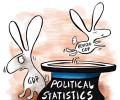
It is also likely to assume a deflator of around 4 per cent. That could take the nominal GDP outlook for FY21 to around 10 per cent. It is this nominal GDP forecast on the basis of which the finance ministry is calculating key Budget targets like the fiscal deficit as a percentage of GDP and tax revenue growth for the coming year.

At a pre-Budget meeting, the FM was asked to ensure that NBFCs come out of the liquidity crisis they are facing with the help of RBI. They also spoke about the futility of trying to achieve a 3 per cent fiscal deficit target over the medium term.

India's economy recovered faster than expected in the September quarter as a pick-up in manufacturing helped GDP clock a lower contraction of 7.5 per cent and held out hopes for further improvement on better consumer demand. The gross domestic product (GDP) had contracted by a record 23.9 per cent in the first quarter of the 2020-21 fiscal (April 2020 to March 2021) as the coronavirus lockdown pummelled economic activity.

Defending the timing of Yes Bank's moratorium, Reserve Bank of India governor Shaktikanta Das on Friday assured swift resolution to the issues concerning the beleaguered lender. "The resolution (to Yes Bank) will be done very swiftly, it will be done very fast. 30 days which we have given is the outer limit. You will see a very swift action from RBI," Das told reportters in Mumbai.

An official said that people in the government were aware of the benefits as well as the drawbacks of issuing overseas sovereign bonds, and there will be consultations with all stakeholders.

Revenue buoyancy of GST will be key to improve the resource position of both central and state governments.

Concerned by GDP slowdown and unrealistic tax targets, the economists urged Finance Minister Nirmala Sitharaman to implement long-term structural steps like land and labour reforms. Warning against any off-Budget financing the economists said the government should prepare a statement of intent for its social, rural and welfare sector expenditure.

It is time the government cast its net wide for seeking expert advice on managing the Indian economy and formed a group to help it navigate the difficult days ahead, advises A K Bhattacharya.

Finance Minister Nirmala Sitharaman will present her second Budget a little more than a month from now. Like any other FM, Sitharaman will depend on her team of bureaucrats and advisors to frame and present the Budget.

It is time he stood up and assured the middle class that they can count on him as one of their own, says Dr Sudhir Bisht.

'Rather than cutting and pasting from advanced economies, we should use basic economic principles to think about what is right for India at the stage of development at which we are,' says Chief Economic Advisor Krishnamurthy Subramanian.
 © 2026 Rediff.com - Advertise with us - Disclaimer - Privacy Policy - Sitemap - Feedback - About us - Terms of use - Grievances