
Unhappy with the lack of seriousness being accorded to voices against the nuclear plant, the protestors have been touring the southern-most districts of the state to spread the word.
With the standoff over the Koodankulam Nuclear Power Plant issue continuing, top atomic scientists will meet Tamil Nadu Chief Minister J Jayalalithaa on Friday to discuss ways and means to allay the fears of the locals who are insisting on scrapping the project.
The anti-Koodankulam nuclear power plant activists on Wednesday demanded that Dravida Munnetra Kazhagam withdraw support to the Congress-led United Progressive Alliance government and stand by their cause,as they continued their stir demanding scrapping of the project.
The Centre is expected to constitute an expert group after Prime Minister Manmohan Singh's return from abroad and would seek the guidance of former President A P J Abdul Kalam on allaying the fears of the locals opposed to the controversial Koodankulam nuclear power project.
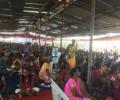
Breaking the brief truce, more than 7,000 people on Sunday observed a token fast against the Koodankulam nuclear power plant and vowed to intensify the struggle if the government did not scrap it.
Amid demands for scrapping the Koodankulam nuclear power project, a top atomic scientist on Saturday vouched for its safety, saying all types of exigencies including a Fukushima-type mishap have been factored in.
Protesters on Thursday formally ended their 12-day fast against the Koodankulam Nuclear Power Project, a day after the Tamil Nadu government promised to pass a resolution at the Cabinet for halting the project.
The 11-day-old fast by locals demanding the scrapping of the Koodankulam nuclear power project was called off on Wednesday after Tamil Nadu Chief Minister J Jayalalithaa agreed for a cabinet resolution to request the Centre to halt the project.
Stalemate over the controversial Koodankulam nuclear power project continued despite efforts by the Prime Minister's emissary to break the ice even as the indefinite fast by locals demanding scrapping of the project entered the 10th day on Tuesday.
The Centre is looking into Tamil Nadu's demand for allocation of entire power to be generated from the Koodankulam Nuclear Power Plant, Minister of State in the PMO, V Narayanasamy on Friday said.
A day after the Tamil Nadu government gave its go ahead to the Koodankulam Nuclear Power Plant, work at the Indo-Russian project started in full swing with officials expressing hope that the first unit would be commissioned "as soon as possible."
Fuel is being loaded in the Koodankulam Nuclear Power Plant. Outside, the agitation continues, though to most observers it seems futile -- the fishermen continue to fast, stand in knee deep water one day and neck deep water the next day. A Ganesh Nadar reports
Upset over the prolonged delay in the commissioning of the Koodankulam Nuclear Power Plant, Russia on Wednesday said it should "start working now" and there should be a "movement" to start the plant. "The machines have to start working now because after several weeks, you will have to spend much more time and money to maintain them. You will pay for nothing. They will be idle but you have to pay for their maintenance," Russian Ambassador to India Alexander M Kadakin said.
Strongly batting for early commissioning of the Koodankulam nuclear power project, Home Minister P Chidambaram on Saturday night said the Centre was probing the flow of funds allegedly received by anti-project activists and would take strong action if the money was supplied in a "wrong way". "Investigation is going on to know how the protestors are getting funds. If there is anything wrong, if the money came in a wrong way, if it was used for wrong purpose," he said.
The plant was earlier scheduled for commercial operations in December but it was deferred to March next due to the stir by locals and resultant stand-off between them and government. The commercial operation of the second unit to produce another 1000 mw is now expected by February 2013, the NPCIL said.
Hardening their stand on the controversial Koodankulam Nuclear Power Project, anti-nuclear activists on Sunday appealed to Chief Minister Jayalalithaa to take a stand and adopt a cabinet resolution on scrapping it.
Talks to break the logjam over the controversial Koodankulam Nuclear Power Project made no headway on Friday with protestors terming as "failure" the discussions with the Central government's expert committee on the issue.
Bogged down by the over month-long agitation by local people led by anti-nuclear activists, commissioning of the first reactor of the controversial Koodankulam Nuclear Power Project has been delayed by three months.
The committees set up by the Centre and Tamil Nadu government to resolve the standoff over the Koodankulam Nuclear Power Plant met in Tirunelveli on Tuesday for the first time when representatives of the protesters presented a charter of demands including a paper on plant's status.
Dr Kalam assures the protestors and the country that the technology used in the Koodankulam nuclear project is the best in the world, and tries to allay the fears of the villagers over its safety arrangements, reports A Ganesh Nadar.
Giving a thumbs up to the Koodankulam nuclear power project, former President A P J Abdul Kalam on Sunday said he is "fully satisfied" with the safety measures incorporated in the mega power project.
Villagers of Idinthakarai in Tamil Nadu are on a relay fast since the last one week protesting the construction of the nuclear power project in neighbouring Koodankulam. Rediff.com's A Ganesh Nadar spoke to the man heading the protest, S P Udaykumar.
The week-long protest against Koodankulam nuclear power plant was suspended for two days on Sunday in view of the civic polls in Tamil Nadu even as the stir has left over 100 staff members stranded inside the main project complex.
The Centre on Saturday said it is confident of commissioning the first unit of the Koodankulam Nuclear Power Project to generate 1,000 MW of power in two months as 99 per cent of its works are over.
The Koodankulam Nuclear Power Project has been jinxed ever since it was thought of. It was first talked about in 1988 when the Soviet Union agreed to build a plant in India and also supply it fuel. The Soviet Union broke up soon after. Rediff.com's A Ganesh Nadar spoke with Swapnesh Kumar Malhotra.

Check to see how!
The Centre has zeroed in on Kovalam village in Kanyakumari district for a new port, but fishermen's protests could derail this plan.

'We see different people bringing different resentments and we feel this is the result of the deprivation of an identity because of the reintroduction of Hindi, the Hindutva overtones in the national discourse, the betrayal of the Dravidian parties and even small things like the Devanagiri script in the Rs 2,000 note.'

In one village, a woman asks, "They are always showing cash seizures on television, you think some of it will escape and we will get money as usual?" "Only 1 percent of cash is actually seized, the rest has arrived, you don't worry," a party worker assures her. Rediff.com's A Ganesh Nadar reports on the election in the southern-most tip of the country.

R S Sundar, the site director of KNPP, on how the plant is producing 1,000 MW of nuclear power, the largest in the country.

In a spontaneous outpouring of grief, thousands of people bid an emotional farewell to former President APJ Abdul Kalam who was on Thursday laid to rest with full state honours in his home town here amid chants of "Bharat Mata Ki Jai".

'The government is using the Intelligence Bureau to go after NGOs.' 'It is not only the NDA, the UPA also didn't like NGOs.' 'NGOs predominantly work with the poor. So, when you cancel an NGO, the affected are the poor, the Dalits, the tribals, the street children and the marginalised.'

Muzzling NGOs is unbecoming of a democracy. Self-confident democracies encourage, indeed applaud, the involvement of citizens' associations, including NGOs, in social and political decision-making and development planning. Instead, our paranoid government bullies and terrorises them, says Praful Bidwai.
Anti-nuclear activist S P Udayakumar, who has been called a threat to the economic security of India by the Intelligence Bureau, speaks to A Ganesh Nadar.
 © 2026 Rediff.com - Advertise with us - Disclaimer - Privacy Policy - Sitemap - Feedback - About us - Terms of use - Grievances