
Foreign portfolio investors withdrew over Rs 22,530 crore ($2.5 billion) from Indian equities so far this month amid rising US bond yields and a stronger dollar, continuing their selling streak from last year. This came following an outflow of Rs 1.66 lakh crore ($18.9 billion) recorded in 2025, triggered by volatile currency movements, global trade tensions and concerns over potential US tariffs and stretched market valuations.

India's top 9 cities are likely to witness a 4 per cent decline in housing sales in the quarter ending September to over 1 lakh units on lower demand in Mumbai region and Pune, according to PropEquity. Real estate data analytics firm PropEquity on Sunday released data of primary residential market for July-September, which is generally considered as a weak quarter because of monsoon season and inauspicious Shraadh period.

Housing sales are estimated to decline 23 per cent annually to nearly 1.06 lakh units during January-March across nine major cities on subdued demand due to high prices and concern over economic growth, according to PropEquity.

The government on Tuesday proposed reducing the long-term capital gains tax on immovable properties to 12.5 per cent from 20 per cent, but removed the indexation benefits to adjust for inflation, a move experts termed as "negative" for sellers.

Credit outstanding to the housing sector rose by nearly Rs 10 lakh crore in the last two fiscals to reach a record Rs 27.23 lakh crore in March this year, according to RBI's data on 'Sectoral Deployment of Bank Credit'. Experts from banking and real estate sectors attributed this growth in housing credit outstanding to a strong revival in the residential property market post-COVID pandemic on pent-up demand. According to the data of the Reserve Bank of India (RBI) on sectoral deployment of bank credit for March 2024, the credit outstanding to the housing (including priority sector housing') stood at Rs 27,22,720 crore in March 2024, up from Rs 19,88,532 crore in March 2023, and Rs 17,26,697 crore in March 2022.

'If they are taking marquee locations and, say, are paying 50 per cent higher rent, those locations will see a spurt in rates as well.'

With the arrival of the second Covid wave in April, the numbers fell by almost 50 per cent.
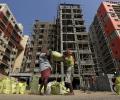
Housing sales across seven major cities in the country fell 35 per cent year-on-year to 50,983 units during the July-September period even as the demand recovered post lockdown, according to data analytics firm PropEquity. Sales stood at 78,472 units in the year-ago period in seven cities -- Delhi-NCR, Mumbai Metropolitan Region (MMR), Chennai, Kolkata, Bengaluru, Hyderabad and Pune.
Listed realty developers saddled with unsold properties worth Rs 1 trillion

Abraham succeeds Dr Surinder Malhotra who served as president of the Indian National Overseas Congress for the last 12 years. George Joseph reports from New York

Keep in mind interest rate, tenure and additional charges if you exceed credit card limit

Sales in newly launched residential products have gone up slightly owing to discounted prices. But will this trend sustain?

Currently, there's a shortfall of 23 million houses in India.

Experts attribute this to economy slowdown and political uncertainty with the general elections round the corner.

Home seekers demand has exceeded supply and hence there is a possibility of rentals going up by atleast 10 percent.
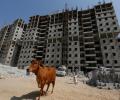
Experts say that the lockdown and its aftermath will further quicken the consolidation in the real estate sector, which has been taking place since 2012, with more small players going out of the business and bigger, branded players dominating the market.

There is also scope for buyers to negotiate for discounts.

The maximum fall on total market valuation will be in Mumbai (Rs 2,00,330 crore) followed by Bangalore (Rs 99,983 crore) and Gurgaon (Rs 79,059 crore).

SBI Cards on Tuesday launched a credit card especially meant for transactions on e-commerce websites.
.jpg)
Experts say in the serviced apartments space, developers, primarily from the hospitality sector, are targeting non-resident Indians, expatriates and now, even domestic investors.

Some banks might charge you a nominal amount of Rs 100-150 for issuing the card.
 © 2026 Rediff.com - Investor Information - Advertise with us - Disclaimer - Privacy Policy - Sitemap - Feedback - About us - Terms of use - Grievances