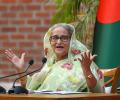
India has acknowledged that it is currently reviewing the Bangladesh government's request for the extradition of former Prime Minister Sheikh Hasina, as part of ongoing judicial and legal processes.

A leading British law firm has challenged the fairness and legality of the trial and death sentence handed down to deposed Bangladeshi Prime Minister Sheikh Hasina, citing violations of international law and a politically hostile environment.

BNP chairman Tarique Rahman called for maintaining law and order and sought cooperation in building a safe and humane Bangladesh after his party's victory in parliamentary elections.
Bangladesh's interim government has formally requested India to extradite former Prime Minister Sheikh Hasina after she was sentenced to death by the International Crimes Tribunal for crimes against humanity.
Sheikh Hasina, sentenced to death in absentia in Bangladesh, denounces the tribunal as biased and rigged, claiming the verdict reveals the murderous intent of extremist figures within the interim government.

Bangladesh's deposed prime minister Sheikh Hasina was sentenced to death in absentia by a special tribunal for crimes against humanity committed during protests against her government.
The United Nations has said that the verdict against Bangladesh's ousted prime minister Sheikh Hasina on charges of crimes against humanity is an 'important moment' for the victims, but expressed regret over the imposition of the death penalty.
Bangladesh's interim government has called on India to extradite Sheikh Hasina after she was sentenced to death in absentia. The move has sparked reactions from various political parties.
India is examining Bangladesh's request to extradite former prime minister Sheikh Hasina, who was sentenced to death in absentia. India emphasizes its commitment to the best interests of the people of Bangladesh.

This marks the first time that the ousted Awami League leader has been sentenced in any case since she left office and fled the country 11 months ago.

Sporadic violence erupts across Bangladesh as the nation awaits a special tribunal verdict against former Prime Minister Sheikh Hasina in a case of alleged crimes against humanity. Security is heightened, and authorities are on high alert.
Now, in exile in India, Hasina, often dubbed the 'Iron Lady' of Bangladesh, watches from across the border as the nation she helped build, and often ruled with a firm hand, grapples with the legacy her rise and fall has left behind.
'Yunus' hostility to India is foolish and self-defeating in the extreme and reveals him for the weak monarch he is, unelected, chaotic, and dependent upon the support of extremist'

Former Indian envoys criticize the death sentence handed down to ousted Bangladeshi Prime Minister Sheikh Hasina, expressing concerns about political polarization and stability in Bangladesh.
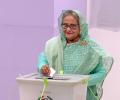
Bangladesh's election commission on Wednesday said it has 'locked' deposed prime minister Sheikh Hasina's national identity cards, effectively barring her from voting in the general elections scheduled for February next year.
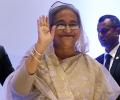
A court in Bangladesh has issued fresh arrest warrants against former Prime Minister Sheikh Hasina, her son Sajeeb Wajed, and 16 others in two cases related to alleged irregularities in allocating residential plots on the outskirts of the capital. The warrants were issued based on chargesheets filed by the Anti Corruption Commission (ACC), which alleges that Hasina and her family members illegally acquired plots in Purbachal New Town by abusing state power. The court has ordered police to submit a report by April 29 on the progress of executing the warrants. This is the latest in a series of legal actions against Hasina and her family members since her Awami League regime was toppled last year in a student-led mass uprising.
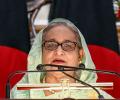
Bangladesh's International Crimes Tribunal is set to formally hear charges against deposed prime minister Sheikh Hasina on Sunday allowing state-run BTV to broadcast live the event, a first such instance in the country's history.
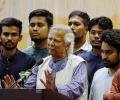
Yunus said his administration took over to carry out three mandates 'justice, reform and elections.'
Bangladesh police have filed a case against deposed prime minister Sheikh Hasina and 72 others on charges of hatching a conspiracy to overthrow the interim government led by Muhammad Yunus by waging a civil war, officials and media reports said on Saturday.

The Awami League leaders were charged with committing crimes against humanity over the deaths of hundreds of people during last year's anti-government protests by a student platform. The protests resulted in the ouster of Hasina's 16-year-long regime on August 5.
Bangladesh's interim government has formally requested India to extradite deposed Prime Minister Sheikh Hasina, who is currently in India. The request has been made after Bangladesh issued arrest warrants for Hasina for "crimes against humanity and genocide." However, India has not yet responded to the request. Hasina is accused of using her security forces to oversee the abduction, torture, and murder of hundreds of activists during her time in office. She denies the allegations and claims she is being politically persecuted. The Bangladesh interim government's Chief Adviser, Muhammad Yunus, said he was shocked by the conditions he witnessed at one of the secret jails used during Hasina's regime.
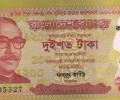
Religious structures, Bengali traditions, and 'graffiti' drawn during the July uprising will be included on the currency notes.

Indian Foreign Secretary Vikram Misri is scheduled to visit Bangladesh next week for a foreign secretary-level meeting, amidst ongoing tensions between the two countries. The visit comes after the interim government led by Muhammad Yunus took power in Bangladesh, following the ouster of Sheikh Hasina as prime minister. The meeting will focus on a range of bilateral issues, including the potential extradition of Hasina and visa-related matters. Tensions between the two nations escalated further with the arrest of Hindu monk Chinmoy Krishna Das in Bangladesh, leading to concerns from India regarding attacks on minorities in the country.

Stating that an investigation team will work under the full supervision of the United Nations to ensure complete transparency and impartiality, he said, "None of the outgoing government involved in the murder will be exempted."
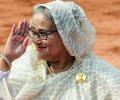
An anti-graft panel in Bangladesh has launched an investigation against former prime minister Sheikh Hasina and her family in connection with the allegations of embezzling $5 billion in the Rooppur nuclear power plant, according to a media report.

A large group of protesters vandalized and set fire to the residence of Bangladesh founder Sheikh Mujibur Rahman in Dhaka during a live online address by his daughter and deposed prime minister Sheikh Hasina. The incident occurred as Hasina was delivering a speech organized by the Awami League's now disbanded student wing Chhatra League, calling upon the countrymen to resist the current regime.

According to the complaint, Awami League leaders and activists attacked the protesters and hacked Hossain to death with sharp weapons.

Protesters in Bangladesh have attacked and torched houses of leaders of Sheikh Hasina's Awami League across the country, while murals of the country's founder Sheikh Mujibur Rahman were demolished and defaced in nearly two dozen districts. The unrest sparked after a live online address of Hasina, who is living in India following a massive student-led protest that toppled her Awami League's 16-year regime. The protesters have also called for scrapping the 1972 Constitution and changing the national anthem.
Bangladesh's interim government on Sunday said it will seek Interpol's assistance in repatriating deposed prime minister Sheikh Hasina from India, and other 'fugitives', to face trial for alleged crimes against humanity.
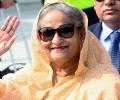
Bangladesh's interim government has requested India to extradite deposed Prime Minister Sheikh Hasina, who has been living in exile in India since August. The request comes after the Bangladesh-based International Crimes Tribunal issued arrest warrants for Hasina and several others for "crimes against humanity and genocide." The interim government has cited an existing extradition treaty between the two countries as grounds for the request. Hasina has accused the interim government of perpetrating "genocide" and failing to protect minorities since her ouster.

The application accuses Hasina and others of orchestrating a violent crackdown on student protestors, resulting in widespread casualties and human rights violations.

This will be the first time the UN is sending a fact-finding mission to Bangladesh since its independence in 1971 to investigate widespread human rights abuses in the country, according to a UN official.

Quamruzzaman, an assistant secretary general of Jamaat, is the fourth accused who was convicted for the 1971 war crimes siding with Pakistani troops while his party was opposed to Bangladesh's independence.

A top leader of the fundamentalist Jamaat-e-Islami was on Tuesday sentenced to life by a special Bangladeshi tribunal on charges of committing "crimes against humanity" during the 1971 independence war against Pakistan. "He (Abdul Kader Mollah) will serve the life term," said chairman of the three-member International Crimes Tribunal Justice Obaidul Hassan.

Bangladesh on Friday deployed paramilitary border guards to beef up security after a top Islamist opposition leader was sentenced to death, sparking nationwide riots that killed at least 42 people.

Bangladesh on Sunday deployed troops in its north as a fresh wave of violence claimed 19 lives, taking the death toll to over 75, in clashes that have rocked the nation since the conviction of Islamist leaders for 1971 war crimes.
A special Bangladeshi tribunal on Sunday indicted an 89-year-old former chief of fundamentalist outfit Jamaat-e-Islami on 61 charges for committing crimes against humanity during the 1971 Liberation War, months after he was arrested. "The International Crimes Tribunal indicted Professor Ghulam Azam for five types of crimes he committed during the 1971 Liberation War," said prosecuting lawyer Syed Rezaur Rahman.
The nearly year-long trial of eight suspects at the International Crimes Tribunal in Bangladesh, who have been accused of war crimes during the 1971 war, may not have made headlines in India, but it is attracting huge international attention and further polarising the country's politics.
Bangladesh government on Monday pressed war crime charges against fundamentalist Jamaat-e-Islami (JI) leader Ghulam Azam at the International Crimes Tribunal, calling him a "key collaborator" of the then Pakistani regime during the 1971 Liberation War.

Nizami now faces execution unless his case is reviewed by the court or he is granted clemency by the President.
 © 2026 Rediff.com - Advertise with us - Disclaimer - Privacy Policy - Sitemap - Feedback - About us - Terms of use - Grievances