
Indian benchmark indices Sensex and Nifty closed lower for the second consecutive day, driven by investor caution over conflicting geopolitical signals from West Asia and fresh foreign institutional investor (FII) outflows.

The Indian government has issued a stern warning to industrial users who are reportedly procuring cheaper retail fuel instead of industrial-grade fuel, leading to significant losses for state-run oil marketing companies (OMCs) and potential local shortages. This diversion, driven by a substantial price difference between retail and bulk diesel, is adversely impacting OMCs, which are absorbing daily losses of approximately 550 crore to keep retail prices stable.

Equity-oriented mutual fund schemes in India experienced a 5 per cent decline in net inflows in April, reaching Rs 38,440 crore, while monthly Systematic Investment Plan (SIP) contributions also saw a decrease.

Uttar Pradesh Chief Minister Yogi Adityanath criticised the TMC government in West Bengal, alleging the closure of numerous industries and a decline in the state's cultural and economic status.

Indian stock market benchmark indices Sensex and Nifty rebounded in early trade, driven by a decline in crude oil prices, supportive global cues, fresh foreign fund inflows, and buying in blue-chips like Reliance Industries and HDFC Bank. Track Sensex, Nifty movement on June 22, 2026.
Indian stock markets, including the Sensex and Nifty, rebounded significantly, driven by a decline in crude oil prices and positive global cues stemming from hopes of diplomatic progress in US-Iran negotiations.

Haryana Chief Minister Nayab Singh Saini criticises the AAP-led Punjab government for political instability and lack of industrial development, while promoting Haryana's investor-friendly policies and industrial growth initiatives.

New completions in India's office real estate sector fell by 36 per cent to 9.7 million square feet in Q1 2026, the lowest in four quarters, primarily due to developers adopting a cautious stance amid global uncertainties, particularly in Bengaluru, Hyderabad, and Mumbai. Despite this, office absorption increased by 20 per cent, indicating strong occupier demand.

Market benchmark indices Sensex and Nifty drifted lower in early trade on Monday amid renewed hostilities between the US and Iran. The 30-share BSE Sensex declined 63.65 points to 77,047.63 during initial trading. The 50-share NSE Nifty went marginally up by 16.55 points to 24,070.20. Later, the BSE benchmark dropped 246.54 points to 76,853.93, and the Nifty dipped 50.55 points to 24,005.45. Track Sensex, Nifty on June 29.
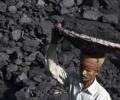
India's core sector output contracted by 0.4 per cent in March, marking the first decline in five months, with coal, crude oil, fertiliser, and electricity production falling, according to official data.
Net mutual fund inflows into active equity schemes in India plummeted by 40 per cent month-on-month in May, reaching a one-year low of 22,908 crore, primarily due to weaker lump-sum investments and increased redemptions amidst significant market volatility and global uncertainties.

Indian benchmark equity indices, Sensex and Nifty, ended lower after a five-day rally, with the Sensex dropping 607 points and the Nifty falling to 24,013.10. The decline was primarily driven by heavy selling in IT firms following Accenture's trimmed revenue guidance and renewed geopolitical uncertainty, specifically the postponement of US-Iran negotiations.

Indian IT stocks experienced a significant downturn following OpenAI's acquisition of consulting firm Tomoro, intensifying fears that global AI companies are encroaching on traditional IT service models through end-to-end consulting and implementation services.

Monthly gold imports have declined to 25-30 tonnes from 70-80 tonnes while recycling of old jewellery has increased following the recent hike in import duties.

Ola Electric is experiencing a significant rebound in the June quarter, with vehicle registrations in Q1 FY27 already exceeding the total registrations for Q4 FY26, indicating a strong recovery in demand.

Streaming has globalised the entertainment industry, enabling artists like Diljit Dosanjh and Arijit Singh to reach diverse international audiences.

Indian benchmark indices Sensex and Nifty rallied in early trade, driven by a positive trend in global markets, cooling crude oil prices following a US-Iran peace deal, and fresh foreign fund inflows.

The United States and India are on the verge of finalising a landmark bilateral trade deal, aiming to boost trade to USD 500 billion by 2030, according to US Deputy Assistant Secretary of State Bethany Poulos Morrison. The agreement seeks to open India's 1.4 billion-strong market to American goods on reciprocal terms, with ongoing high-level discussions to recalibrate the pact after recent changes in US tariff policy.

Indian benchmark indices Sensex and Nifty experienced a significant slump, with the Sensex tumbling 719.08 points, driven by escalating West Asian tensions, a sharp rise in crude oil prices, and a global sell-off in technology stocks.
Analysts predict that developments in West Asia, their impact on crude oil prices, and the trading activity of foreign institutional investors (FIIs) will be crucial factors influencing the Indian stock market this week.

'We're doing a lot of work around work-integrated learning, providing students with every opportunity to take at least part of their education as a practical work-based experience.'

A tripartite pact -- amid the promise of removing AFSPA from almost all of the North East -- revives hydrocarbon exploration along the Assam-Nagaland border after decades of dormancy.

Indian benchmark indices, Sensex and Nifty, closed sharply higher, with the Sensex climbing 1,695.40 points and the Nifty surging nearly 2 per cent, driven by a global market rally and a decline in crude oil prices following US President Donald Trump's declaration that his country has ended the war with Iran.

Indian benchmark indices Sensex and Nifty recovered early losses to trade higher, supported by encouraging developments on the geopolitical front, specifically the US-Iran peace deal, and easing crude oil prices.
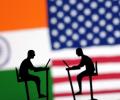
India and the United States have reviewed progress on a proposed interim bilateral trade agreement, discussing market access, digital trade, and non-tariff barriers, as they race to finalise a deal before a temporary 10 per cent US tariff regime expires on July 24.

Global oil prices fell on Thursday to their lowest levels since before the outbreak of the Iran conflict, offering a significant economic tailwind for India, the world's third-largest crude importer, by easing inflation risks, reducing the import bill and improving the government's fiscal position.
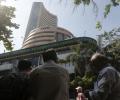
Indian stock market benchmarks, Sensex and Nifty, saw gains in early trading, driven by anticipation surrounding the Reserve Bank of India's monetary policy decision, despite mixed global cues and significant FII outflows.

India's top 16 IT services companies distributed a record 1.3 trillion to shareholders in FY26 through dividends and share buybacks, a 36.3 per cent increase from FY25, even as the industry grappled with AI-driven business model threats and a significant decline in market capitalisation.

Congress leader Rahul Gandhi criticised Prime Minister Narendra Modi and West Bengal Chief Minister Mamata Banerjee, accusing them of favouring the wealthy over the poor and prioritising power.

High costs, visa hurdles, and logistics for the World Cup are deterring fans, leading to a disappointing boost for US hotels, airlines, and the travel industry.

The reopening of the Strait of Hormuz, following a ceasefire agreement between the US and Iran, is expected to significantly ease India's crude oil supply risks, lower freight costs, and reduce inflationary pressures, as global oil prices have already dropped.
Indian benchmark indices Sensex and Nifty experienced a significant slump in early trade, mirroring a sharp decline in global equities and a fresh spike in crude oil prices, exacerbated by simmering tensions in West Asia and a global unwinding of the AI-led rally. Track how sensex, Nifty fared on June 8.

'India has initiated a bear market and we will still go lower. It has nothing to do with the economy.'

The unprecedented rally in artificial intelligence (AI)-linked stocks has led to Indian companies being excluded from the top 10 constituents of the MSCI Emerging Markets (EM) Index for the first time in over two decades, raising concerns about concentration risk.

A recently finalised peace deal between the US and Iran, set to be signed on June 19, is expected to significantly benefit India's economy by boosting exports to West Asia, stabilising the rupee, and easing inflationary pressures, according to exporters and experts.

India's leading two-wheeler manufacturers experienced significant growth in May, propelled by strong domestic demand for premium motorcycles and scooters, channel inventory replenishment, and a recovery in export markets.
Net investments into equity mutual fund schemes in India remained elevated at approximately 38,440 crore in April, despite a slight dip from March's high and a 3% month-on-month decline in Systematic Investment Plan (SIP) inflows.

India's mutual fund industry has significantly increased its share of public trading in the stock market, widening its lead over the Life Insurance Corporation of India (LIC) for the fifth consecutive year. While LIC's share of free-float listed shares has fallen to 7.42% as of March 2026, the mutual fund industry's share has surged to 22.92% from 7.06% in 2012.
Indian benchmark indices Sensex and Nifty surged significantly in early trade, tracking a global rally fueled by US President Donald Trump's declaration of an end to the war with Iran and a subsequent drop in crude oil prices.

West Bengal BJP president Samik Bhattacharya has expressed the state government's desire for the Tata Group to return to Singur, viewing it as an economic necessity and a signal that West Bengal is open for business. The move aims to reverse the negative perception created when the Nano project was forced out of the state.
