
GST collections in March grew 13 per cent to the second highest ever at Rs 1.60 lakh crore, taking the growth rate of revenue mop-up for full 2022-23 fiscal to 22 per cent. March also saw over 91 per cent of the GST registered businesses filing returns and paying taxes - reflecting greater compliance and improving economic activity. Gross GST revenue collected in March 2023 is Rs 1,60,122 crore, of which Central GST is Rs 29,546 crore, State GST is Rs 37,314 crore, Integrated GST is Rs 82,907 crore (including Rs 42,503 crore collected on import of goods) and cess is Rs 10,355 crore, the finance ministry said in a statement.

'Consolidation was part of the Indradhanush package.'

Indian companies are planning to increase investments in the new year to expand capacity, acquire companies, and go on a hiring spree, a survey of top executives showed. They, however, cited rising costs, weak consumer demand, and increasing interest rates as major concerns for 2023 which may impact their plans.


The television actor's off-screen style moments are as noteworthy as her costumes on-screen.

Enthused by higher than expected GDP numbers in the fourth quarter of 2022-23, Chief Economic Adviser (CEA) V Anantha Nageswaran on Wednesday said India's economic growth may exceed the initial estimate of 6.5 per cent in the current fiscal and the country can look for another year of solid economic performance.

The report also points out that a larger section of the poor and vulnerable households achieve middle-class status in urban areas in India despite the presence of a large urban informal sector.

While gold prices surged, inflation dipped a bit.

India needs $800 billion (Rs 50 lakh crore) annually if the economy is to grow at 7 per cent, Financial Services Secretary Hasmukh Adia said.

The economy is likely to grow at about 5.6 per cent in 2014-15 and fiscal and current account deficits no longer pose a threat to macroeconomic stability, India Ratings said on Friday.
The biggest risk to India's growth outlook is an escalation of geopolitical tensions, especially if these tensions spread to the Asian region, RBI Monetary Policy Committee (MPC) member Jayanth R Varma said on Wednesday. Varma, in an interview to PTI, said that inflation and inflationary expectations appear to be moderating and high inflation will certainly not become the 'norm' in the country. He is cautiously optimistic about the Indian economy as after the pandemic abated, consumption demand has begun to recover though the recovery is uneven across sectors and industries.

Zero inflation will pave way for rate cuts in the next RBI policy.

Foreign direct investment into the country is expected to rebound in the coming months on account of India's high economic growth, and steps to further improve the business environment of India, the Economic Survey said on Tuesday. The rise in global uncertainty in the wake of the Russia-Ukraine conflict, FDI equity inflows in the manufacturing sector in the first half of the current fiscal (April-September) fell below its corresponding level in the first half of 2021-22, the document, which was tabled in Parliament, said. The monetary tightening at the global level has further restricted the FDI equity inflows, the survey said.

Equity benchmark Sensex declined over 215 points on Wednesday, weighed by losses in index heavyweight Reliance Industries, Bajaj Finserv and Tata Steel, after the Reserve Bank raised the key interest rate by 35 basis points. Subdued Asian markets and continued selling by foreign investors also weighed on sentiment, traders said. Extending its losses for the fourth straight session, the 30-share BSE Sensex ended 215.68 points or 0.34 per cent lower at 62,410.68.
India's sovereign rating could be cut if the government loosens fiscal policy in the run-up to elections, says Fitch.

Technically speaking, US equities have seen net losses since January. India is strongly influenced by US trends.

'People trust India and Indians a lot more than they trust China and the Chinese.'

Domestic mutual funds (MFs) have kept their faith in the Indian stock market despite multiple headwinds all through 2022-23 (FY23), with their net flows into equities crossing the Rs 1.5-trillion mark for the second consecutive financial year. MFs pumped a net Rs 1.53 trillion into equities till March 1, 2023, the Securities and Exchange Board of India (Sebi) data shows, as compared to Rs 1.72 trillion in FY22. Since FY15, MFs have been net buyers of equities, except in FY21, when they sold a net Rs 1.21 trillion.

Benchmark interest rate hiked by 50 basis points to 3-year high at 5.90 per cent. Economic growth projection for FY23 cut to 7% from 7.2% estimated in August. GDP expected to grow at 6.3% in September quarter, 4.6% each in December and March quarters.

The good news for us is that India's economy - and sentiment about it - is much better than it was a year ago, says Jamal Mecklai.
Moody's Investors Service on Thursday slashed India's economic growth projection for 2022 to 7.7 per cent, saying that rising interest rates, uneven monsoon, and slowing global growth will dampen economic momentum on a sequential basis.

For India, it is business as usual with the government muddling along.

Asian Development Bank (ADB) has kept its outlook for India's economic growth unchanged at 7 per cent for the current fiscal year while forecasting a weaker-than-previously expected pace for developing Asia. ADB's 7 per cent growth projection for fiscal 2022-23 (April 2022 to March 2023), unchanged from its September forecast, compares to 8.7 per cent GDP growth in 2021-22. For 2023-24, the GDP growth has been kept unchanged at 7.2 per cent.
The Chairman of the $100-billion conglomerate has also hit out at the Opposition, media and 'some members of ruling party', saying it is 'grossly misdirected' to single out the Prime Minister and blame him for the economic woes that the country is facing at present.
The two paths India could follow: one moderately positive, one relentlessly negative.

With an Interim Budget and an election victory behind him, and a full-year budget ahead, Mukherjee would presumably have lots on his mind, but understandably be coy of revealing much.
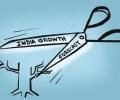
The argument that India is going towards a 'Hindu rate of growth' is "ill-conceived, biased and pre-mature" when weighed against the respective data on savings and investments, said SBI Research in its Ecowrap report. The term Hindu rate of growth was coined by economist Raj Krishna in 1978, which denoted the economic growth of about 3.5-4.0 per cent in terms of GDP during 1947-1980. "India's quarterly sequential Y-o-Y GDP growth has been in a declining trend in FY23.
Confederation of Indian Industries said on Monday that the economy has shown clear signs of a turnaround over the last four quarters with sales
It would be foolish to deny that some of the increased spending by governments (Centre and states) is showing up in better numbers.
A series of interest rate cuts in India has failed to lead to cheaper commercial lending, leaving Asia's third largest economy to grow at only 6 per cent this year, the central bank said on Tuesday.
Now, we have to demonstrate self-confidence and take strong corrective and decisive measures.

'... and without necessarily calling them Economic Surveys.' 'One should stick to the main focus, which is to give people a good perspective on how the economy is doing.'
Ganesha analyses the chart of Taurus rising Ascendant with Krutika Constellation. Rahu is in conjunct with the degrees of Ascendant. Mars is posited in second house whereas Jupiter is in Sixth house. Ganesha observes a stellium of six planets in third house.

Equity indices made an emphatic comeback on Friday after falling for seven straight sessions after the RBI hiked interest rates by 50 basis points on expected lines and projected inflation coming under control from January next year. A strong recovery in the rupee added to the momentum, traders said. Overcoming a wobbly start, the 30-share BSE Sensex soared 1,016.96 points or 1.80 per cent to settle at 57,426.92. During the day, it rallied 1,312.67 points or 2.32 per cent to 57,722.63.
The Indian economy is estimated to grow at 7 per cent in the 2022-23 fiscal, down from 8.7 per cent a year ago, mainly due poor performance of mining and manufacturing sectors. As per the first advance estimates of national income released by the National Statistical Office (NSO) on Friday, the manufacturing sector output is estimated to decelerate to 1.6 per cent in the current fiscal from 9.9 per cent in 2021-22. Similarly, mining sector growth is estimated at 2.4 per cent in the current fiscal as against 11.5 per cent in 2021-22.

India's economic growth is now 'extremely fragile' and needs all the support that it can get, as private consumption and capital investment are yet to pick up, RBI Monetary Policy Committee (MPC) member Jayanth R Varma said on Friday. Varma further said out of the four engines of growth for the economy, exports and government spending supported the Indian economy through the pandemic, but other engines need to pick up the baton now. " I like to think in terms of the four engines of growth for the economy: exports, government spending, capital investment and private consumption. "...while exports cannot be the main driver of growth because of the global slowdown, government spending is necessarily limited by fiscal constraints," he told PTI.
His faith in India remains unshaken but steel magnate Lord Swraj Paul has little doubt that it will suffer badly in the current global economic meltdown, a view contrary to that of many economists who feel that the country's strong domestic economy will help it deal with the crisis.
The government and Reserve Bank of India are working on measures that include relaxing norms for Non-Performing Assets (sticky loans) and prudential lending to kick-start key infrastructure projects.
 © 2026 Rediff.com - Advertise with us - Disclaimer - Privacy Policy - Sitemap - Feedback - About us - Terms of use - Grievances