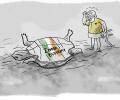
S&P Global Ratings on Monday cut India's economic growth forecast for current fiscal year to 7 per cent, but said the domestic demand-led economy will be less impacted by the global slowdown. S&P had in September projected the Indian economy to grow 7.3 per cent in 2022-23 and 6.5 per cent in next fiscal year (2023-24). "The global slowdown will have less impact on domestic demand-led economies such as India... India's output will expand 7 per cent in fiscal year 2022-2023 and 6 per cent in next fiscal year," S&P Global Ratings Asia-Pacific chief economist Louis Kuijs said.

'The Indian economy and the Indian financial sector today remain resilient and much better placed.'

India, he said, has opened up its markets and stepped up public investment including in the infrastructure space and is concentrating a lot on boosting expenditure to improve the quality of rural life

Excerpt from the address by Reserve Bank of India Governor Dr Y V Reddy at the Institute of South Asian Studies, Singapore on May 20, 2008.

India suffered a $3 billion loss to its economy from severe rainfall and flooding in November and early December.

'Geopolitical risks and their impact on oil prices, if any, are another concern for global markets, particularly for India.'
Differing with some of the leading corporate voices against perceived policy paralysis in the government, industrialist Ratan Tata on Thursday said there is no need to be pessimistic because of the global uncertainties as India's economic fundamentals are strong.

For the first time in three years, India will register lower growth rate, but some economists believe all is not lost.

'China seems more intent on creating a new world order rather than shaping the existing one.' 'India is of course, at this moment in time, aligned with the West-led order because of China's full-spectrum aggressive behaviour towards India.'
The economies of China and India are 40 per cent smaller than previously thought, according to new estimates published by the World Bank this week.

Foreign portfolio investors (FPIs) infused Rs 11,630 crore in the Indian equity markets in April on the reasonable valuation of stocks and appreciation in the rupee. This came after FPIs infused a net sum of Rs 7,936 crore in equities in March, mainly driven by bulk investment in the Adani Group companies by the US-based GQG Partners. However, if one adjusts for the investments of GQG in Adani Group, the net flow was negative.

Finance Minister Nirmala Sitharaman on Wednesday said the government is keeping an eye on inflation which is purely "extraneous" nowadays because of fuel and fertiliser prices. Replying to the debat on the Supplementary Demands for Grants in the Rajya Sabha, the minister said wholesale inflation has fallen to a 21-month low. Later, the Rajya Sabha returned the Supplementary Demands for Grants to the Lok Sabha, thus completing the process of authorising the government to spend an additional Rs 3.25 lakh crore in FY2022-23.

Finance Minister Nirmala Sitharaman on Tuesday said many countries have evinced interest for bilateral trade in the rupee after the RBI announced a mechanism recently. Speaking at Mindmine Summit 2022, she said this along with other steps taken by the government is towards full capital account convertibility. "It isn't the rouble-rupee which was in the old format. "Now this (bilateral rupee trade) formulation, which I am glad the RBI has come up at a time which was so critical," she said when asked if India is ready for capital account convertibility.

Amid growing fears of another global recession looming large, President Pratibha Patil today exuded confidence that India with its "strong fundamentals and resilience" will continue to grow economically.
Credit growth has slowed down from around 32 per cent (year-on-year) in July 2006 to around 23 per cent in August. Anecdotal evidence suggests that much of the deceleration in growth has come on the back of softer retail credit off-take.
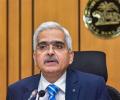
The RBI raked in a massive net income gain from foreign exchange currency sales as a buffer for the rupee during tumultuous geopolitical upheavals last year owing to Russia's invasion of Ukraine.
It said early polls suggested the BJP should win the largest number of votes and seats, giving it the opportunity to form a government.
The overhang of corporate debt is the primary straitjacket that ties our firms down, not the bottlenecks created by our alternately slothful and interventionist courts and bureaucrats.

India's unemployment rose to a three-month high in March to 7.8 per cent as the country's labour markets deteriorated, according to data from the Centre for Monitoring Indian Economy (CMIE). Unemployment rate in the country surged in December 2022 to 8.30 per cent but declined in January to 7.14 per cent. It edged up again in February to 7.45 per cent, the CMIE data released on Saturday showed. During March, the unemployment rate in urban areas was at 8.4 per cent while in the rural areas it was at 7.5 per cent.
Union Minister of State for Industry Ashwani Kumar has asked investors to grab the opportunities in the fast expanding infrastructure, manufacturing and consumer goods sectors in the country.

The gap between the highs and the lows in April for the benchmark S&P BSE Sensex was just 4.1 per cent - the narrowest since July 2021 and nearly half its three-year average. The absence of major positive triggers, sectoral rotation, and cautiousness due to earnings and economic uncertainty have kept a tight leash on the markets, observe experts. Remarkably enough, during the 17 trading sessions in April, the Sensex didn't even log an advance or a decline of more than 1 per cent.
The safe conclusion to draw from the second-quarter gross domestic product (GDP) numbers that were published last Friday is that the cycle has bottomed out and things are unlikely to get any worse.
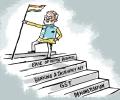
India's GDP expanded 13.5 per cent in the April-June quarter, the quickest pace in a year, to retain the world's fastest growing economy tag but rising interest costs and the looming threat of a recession in major world economies could slow the momentum in the coming quarters.
The key similarity between 1991 and 2014 is the criticality of decisive action.
The tide began to turn in early September with the new Reserve Bank of India governor's confident and well-considered initial policy statement on September 4.

The observations are based on the grouping's latest composite leading indicators released on Monday, that provide early signals of turning points with regard to economic expansion and slowdown.

On Pakistan, the publication quoted him as saying that India wants "normal and neighborly relations."

Mixed earnings and not so encouraging macroeconomic data dented sentiment, Ajit Mishra, VP - Research, Religare Broking Ltd said. In twin blows to Indian economic revival, higher food prices drove retail inflation to a five-month high of 7.4 per cent, while factory output fell for the first time in 18 months. The second consecutive month of rise in consumer price index (CPI)-based inflation will add to the pressure on the Reserve Bank of India (RBI) to again raise interest rates to tame high prices. In the broader market, BSE Midcap declined 0.73 per cent while smallcap dropped 0.45 per cent.

Mahindra & Mahindra chairman emeritus Keshub Mahindra passed away this morning in Mumbai due to old age. Mahindra, 99, breathed his last this morning at home peacefully, said a person close to the family. After joining the company in 1947, he became the chairman in 1963.
The five policy missteps that have led India to economic crisis.
Among the sectors seen as most vulnerable to corruption are the government and the public sector, infrastructure, real estate, metals, mining, aerospace, defence, power and utilities.

The Constitution amendment bill for roll-out of GST is pending in Rajya Sabha for a long time.

Morgan Stanley draws optimism from a slew of favourable factors.
India is in a Chakravyuh, where with every passing day it is getting mired in one crisis after another.

'Investors should hold equity assets for 3 to 5 years.'
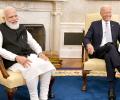
Prime Minister Modi will embark on his first state visit to the United States at the invitation of President Joe Biden and First Lady Jill Biden in June.

India must be prepared to deal with climate disasters, geopolitical confrontations, and social strife linked to global events, asserts Jayant Sinha, chairman of Parliament's Standing Committee on Finance.

NITI Aayog has not said what the reasons were for having achieved or not having achieved what was sought to be achieved, or what lessons can be learned for the future, points out Aakar Patel.
From Dalal Street to the high street, India shrugs off global concerns with robust demand.
 © 2026 Rediff.com - Advertise with us - Disclaimer - Privacy Policy - Sitemap - Feedback - About us - Terms of use - Grievances