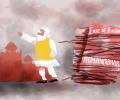
'Limited spillovers' to Asia's third-largest economy, even as world 'perilously close' to recession.

'Tax rate and stock markets are entirely two different things.'

India will be the world's third-largest economy by 2028 as it becomes the world's most sought-after consumer market and gains share in global output, driven by macro stability influenced policy and better infrastructure, Morgan Stanley said. From a $3.5 trillion economy in 2023, the Indian economy is projected to expand to $4.7 trillion in 2026, which will make it the fourth largest in the world behind the US, China and Germany.

High frequency indicators, like vehicles sales, air traffic, steel consumption and GST E-way bills, point towards a sequential pickup in momentum of economic activity during the second half of the fiscal 2024-25 and sustain moving forward, RBI Bulletin said on Wednesday. However, a strong dollar, driven by US economic resilience and trade policy pivots, could exacerbate capital outflows from emerging economies, push risk premiums higher, and intensify external vulnerabilities, said an article on 'State of the Economy' published in RBI's February bulletin.

Since Sanjay Malhotra took office as governor in December, the Reserve Bank of India (RBI) has adopted a more accommodative stance, which bodes well for banking and the economy as they navigate a growth slowdown, according to analysts.

Foreign companies now pay less tax relative to their earnings than at any time in more than three decades. Foreign private companies paid 24.36 per cent of their pre-tax profit as tax in 2023-24, show numbers from the Centre for Monitoring Indian Economy (CMIE).

The Indian economy has recovered 'handsomely' from the pandemic-induced disruptions, former Niti Aayog vice chairman Arvind Panagariya said on Tuesday, while expressing hope that the recovery will be sustained and the growth rate of 7 to 8 per cent will be restored. Panagariya suggested that the government must now signal its intention to wind down fiscal deficit by cutting it by half-to-one percentage point in 2022-23. "The Indian economy has recovered handsomely, returning to its pre-COVID GDP... "Only private consumption is still below its pre-COVID-19 level," the eminent economist told PTI in an interview.

'Expect India to keep doing well irrespective of geopolitics.'

The AAP chief stressed the need for an increase in healthcare spending, suggesting a rise to 10 percent of the GDP, along with the removal of taxes on health insurance premiums.

'The bull market cycle ran for five years. It's the end of that cycle.' 'The next cycle is a down cycle, and in that down cycle, you will see the Sensex falling from their highs of around 68,000 to maybe 40,000-50,000 at the bottom of the cycle.'

'If weak indicators persist, there is a risk that India could slip into a prolonged slowdown similar to the one experienced between 2014 and 2019,' warns Debashis Basu.
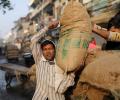
The Indian economy is recovering from the slowdown in momentum witnessed in the September quarter, driven by strong festival activity and a sustained upswing in rural demand, according to a Reserve Bank of India (RBI) bulletin released on Tuesday. An article on the 'State of the Economy' in the December bulletin noted that the global economy continues to exhibit resilience with steady growth and moderating inflation.

Upbeat high-frequency indicators and consumer confidence show that Indian economy continues to forge ahead, emerging out of shackles of pandemic, said an article on the state of economy published in RBI Bulletin on Wednesday. The recovery is spearheaded by an uptick in private investment through November-December alongside a turnaround in bank credit offtake and high capex from the government sector (Centre and states). In conjunction, the employment situation has brightened, said the article written by RBI officials.

India Ratings on Thursday said that any broad-based or strong recovery in corporate capital expenditure was unlikely in the upcoming financial year 2026 (FY26) due to uncertainty of domestic and external demand. The uncertainty is adversely affecting the overall corporate sector capex. Interest rates on credit are not the primary deterrent to decisions about capital expenditure, said Soumyajit Niyogi, director, core analytical group, Ind-Ra, in a webinar on the credit market outlook.

S&P Global Ratings on Wednesday said the impact of the US reciprocal tariff will be limited on India as the economy is domestically oriented with less reliance on exports. YeeFarn Phua, Director, Sovereigns and International Public Finance Ratings, Asia-Pacific S&P Global also said India will clock a 6.7-6.8 per cent GDP growth over the next two years.

'We face the risk of remaining a low-income country for a very long time unless something changes in the next few years.' 'Instead of constantly talking about becoming a developed economy, we need to start fixing the problems of the economy one by one.' 'There is so much potential, and we are squandering away the opportunity.'

'I am more optimistic about India than before.'

The Indian economy recovered from the Covid-induced downturn during 2022 and is poised for further improvement in the coming quarters though downside risks emanating from geopolitical tensions, strengthening dollar and elevated inflation will continue. The positive trajectory in the growth trend and improved fundamentals will help the nation in neutralising the impact of global headwinds which are expected to have a bearing on the country's exports in the months to come. The challenges before the government and the Reserve Bank in the new year would be to arrest inflation, check declining value of rupee against US dollar and promote private investment and growth, with a view to ensure that the country remains one the fastest growing major economies of the world.
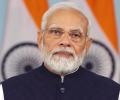
Prime Minister Narendra Modi on Friday expressed hope that G20 will draw inspiration from the vibrancy of the Indian economy and work towards bringing back stability, confidence and growth on the global landscape.
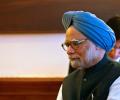
Former Prime Minister Manmohan Singh was a brilliant economist with a visionary outlook on India's potential, combined with a fine sense of political feasibility, former RBI Governor Raghuram Rajan said on Friday. Singh, the architect of India's economic reforms, passed away here late on Thursday at the age of 92.

'Unsurprisingly, Trump shared Modi's podcast with Fridman on his Truth account.' 'The intentions of Trump, a transactional president, are never easy to tell.' 'We will know in the next fortnight if and when he unfolds reciprocal tariffs on Indian goods, whether Modi's flattering words made any significant difference to Trump's compass,' notes Ambassador M K Bhadrakumar.

The government, in the forthcoming Budget, could consider levying higher tariffs on imports to check the significant decline in rupee value witnessed in the past few months, said EY Chief Policy Advisor DK Srivastava. The noted economist argued that higher import duties would curb the demand for dollars from importers and help arrest the sliding value of the rupee, which touched a historic low of 86.70 to a dollar on January 13.

State Bank of India, Adani Ports, Tata Consultancy Services, ICICI Bank, Reliance Industries and PowerGrid were also among the laggards.

'Reduce your equity allocation, put that allocation into gold and fixed income.'
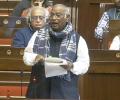
RS Chairman Dhankhar called Kharge making the claim a "very sad moment" and asked him to withdraw his statement, the Leader of Opposition insisted the government give the correct figures and continued with his speech.

Excess earnings of unlisted companies over and above their interest costs are at a record level. The interest-coverage ratio of 2.94 is the highest going back to 1990-91, according to numbers from the Centre for Monitoring Indian Economy (CMIE). The ratio measures earnings relative to every rupee to be paid as interest on outstanding debt.
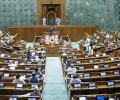
The deportation of Indians from the United States, deaths in the Maha Kumbh stampede and the joint Parliamentary committee report on the Waqf bill were among the issues that led to heated exchanges and some disruptions in an otherwise smooth first part of the Budget session that ended on Thursday.

Shaktikanta Das will demit the office on Tuesday after completing six years as the 25th Governor of the Reserve Bank of India. Revenue Secretary Sanjay Malhotra will replace him as the 26th Governor. He was appointed as the Governor on December 12, 2018, after the abrupt exit of Urjit Patel.

Both new and completed project values as of December 2024 remain below pre-pandemic levels seen in 2019.

Recent documents by NITI Aayog and periodic labour force surveys on employment show that the importance of agriculture is rising in the Indian economy.

"The new structure will substantially reduce taxes on the middle class and leave more money in their hands, boosting household consumption, savings and investment," Sitharaman said presenting what was dubbed as 'reformist' budget for the next fiscal in Lok Sabha.

We must bring a laser focus on our own interests, and define our friends and foes more clearly instead of trying to live by somebody else's rules. We must grow up, think for ourselves, think India First, asserts R Jagannathan.

Reserve Bank of India Governor Shaktikanta Das on Friday said the country's economy is an island of stability despite two Black Swan events and multiple shocks. "In an ocean of high turbulence and uncertainty, Indian economy is an island of macroeconomic and financial stability," Das told reporters during the post policy press conference. He said the financial stability, macroeconomic stability and resilience of growth is being witnessed despite two Black Swan events happening one after the other and multiple shocks.
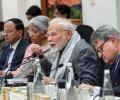
Job creation, improving farm productivity, and mobilising public funds for infrastructure development were some of the issues that figured during the interaction between Prime Minister Narendra Modi and economists ahead of the 2025-26 Union Budget. The prime minister on Tuesday met eminent economists and sectoral experts at NITI Aayog to hear their views and suggestions for the upcoming Budget. Union Finance Minister Nirmala Sitharaman is scheduled to present the Budget for 2025-26 in the Lok Sabha on February 1, 2025.

Largecap companies are generally less vulnerable to economic slowdowns than their mid- and smallcap counterparts.

The US Fed rate cut of 50 basis points is unlikely to have any significant impact on foreign inflows into India, Economic Affairs Secretary Ajay Seth said on Thursday. He said the US Federal Reserve has done what it assesses is good for the largest economy in the world, but the RBI will take a decision on interest rate cut keeping the Indian economy in mind. "It is a positive for the global economy, including the Indian economy. "It is a 50 basis points cut from a high level.
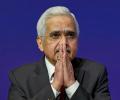
Outgoing Reserve Bank Governor Shaktikanta Das said on Tuesday that restoring inflation-growth balance is the most important task ahead of the central bank. Addressing a press conference on his last day as the central bank chief, Das said his successor will have to navigate the changing world order, effectively deal with cyber threats, and focus on harnessing new technologies.

President Droupadi Murmu addressed both Houses of Parliament, highlighting the government's achievements in various sectors, including economic growth, social welfare, and infrastructure development. She emphasized the government's efforts to lift the economy out of "policy paralysis" and create a more inclusive society. Murmu also acknowledged the challenges posed by digital fraud and cybercrime and stressed the need for a social infrastructure revolution. The President's speech is considered a policy statement, outlining the government's vision and roadmap for the future.

'...how do they consume and contribute to the GDP?'

 © 2026 Rediff.com - Advertise with us - Disclaimer - Privacy Policy - Sitemap - Feedback - About us - Terms of use - Grievances