
Indian manufacturing sector witnessed the fastest improvement in operating conditions in over 17 years in August, driven by an increased production efficiency and healthy demand conditions, a monthly report said on Monday. The seasonally adjusted HSBC India Manufacturing Purchasing Managers' Index (PMI) rose from 59.1 in July to 59.3 in August, indicating the fastest improvement in operating conditions for 17-and-a-half years.

Senior Congress leader Shashi Tharoor says US tariffs are negatively impacting India, leading to job losses, and criticizes President Trump's diplomatic behavior.

The 50 per cent US tariff on Indian goods pose a downside risk to growth but the impact is expected to be short-lived for the economy, and consumption demand could see an uptick after the new goods and service tax (GST) rates are implemented which could even offset the external uncertainty, Chief Economic Advisor (CEA) V Anantha Nageswaran reckoned on Friday.

India responded to US President Donald Trump's criticism, emphasizing the strength and resilience of the India-US strategic partnership.

'Given the lag in transmission, further softening of lending rates may happen in the coming months.'

The GST Council on Wednesday approved a two-tier rate structure of 5 and 18 per cent, which will be implemented from September 22.

The collective West has always opposed strong leaders and economic development in India, asserts Colonel Anil A Athale (retd).

'It was like rigorously preparing for a solid, good exam...' 'I don't know what marks I will get, but I felt the rigorous preparation of an exam.' 'You may sweat, but I feel rejuvenated.'

Plans for big bang reforms in the GST regime by Diwali, the Putin-Trump summit and S&P upgrading India's sovereign credit rating are likely to instil optimism in the domestic equity market in the week ahead, analysts said. Besides, trends in global markets and the trading activity of foreign investors would also impact domestic investors' sentiment.

India's economic growth is expected to be lower at 6.3 per cent this fiscal compared to the RBI's projection of 6.5 per cent, a SBI Research Report said on Thursday. The report pegged the first quarter GDP estimate at around 6.8-7 per cent, mainly due to muted private capex.

"We are contributing about 18 per cent, which is more than the US where the contribution is expected to be much less -- about 11 per cent or something. We are doing very well and we will continue to improve further," RBI governor Sanjay Malhotra said, replying to a question on Trump's recent comments.

You can't be the second-most expensive market in the world and deliver just 10 per cent EPS growth, points out Akash Prakash.

Among Sensex firms, Eternal, Infosys, Asian Paints, HDFC Bank, Bajaj Finserv and Titan were the major gainers. However, Tata Steel, Tech Mahindra, Adani Ports and Bharat Electronics were among the laggards.

The BJP has accused the Congress party of fabricating the theory of 'Hindu terror' to undermine Narendra Modi and appease Muslim voters. This statement follows the acquittal of seven individuals in the Malegaon blast case. The BJP demands compensation for the acquitted and an apology from the prosecution.

Prime Minister Narendra Modi's attendance at the G7 summit is a reflection of the size and dynamism of the Indian economy and the leadership position India plays, Canadian Prime Minister Mark Carney has said.
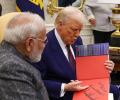
'The current strain in the relationship is serious and likely to be long lasting.' 'Even if Trump suddenly changes his attitude toward India -- which he is entirely capable of doing -- it is unlikely that New Delhi will be able to pick up the pieces and respond as if nothing has happened.'

In the Indian stock market, investors are interested in the actions of both domestic and foreign institutional investors (FIIs and DIIs). These groups have wealth as well as expertise in research, which makes them powerful participants in the Indian stock market. Their buy and sell positions have a large effect on stock prices and market sentiment due to the large volume.

Generative AI is transforming workplaces but at a cost -- there are fewer jobs for young workers just entering the workforce, reveals a Goldman Sachs report.
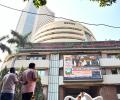
'BSE has facilitated nearly Rs 35 trillion in capital raising across multiple segments.'

The way to deal with a bully is to resist bullying, because submission in the first instance only invites even more overbearing demands in future. What may seem like a small price to pay now will lead to a much higher price later, warns former foreign secretary Shyam Saran.

More than half of all new project announcements in the June 2025 quarter came from the manufacturing sector. Manufacturing projects worth around Rs 2.3 trillion were announced in the three-month period, accounting for 54 per cent of total new projects, according to data from the Centre for Monitoring Indian Economy (CMIE).

'What India has done will surely embolden more countries to stand up to Trump.'

In the past 10 years, over 500 PSB officers have died by suicide. When targets are overwhelming, senior management and customers are both impatient, and there is constant fear, not every banker has the resilience to survive and thrive, warns Tamal Bandyopadhyay.

The point to note for India is that we must not panic. The United States may be our largest export destination, but high tariffs will not exactly mean gloom and doom. Sure, we can throw some morsels as we continue negotiating, but we must be firm that some red lines cannot be crossed, no matter what, asserts Shreekant Sambrani.

'India did not surrender. That was why he wanted to pressurise India by this 25% tariffs.'

While a giant, it's a nimble-footed one, and is growing at a speed that even some of its private sector peers find enviable.
Between FY18 and FY24, it doubled its balance sheet. Despite being a late entrant in some segments, it has been able to grab market share, observes Tamal Bandyopadhyay.
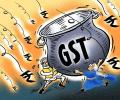
Goods and Services Tax (GST) collection rose 12.6 per cent Y-o-Y to an all-time high of about Rs 2.37 lakh crore in April, which the government said shows resilience of the Indian economy and the effectiveness of cooperative federalism. The gross GST mop-up was Rs 2.10 lakh crore in April 2024 -- the second highest collection ever since GST was rolled out on July 1, 2017. The net mop-up was Rs 1.92 lakh crore.

From the Sensex firms, Tech Mahindra, Tata Steel, Tata Motors, Titan, HDFC Bank, IndusInd Bank, Infosys and Kotak Mahindra Bank were among the biggest laggards. On the other hand, Adani Ports, Mahindra & Mahindra, Power Grid, Eternal and Hindustan Unilever were among the gainers.

Flipkart has received a lending licence from the Reserve Bank of India (RBI), the Walmart-backed ecommerce company confirmed on Thursday. The nod came in March this year, according to sources.

'If you align your ambition with India's rise, the peak of your careers will unfold alongside the peak of India's power.'
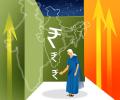
Structural reforms, pro-people programmes and employment opportunities helped the economy get new vigour, the finance minister said. After contracting by 5.8 per cent in 2020-21, the economy recorded a growth of 9.1 per cent in 2021-22.

'We need to be very vigilant as we are passing through some fraught times.'
NITI Aayog member Arvind Virmani on Monday said India is set to become the fourth largest economy in the world by the end of 2025, an assertion which came days after NITI CEO BVR Subrahmanyam claimed India has already overtaken Japan to reach that spot. The International Monetary Fund (IMF), in its World Economic Outlook (WEO) report released in April had said that India is expected to be the fourth largest economy in the world with a GDP of $4.19 trillion in 2025, ahead of Japan.

India's macroeconomic health is in a "relative goldilocks situation", and although the risk of higher landed oil prices, due to insurance cost surges and closure of choke points due to the brief Israel-Iran war, has receded, it is "too soon to sound the 'all clear' for the rest of the year", the Finance Ministry said on Friday.
S&P Global Ratings on Tuesday upped India's GDP growth forecast for the current fiscal to 6.5 per cent, citing lower crude prices, monetary easing and normal monsoon, and said the ongoing geopolitical tensions are unlikely to put a "significant pressure" on the rupee or inflation.

RBI's interest rate decision, macroeconomic data announcements and global trends are the key factors that would dictate the momentum in the equity market this week, analysts said.
Reserve Bank on Tuesday launched mobile application 'RBIDATA' which will provide access to more than 11,000 different series of economic data related to the Indian economy. The mobile app offers macroeconomic and financial statistics relating to the Indian economy in a user-friendly and visually engaging format, Reserve Bank of India (RBI) said in a release.

However, under several external factors -- such as technological disruption or advancement, regulatory or policy changes, or economic shocks -- the gig workforce may grow only to 32.5 million by 2047, a report points out.

India has ranked 131 out of 148 countries in the World Economic Forum's Global Gender Gap Report 2025, slipping two places from its position last year.

'Many global investors have been overweight on dollar assets, so some diversification or hedging is naturally expected.'
 © 2026 Rediff.com - Advertise with us - Disclaimer - Privacy Policy - Sitemap - Feedback - About us - Terms of use - Grievances