
'India did not surrender. That was why he wanted to pressurise India by this 25% tariffs.'

South Korea: 15%
EU: 15%
Japan: 15%
Philippines: 19%
Indonesia: 19%
Vietnam: 20%
UK: 10%
Mexico: 30%
Canada: 35%
India: 25%
These are the trade tariff rates imposed on various countries by United States President Donald John Trump.
There is an additional penalty for buying oil from Russia for India.
Though the trade negotiations between India and the US are still going on, from today Indian exporters have to pay 25% on all the goods exported to the US market.
How is this going to affect the Indian economy which Trump described as 'dead'?
"The US wants to India to relax its domestic policies. They want to operate in India. They want their companies like Amazon to have more facilities for operations. They want unlimited data flow for Google," Ajay Srivastava, founder of the Global Trade Research Initiative, tells Rediff's Shobha Warrier.
25% tariff on all goods and a penalty for buying oil from Russia. Should India be worried? Or how much should India be worried?
There is no reason to worry.
We have to first understand that this is not the end of trade negotiations between the two countries.
India was the first country to start negotiating a trade deal with the US with the prime minister meeting the US president on the 13th of February.
Since then, many rounds of negotiations have taken place.
Though Trump has slapped 25% tariff and a penalty for buying oil from Russia, negotiations will continue.
What I want to say is that he expected India to surrender agriculture and the dairy sector like the EU or Japan did. But India did not surrender. That was why he wanted to pressurise India by this 25% tariffs.
With the 25% tariff in place from August 1, which sector in India is going to suffer the most? The textile sector?
Yes, the 25% blanket tariff without exemptions threaten the $25 billion exports to the US.
Most affected categories will be petroleum products, pharmaceuticals and electronics. Other sectors like engineering goods, electronics, and textiles will also to bear the brunt of the tariffs.
Jewellery cannot absorb 25% tariff. So, exports will decline.
We export $ 1billion worth shrimps to the US under a 15%-16% tariff. If 25% is added to it, it will be very high. So, they may buy from Canada if supplies are available from there.
This sweeping measure, part of a new executive order issued by President Trump on July 31, goes beyond mere tariff revision.
It places India among the most harshly treated countries in the new US tariff regime, offering no product level exemptions even for sectors deemed critical like pharmaceuticals, energy and electronics.
This blanket tariff, approved by President Trump, is one of the toughest trade actions the US has taken against a key trading partner in recent years.
What sets this action apart is that, unlike many other trading partners, India has been denied all product-level exemptions -- even for products and sectors, the US exempted goods from other countries.
These tariff exempted categories included finished pharmaceutical drugs, active pharmaceutical ingredients and other key drug inputs; energy products such as crude oil, refined fuels, natural gas, coal, and electricity; critical minerals; and a wide range of electronics and semiconductors, including computers, tablets, smartphones, solid-state drives, flat panel displays, and integrated circuits.
These exclusions do not apply to India. Instead, India is subject to a flat 25% ad valorem duty across all goods, with no exceptions by product or sector.
The order mentions that tariffs may be reduced once countries do a deal with the US.
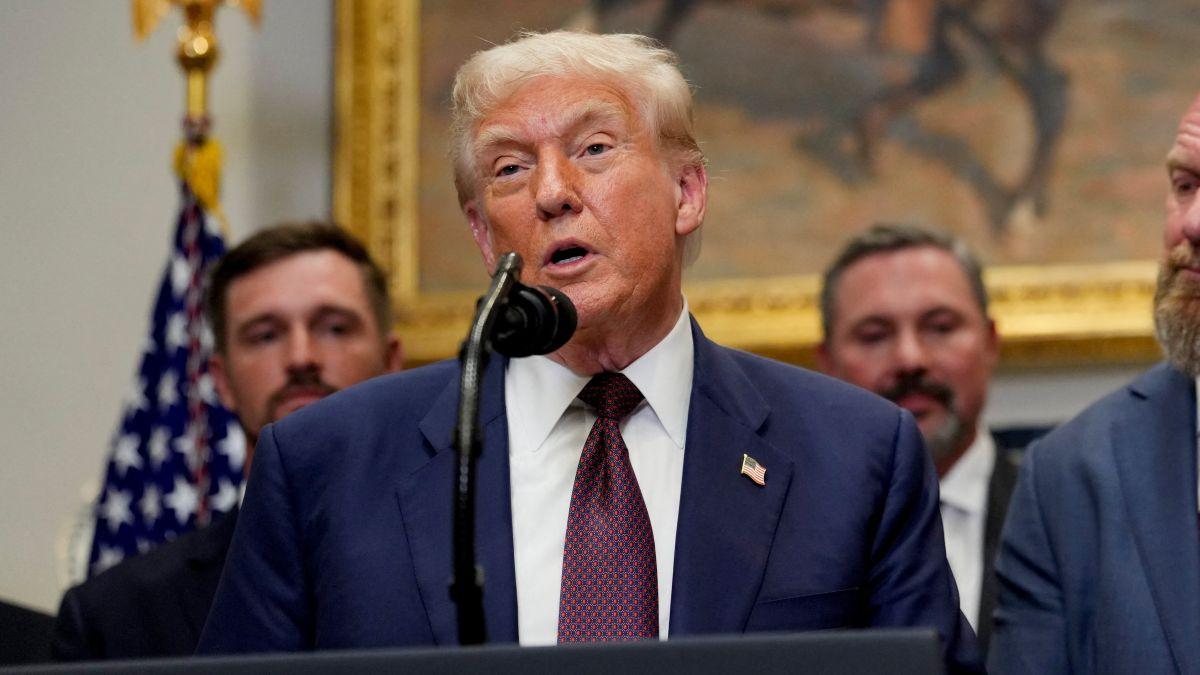
Trump is not known for reasoning. In fact, he described India's trade policies as 'strenuous and obnoxious'...
It was his way of putting pressure on India so that India would surrender its agriculture and dairy.
I don't give much importance to his pressure tactics.
Do you think like the EU or Japan, India also will surrender agriculture and dairy sectors under pressure from Trump?
India has not surrendered so far, and that is why this problem.
But Europe, Japan, Indonesia, South Korea, etc surrendered, and that was why a better deal was possible with those countries.
Agriculture and dairy have very strong red line for India. 700 million people depend on agriculture and it's their livelihood. If we surrender to the US, it will be a threat to their livelihood.
We are not talking about employment; we are talking about livelihood.
If there is no agriculture, what will they do? There are no industrial services.
The Indian government understands this and that's why they are keeping agriculture in the red line.
I think India will not open up the agriculture and dairy sectors.
Vietnam, after sacrificing its entire agriculture and industrial sector, has to pay 20% tariff.
We have not sacrificed anything, and we have to pay 25% tariff.
So, I am of the opinion that India is better off without a deal than countries which sacrificed heavily like the EU, Japan, South Korea, Philippines, Vietnam, etc.
I would put it this way. India without a trade deal is not worse off than countries with deals.
 IMAGE: Ajay Srivastava
Do you think how Trump reacted to India is more political than business-like?
It is not basically a trade deal.
It is something beyond a tariff cut.
The US wants to India to relax its domestic policies. They want to operate in India. They want their companies like Amazon to have more facilities for operations. They want unlimited data flow for Google.
So, it is beyond tariff, it is beyond trade. The US wants a big pie of the domestic economy.
- Part 2 of the Interview: 'Trump Is Frustrated'
Feature Presentation: Aslam Hunani/Rediff








 © 2025