
According to assurance, tax and advisory firm Grant Thornton, corporates in the country announced 458 deals in the January-November period amounting to $26.76 billion.

The combined pay for India Inc's top management was up 30 per cent in FY16, growing at the fastest pace in nine years

Indian CEOs might like to make some serious course correction.

'More than investors, fund houses, and advisors have raised caution and limited flows on small-and mid-caps.'

The lack of a strong diversity policy on the part of companies, a limited pool of women candidates as well as socio-cultural factors contribute to their low numbers.

Chief executives in the real estate, consumer products, automobiles, construction, and textile sectors said they were all expecting workers to re-join in the next 45-60 days, which would help them ramp-up production from July.

The status quo decision came as a breather as only last week the RBI had pulled up banks for not helping it in monetary policy transmission.

Banking is a boring business but still the banker should enjoy it as fancy awards and cozy relationships with politicians, Bollywood stars and corporate honchos cannot save them if the job is not done properly. In the concluding part of the series Tamal Bandyopadhyay wonders how long Kochhar would need to wait for her redemption or downfall and atonement.
.jpg)
Prime Minister's key economic advisor C Rangarajan on Friday lowered the growth forecast for the current fiscal to 5.3 per cent from 6.4 per cent projected earlier and listed out host of measures, including further liberalisation of FDI norms to improve economic condition.

With the threat of a third Covid-19 wave looming large, companies are scrambling to protect employees and keep operations safe--from a no-jab-no-entry-at-workplace policy to ramping up vaccination, it's an all-out effort to prevent the scale of devastation seen in the first two waves. At least two top steel companies--Tata Steel and ArcelorMittal Nippon Steel India (AM/NS India)--are pushing for vaccination certificates for entry into work premises. AM/NS India, a joint venture between world's leading steelmaker, ArcelorMittal, and Japan's Nippon Steel, is set to make vaccination the certificate a requirement from July 1.

Corporate houses believe RBI must cut rates to boost investment in the system.

Analysts now expect India Inc to report a decline in both top line and bottom line for the September quarter.

Industrialists affirm their belief that the adverse effects of demonetisation and the goods and services tax are finally over.

China has cast a long shadow on India's economy.

Combined profit before tax of 81 firms down 37.5% y-o-y, worst show in at least 3 years.

'The Indian state is very benevolent when it comes to corporates,' says Tom Thomas, chief executive officer of Praxis, and convenor of CRW India.

Top companies across sectors -- automobile maker Maruti Suzuki, consumer electronics giant Samsung to IT giant Infosys -- have reopened factories and offices as India took its first steps towards resuming economic activity after weeks under a near-total coronavirus lockdown.
.jpg)
Arvind Kumar Sharma, a 1988-batch IAS officer and one of the many joint secretaries in PMO, definitely wields some power.

India Inc on Wednesday said it looked forward to the new RBI Governor Raghuram Rajan initiating cut in interest rates and improving credit flow to crucial sectors like infrastructure to put economy back on high-growth path.

Bankers said the outlook of M&As in India in 2024, especially in the second half after the Lok Sabha election, seems relatively better.

Corporate India handed over an average increment of 8 per cent in 2021, and early estimates reveal that average increment for 2022 is expected to increase to 8.6 per cent in line with a healing economy and improving confidence, according to a Deloitte survey. As per the second phase of Deloitte's Workforce and Increment Trends survey 2021, 92 per cent companies gave an increment in 2021 at an average of 8 per cent, compared with only 4.4 per cent in 2020, where just 60 per cent companies had extended a pay hike. For 2022, average increment is expected to increase to 8.6 per cent, at par with the pre-pandemic levels of 2019, the survey said, adding that about 25 per cent companies surveyed have projected a double-digit increment for 2022.

Funds raised by India Inc. through offshore loan syndication hit a 15-year high in 2023 with companies and banks raising $21.4 billion, the highest since 2007. The momentum is expected to continue in 2024 as well with over $4 billion fund raising expected in the first three months of this year. Companies raise funds, both onshore and offshore, depending on interest rates and activities. Funds raised offshore can be deployed in overseas activities.

A total of Rs 52,759 crore has been raised by 61 companies through initial public offers till October this fiscal, higher than the funds mopped up through this route in the last financial year, the government told the Lok Sabha on Monday. Out of the 61 companies that hit the markets till October of the current fiscal, 34 entities were Small and Medium Enterprises (SMEs). Finance Minister Nirmala Sitharaman said that a large number of manufacturing and service sector companies are coming up for listing.

India Inc has pitched for rate cut to boost economic activities.

The migration of domestically developed intellectual property to foreign corporations within India reflects an anomaly in the demand pattern of the country's job market, points out Kanika Datta.

'A bold, progressive step forward,' Kotak Mahindra Bank CEO Uday Kotak said of Nirmala Sitharaman's corporate tax breaks.

While FMCG companies were not barred from carrying out their operations during the 21-day lockdown, since most manufacture staples and essential products, capacity utilisation remained poor, owing to the restricted movement of raw materials, finished goods, and labour.

A recent survey done by indianboards.com suggests that around 283 directors will retire by October this year.

We can hope that some of the benefits of the rural spending - on irrigation, roads, etc -- will spur rural demand and improve rural productivity, says P V Subramanyam.
We can hope that some of the benefits of the rural spending - on irrigation, roads, etc -- will spur rural demand and improve rural productivity, says P V Subramanyam.
We can hope that some of the benefits of the rural spending - on irrigation, roads, etc -- will spur rural demand and improve rural productivity, says P V Subramanyam.

A senior official in the central labour commissioner's office said the efforts of the government were to resolve the cases amicably and not to press for legal action against employers. "Everyone is going through tough times. We could initiate legal action if we want but that's not the idea. We want to address the issues amicably," the official said.
Sentiment has improved but no progress on GST & ending 'tax terrorism' disappoints.

No new capacity addition is planned for 2018 and capital expenditure plans are on hold
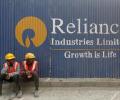
Reliance Industries Ltd was the biggest wealth creator during the five-year period from 2018 to 2023 while Adani Enterprises Ltd was the top all-round wealth creator, according to a study by Motilal Oswal Financial Services. The study, based on stock market performance of companies, said for the fifth time in succession, Reliance emerged as the largest wealth creator, adding Rs 9,63,800 crore wealth over 2018-23. It was followed by Tata Consultancy Services (Rs 6,77,400 crore wealth addition), ICICI Bank (Rs 4,15,500 crore), Infosys (Rs 3,61,800 crore) and Bharti Airtel (Rs 2,80,800 crore).

RBI Governor Raghuram Rajan expressed anguish at the banks' reluctance to pass on benefits of the earlier rate cuts.
.jpg)
Top firms will have enough firepower to go for foreign M&As, given their balance sheet growth, say bankers.
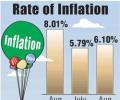
Costlier onion and other vegetables pushed up inflation for the third month in a row to 6.1 per cent in August, making it difficult for the RBI to cut rate in the monetary policy review due later this week.

A full-blown recovery remained elusive for India Inc in the July-September quarter, even as it overcame the challenge of achieving profitable growth.

'...which is possible through flexicap and multicap funds.' 'The latter has a better balance between large, mid and smallcap stocks.'
