
Jaishankar described as a "reasonable supposition" to expect some improvement in the relations between India and China following the last round of disengagement but hesitated to say that there could be a reset of the ties.
Chinese foreign ministry spokesperson Mao Ning told the media in Beijing on Monday that the two sides held an in-depth exchange of views on expediting the resolution of relevant issues.

During a weekly press briefing, the Foreign Office Spokesperson Mumtaz Zahra Baloch said that invitations have been sent to the heads of countries to participate in the meeting which will take place on October 15-16, the Dawn newspaper reported.

Prime Minister Narendra Modi on Tuesday conveyed to Russian President Vladimir Putin that India stands ready to provide all possible cooperation towards ending the Russia-Ukraine conflict and that dialogue and diplomacy is the only way to bring peace to the region.

Quarterly earnings of corporates, trading activity of foreign investors and inflation data are the key factors that are expected to drive the momentum in the equity markets this week, analysts said.
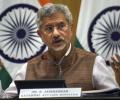
The last Indian external affairs minister to visit Pakistan was Sushma Swaraj. She had travelled to Islamabad in December 2015 to attend a conference on Afghanistan.

Lisa Curtis, who served as deputy assistant to President Trump and as National Security Council senior director for South and Central Asia from 2017 to 2021, said she expected the same bumps for India and the US, as in Trump's first term, including tariff, dependence on Russia over arms supply and oil purchase from Iran. Curtis, however, said both countries could never enter an alliance but develop a partnership that is "short of an alliance". She hoped them to achieve a cooperation that deters China, but also prepares both countries in case of a crisis or conflict, be it in the Taiwan Strait, the South China Sea, or another flare-up on the India-China border.

'India and China have the wise and sage leadership to steer this complex relationship in the coming decades.'

China on Thursday said the meeting between Prime Minister Narendra Modi and Chinese President Xi Jinping in Russia's Kazan on Wednesday carries a "great significance" as they reached an "important common understandings" to improve the bilateral ties.

'Given China's past behaviour and their territorial claims, should we be sceptical regarding China's willingness to adhere to these agreements fully? The answer is yes.' 'As Ronald Reagan famously said in the context of the SALT talks, 'Trust, but verify!' India should also do the same.' 'This has already begun with foot patrolling, drones, satellite imagery and so on. India's military deployment did mirror China's and will continue to do so in the future.'

The situation along the Line of Actual Control (LAC) in eastern Ladakh is stable but sensitive and not normal, Chief of Army Staff General Upendra Dwivedi said on Tuesday on the dragging military standoff between China and India in the region.

China and India have maintained "candid and in-depth communication and coordination" to promote disengagement in areas along the Line of Actual Control (LAC) in eastern Ladakh after the eighth round of talks to resolve the current standoff, the Chinese military said on Thursday.

The Meeting of BRICS and BRICS Plus High-Level Security Officials is scheduled to be held in St Petersburg from September 10-12.
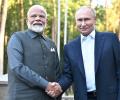
Putin said that the Indian leader had "aptly" noted that it is "not an anti-western one but a non-western one".
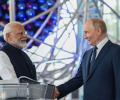
Putin expressed concern over the situation in Gaza, and said Palestinian President Mahmoud Abbas has been invited to BRICS events.

India supports dialogue and diplomacy and not war, Prime Minister Narendra Modi said at the Brazil, Russia, India, China, South Africa (BRICS) Summit in Kazan, Russia on Wednesday, in an unambiguous message calling for resolution of the Russia-Ukraine conflict through peaceful negotiations.

"We should not have a repeat of what happened in Mumbai. That there was a terror attack and there was no response," Jaishankar told reporters in Mumbai.
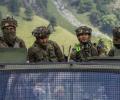
Two days after the India-China military talks, the joint statement, issued in New Delhi by the Indian Army said both sides had a 'candid and in-depth exchange' relating to disengagement along the Line of Actual Control (LAC) in the Western Sector of India-China border areas.

In the talks, Putin hoped that Prime Minister Narendra Modi will travel to Russia's Kazan next month to attend the annual BRICS summit.
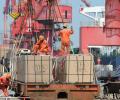
The China-India bilateral trade in the first half of the year totalled $57.48 billion, up 62.7 per cent year on year, perhaps the highest in recent years amid the Ladakh impasse and the COVID-19 pandemic, according to data released by China's Customs. Though Indian exports to China picked up with 69.6 per cent year on year increase, the trade deficit, a structural problem for India for long, climbed to 55.6 per cent. According to data released by China's Customs, India's exports to China reached $14.724 billion, up 69.6 per cent year on year in the first six months and India's imports from China amounted to $42.755 billion, up 60.4 per cent.
The border standoff between the Indian and Chinese militaries erupted on May 5 last year following a violent clash in the Pangong lake area and both sides gradually enhanced their deployment by rushing in tens of thousands of soldiers as well as heavy weaponry.

China does not have to give up what it took in 2020, it will never give up its claim to Arunachal Pradesh, Ladakh and other areas, and it has all the time now to plan its next surprise, points out Lieutenant General Prakash Katoch (retd).

"We are waiting for our good friend Modi and best regards to him," the Russian media quoted Putin as saying in the meeting with Doval.

India and China on Thursday vowed to redouble efforts to resolve the remaining issues in eastern Ladakh at the earliest and 'stabilise and rebuild' ties even as External Affairs Minister S Jaishankar conveyed to his Chinese counterpart Wang Yi during a meeting that the Line of Actual Control (LAC) must be respected.
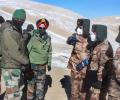
India and China on Tuesday agreed to hold the next round of the Senior Commanders meeting at an early date to achieve complete disengagement from all friction points in eastern Ladakh to create conditions for the restoration of normalcy in bilateral ties.
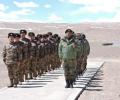
The US hopes that the differences will be resolved peacefully, officials said in Washington.

'Trump's disregard for norms and institutions could prove very costly for America's social fabric.'
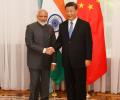
'The fact that Modi and Xi exuded confidence to accelerate the negotiations for a border settlement alone underscores that the Russia-India-China triangle has become very dynamic,' notes Ambassador M K Bhadrakumar.

Without mentioning the boundary dispute, the spokesperson said that China-India relations have been stable on the whole and "our two sides have maintained dialogue and communication at various levels".
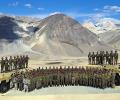
Her comments come a day after External Affairs Minister S Jaishankar said in Geneva that roughly 75 percent of the "disengagement problems" with China are sorted out but the bigger issue has been the increasing militarisation of the frontier.
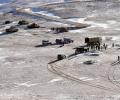
The development comes after after reaching a consensus in the 16th round of military talks, the two sides said in a joint statement this evening.

Colombo seems to be veering to the middle path between China and the US on global matters, but in regional matters of strategic security, it is increasingly identifying with India, points out N Sathiya Moorthy.

It has been 18 years since arch-rivals India and Pakistan have locked horns in a bilateral hockey Test series.
Both countries have reached a mutual agreement for disengagement of troops from the most contentious area of North and South Pangong Lake.

Situated at a height of 15,200 feet above sea level, the pass sits on the top of a craggily formed Himalayan range that separates the Tibetan plateau from the Indian sub-continent.
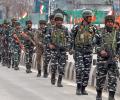
When the internal security situation spirals out of the control of the provincial law and order machinery, the CAPFs can be called in, providing a security buffer before the Army is deployed.
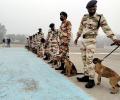
The move, which was approved by the Union home ministry, comes amid a military standoff with China in the eastern Ladakh area.

In underlining the role of border villages as custodians of India's frontiers, New Delhi is following China's example in Tibet.

"I am saddened, however, that there is a small, handful of members that seem to be still tolerating the war," Sergiy Kyslytsya said after the Security Council voted on the United States-led draft resolution.

Ahead of this election, the alliance between the BJP and the SKM had broken down. One reason is the fear that like Article 370, Article 371F might also be changed.
